
 Birthday
 Hydrangeas
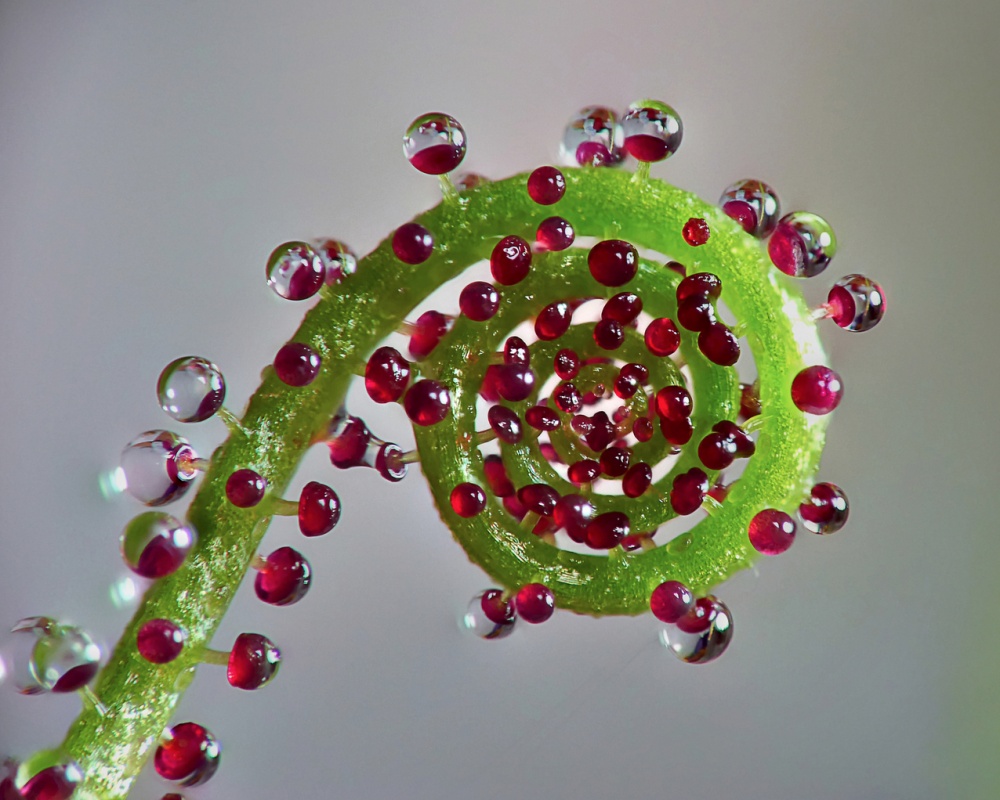
Nature uses no ruler or compass, yet plants form regular patterns remarkably often: spirals, polygons and repeating shapes. There is an explanation for this beauty — growth that follows simple rules. Here are examples you can easily find in a garden or at the market.
Geometry in a bouquet: flowers in a box and potted plants.
Kinds of geometry
Spirals and Fibonacci numbers
Look at a sunflower head: the seeds form two sets of spirals turning in opposite directions. Count them and you will usually get neighbouring Fibonacci numbers, such as 34 and 55 or 55 and 89. In this sequence each number is the sum of the two before it: 1, 1, 2, 3, 5, 8, 13, 21…
The reason lies in how new growth appears. Each new primordium forms at about 137.5° from the previous one — the so-called golden angle. This arrangement packs seeds tightly with no gaps. The same patterns show up in pine cones, pineapples and succulent rosettes.

Fractals: Romanesco
Romanesco cauliflower is one of the clearest examples of a fractal in nature. Its head is made of cones, each built from smaller cones of almost the same shape, repeated over several levels. Every level is arranged in spirals too.

Geometric succulents
- Spiral aloe. A mountain plant from Lesotho whose leaves twist into a striking spiral in mature specimens.
- Crassulas. In some species and cultivars, pairs of leaves sit crosswise and tightly stacked on the stem, forming little towers.
- Echeverias. Perfect rosettes with leaves arranged in a spiral.

Flower symmetry
Most flowers have radial symmetry: a daisy, rose or tulip can be divided along several axes. Orchids, snapdragons and violets have only one axis, like a human face. Botanists link this to pollination: such a flower suits an insect landing from a particular side.
.jpg)
For care of spirals and rosettes at home, see aloe in a pot and cacti at home.
FAQ
Do sunflowers always show Fibonacci numbers?
Usually, but not always: there are exceptions, especially in damaged or unusually grown heads.
Where else can I see Fibonacci spirals?
In pine and spruce cones, pineapples, artichokes, cauliflower and many succulent rosettes.

View full-size photo
Author: Maria Svitlovir
Graduated from Taras Shevchenko National University of Kyiv, Institute of Biology and Medicine (2001). BSc in Biology, MSc in Horticulture. Writes about plants, works at a garden centre selecting and repotting plants, and contributes to plant reference guides.


