
Heuchera is a perennial grown for its leaves rather than its flowers: purple, caramel, lime, silver or almost black. It stays decorative from spring to late autumn, and many varieties keep their leaves even under snow. It thrives in part shade, so it is often planted alongside hostas and ferns. Here is how to choose, plant and care for heuchera.
Heuchera is a herbaceous perennial of the saxifrage family from North America. It forms a compact mound 20–40 cm tall of rounded, lobed leaves. In May–July slender stems carry tiny bells in white, pink or red — hence the name coral bells. Close relatives include × Heucherella (heuchera × tiarella) with deeply cut leaves.
Dark varieties cope with more sun; pale and yellow ones need shade or the leaves scorch.
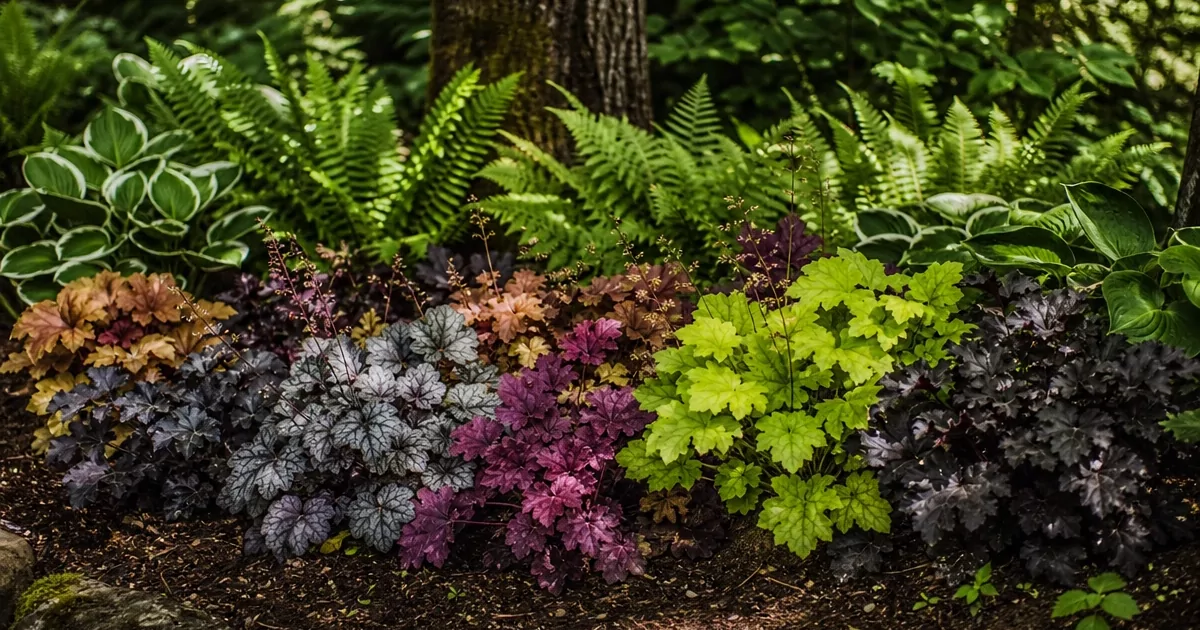
View full-size photoHeuchera remains decorative in part shade with hostas and ferns
Water moderately, avoiding both drought in heat and waterlogging. Feed in spring with half-strength balanced fertiliser — too much makes the colours duller. Cut off flower stems after flowering if you grow it for foliage. Leave the leaves on in autumn to protect the crown, removing only damaged old leaves in early spring.
As it ages, the crown lifts out of the soil, exposing a woody rhizome that suffers in winter. Every 3–4 years, lift the clump in spring or early autumn, divide it into pieces with leaves and roots and replant, burying the rhizome up to the base of the leaves. You can also root rosette cuttings with a piece of rhizome in shade under cover. Seed does not come true to variety.
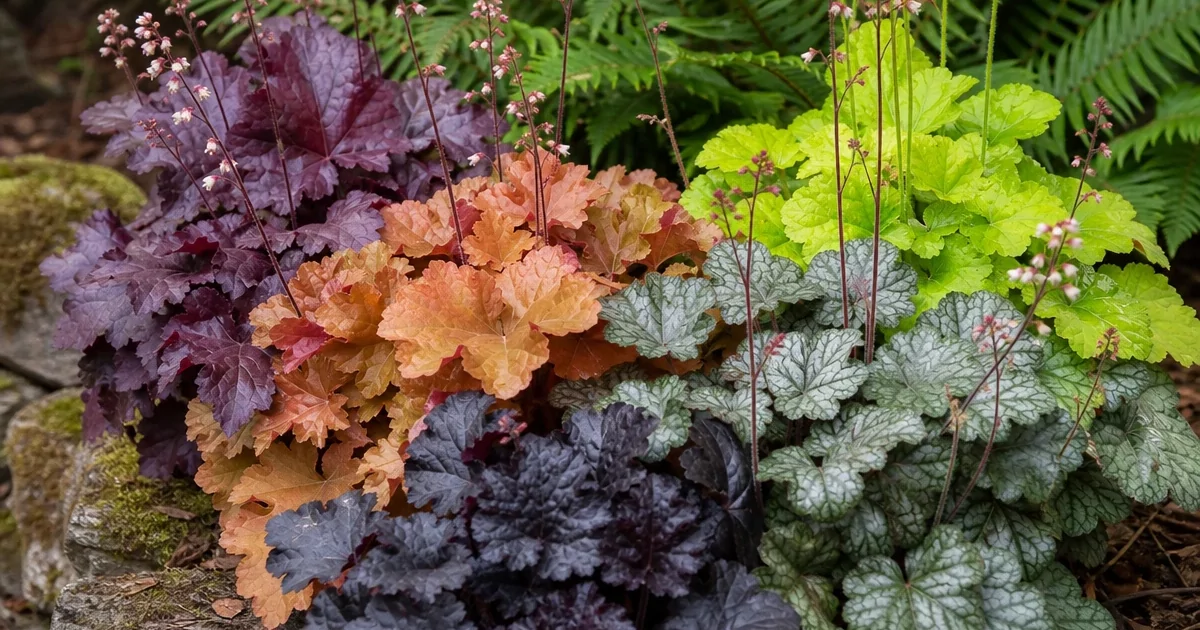
View full-size photoHeuchera leaves come in purple, caramel, lime, silver, and near black
Heuchera is the perfect colour accent for a shade garden. It pairs beautifully with hostas, ferns, astilbes and brunnera, and a row of mixed colours makes a striking edging. Compact varieties suit pots on a terrace. More ideas: shade-loving flowers and a bed that blooms all season.
Heuchera is considered non-toxic to people and pets. Every flower A–Z is in our types of flowers catalogue.
Part shade is best. Dark-leaved varieties tolerate more sun; pale and yellow ones scorch without shade.
Usually not — it is hardy. Mulching helps, and young plants or lifted crowns benefit from a top-up of compost.
It is natural ageing of the rhizome. Divide and replant every 3–4 years, burying the rhizome deeper.

Author: Maria Svitlovir
Graduated from Taras Shevchenko National University of Kyiv, Institute of Biology and Medicine (2001). BSc in Biology, MSc in Horticulture. Writes about plants, works at a garden centre selecting and repotting plants, and contributes to plant reference guides.
© Kyiv 2026 UFL Flower Shop

Trademark UFL №191476 is used under license of the rights holder.
All rights reserved. Any use of materials without a link to the site is prohibited.

 Birthday
 Hydrangeas