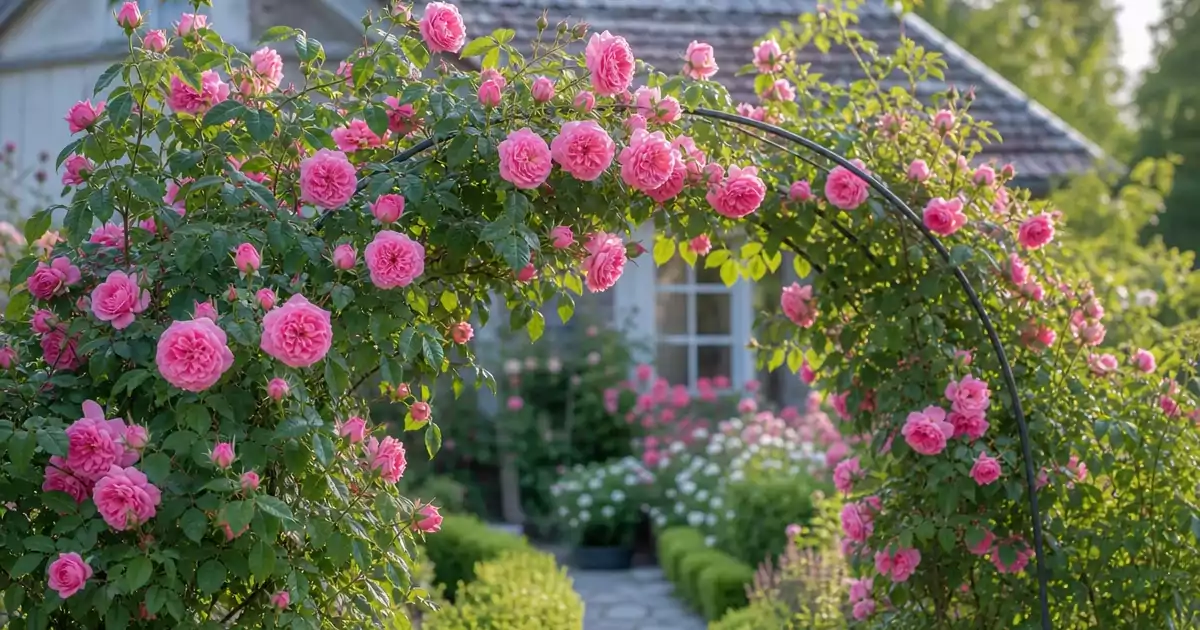
Climbing roses turn a plain fence, arch or wall into a cascade of flowers. They grow fast, flower generously and live for decades, but they need support, correct pruning and winter protection. Here is how ramblers differ from climbers, which varieties do well in Ukraine, and how to plant, train and overwinter a climbing rose.
Ramblers descend from Rosa wichurana: long flexible canes up to 4–6 m, small 2–5 cm flowers in big clusters, and most bloom once in early summer but profusely. Perfect for arches, pergolas and old trees.
Climbers are large-flowered roses with stiffer 2–4 m canes and hybrid-tea-like 8–12 cm blooms that repeat until autumn. They look best on walls, trellises and obelisks.
There are also climbing sports of bush varieties (such as Climbing Iceberg) and English roses that can be trained as climbers — see David Austin English roses.
Varieties for Ukraine
Reliable climbers: Pierre de Ronsard (cream-pink, peony-shaped), Sympathie and Santana (red), Rosarium Uetersen (pink, very hardy), Golden Gate (fragrant yellow), Laguna (strongly scented pink) and Elfe (creamy green).
Ramblers: New Dawn (soft pink, repeat-flowering and tough), Super Excelsa (crimson), and the vigorous Bobbie James and Paul’s Himalayan Musk for trees and large pergolas.
Pierre de Ronsard’s peony-like blooms are often confused with cut-flower varieties — see peony roses.
Planting and support
Choose a sunny (6+ hours), airy spot without standing water. Plant in spring or autumn 30–40 cm from a wall or fence, leaning the plant towards the support, with the graft 7–10 cm deep.
Install the support at planting time — arch, pergola, trellis, obelisk or tensioned wire — and tie canes loosely with soft twine.
The secret to abundant flowers is training canes horizontally or in a fan: almost every bud on a horizontal cane breaks into a flowering side shoot. For gazebo ideas see planting for gazebos and verandas.
Pruning
Once-flowering ramblers are pruned straight after flowering: cut flowered canes to the base and keep this year’s new growth, which will bloom next summer.
Climbers are pruned in spring: remove canes older than 3–4 years and shorten side shoots to 2–3 buds. General rules are in how to prune roses.
Winter protection
In most of Ukraine climbers need cover. In late October take the canes off the support, bend them gently onto spruce branches or boards, mound soil at the base and cover with fleece.
Bend them down gradually over several days before frosts arrive, as frozen canes snap. Step by step in how to prepare roses for winter.
Watering and feeding
Water deeply but infrequently, 15–20 litres once a week in hot weather. Soil by a wall dries out faster, so check it more often.
Feed nitrogen in spring for growth, a rose fertiliser before flowering and after the first flush, and only potassium and phosphorus from August.
Roses with delivery
While your climber covers the arch, we deliver rose bouquets across Kyiv and Ukraine — classic, spray or peony roses.
Graduated from Taras Shevchenko National University of Kyiv, Institute of Biology and Medicine (2001). BSc in Biology, MSc in Horticulture. Writes about plants, works at a garden centre selecting and repotting plants, and contributes to plant reference guides.






 Birthday
 Hydrangeas