
Prepared by the florists at UFL flower delivery. Just as people have doubles, many flowers from different families look remarkably alike. That is good news for buyers: if roses feel too familiar, lilies too fragrant or peony season has passed, there is always a lovely alternative. In part 2 we covered look-alikes of daisies, calla lilies, bellflowers and peonies; here we focus on florists’ top favourites. More flowers with photos, names and meanings are in our guide to types of flowers.
The best-known rose look-alike. Half-open double lisianthus buds are almost indistinguishable from roses, but they have no thorns, silkier petals and grey-green oval leaves. Available in white, cream, pink, lilac, purple and bicolours, it lasts up to two weeks in a vase and is perfect for soft wedding and spring bouquets.
Tight ranunculus buds with dozens of thin petals resemble garden roses, and open flowers look like small peonies; yellow varieties even recall water lilies. A wedding favourite, in season from winter to late spring.
Double camellias with perfectly symmetrical petals are often mistaken for roses — Coco Chanel made the camellia the emblem of her fashion house. Gardenia, with waxy white flowers and a strong scent, also looks like a small rose and is grown as a houseplant.
Peony-flowered tulips and double tuberous begonias, half open, are easily mistaken for roses in a bouquet or flower bed.
If only a rose will do, browse our rose bouquets, from classic varieties to spray roses.
The daylily (Hemerocallis) is a garden perennial whose flowers closely copy lilies. The differences: each flower lasts just one day (hence the Latin name, “beauty for a day”), the leaves grow in a clump from the base and the flower stem is leafless. Daylilies are tough and bloom all summer.
Known as the Peruvian lily or lily of the Incas, it carries several small speckled flowers per stem. It is almost scentless, so it is a great substitute for people who find lilies overpowering and for cat owners — lilies are toxic to cats. Lasts up to 2–3 weeks.
Large trumpet flowers on a thick hollow stalk look like lilies. Hippeastrum is often sold as “amaryllis” and forced for Christmas and New Year.
Lily-flowered tulips have pointed, reflexed petals that make the cup look like a lily. Exotic gloriosa, with wavy swept-back petals, is a relative of autumn crocus and used in designer bouquets.
English roses (David Austin) and Japanese garden roses with cupped, many-petalled blooms resemble peonies, but are available almost all year from greenhouses rather than for two weeks. See our peony-shaped roses.
Pompon and anemone-type chrysanthemums are a long-lasting autumn stand-in for peonies. Dahlias impress with size and colour but last only 4–6 days when cut, while chrysanthemums last 2–3 weeks: chrysanthemums with delivery.
In spring, double tulips (Angelique, Double Price), large ranunculus and double lisianthus replace peonies well. From late May to June, choose real peonies.
Florists deliberately replace expensive or seasonal flowers with look-alikes. When peonies are out of season, garden roses or ranunculus take their place; lisianthus stands in for roses in soft arrangements, and alstroemeria — similar in shape but unscented — replaces lilies. This keeps a bouquet’s style year-round and often makes it last longer. If a specific flower matters to you, discuss it with the florist in advance.
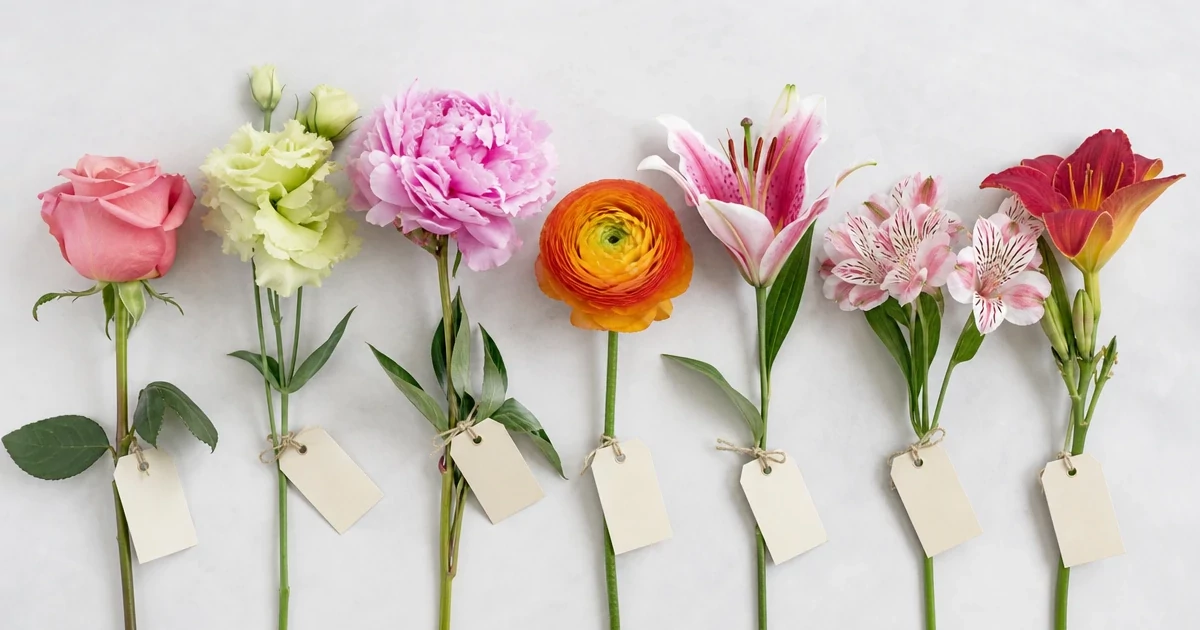
View full-size photoComparison of similar flowers for bouquets: rose, lisianthus, peony, ranunculus, lily, alstroemeria, and daylily.
Double lisianthus, sometimes called the “Texas bluebell” or “Japanese rose”, though it is not related to roses.
Alstroemeria, lily-flowered tulips or orchids. Lilies, including pollen and vase water, are dangerous for cats.
Garden roses, double lisianthus, ranunculus or pompon chrysanthemums.

Author: Maria Svitlovir
Graduated from Taras Shevchenko National University of Kyiv, Institute of Biology and Medicine (2001). BSc in Biology, MSc in Horticulture. Writes about plants, works at a garden centre selecting and repotting plants, and contributes to plant reference guides.
© Kyiv 2026 UFL Flower Shop

Trademark UFL №191476 is used under license of the rights holder.
All rights reserved. Any use of materials without a link to the site is prohibited.


 Birthday
 Hydrangeas


