
Almost everyone has noticed that a bouquet on the table or a flowering plant on the windowsill makes the day a little better. But can flowers really be called an "antidepressant" or a "cure for flu", as some websites claim? Let's look honestly at what scientists have actually found about flowers and mood, the benefits of gardening and caring for plants, and which popular claims about "healing" flowers don't hold up.
Fresh flowers for your home or as a gift: flower baskets and flowers in a box.
One of the best-known studies was carried out by psychologists at Rutgers University (USA) in 2005. Participants were unexpectedly given a bouquet, a candle or a fruit basket. Flowers, more than the other gifts, prompted a genuine "Duchenne smile", and those who received a bouquet still reported a better mood several days later. The researchers concluded that flowers are a powerful emotional signal that people perceive as a sign of care.
Other studies link indoor plants and a view of greenery to lower perceived stress and a more pleasant sense of space. In one study, post-surgery patients with plants in their rooms rated their wellbeing and mood more positively. These findings are interesting, but they are not proof that flowers cure illness.
It is one thing to look at flowers and another to look after them. Gardening combines physical activity, fresh air and a clear result: you plant, it grows, it flowers. Many countries use horticultural therapy — working with plants as part of rehabilitation and social programmes. Even houseplants offer a small but pleasant daily ritual of care.
Yes. Studies show that receiving flowers triggers genuine positive emotions, and indoor plants are linked to lower perceived stress.
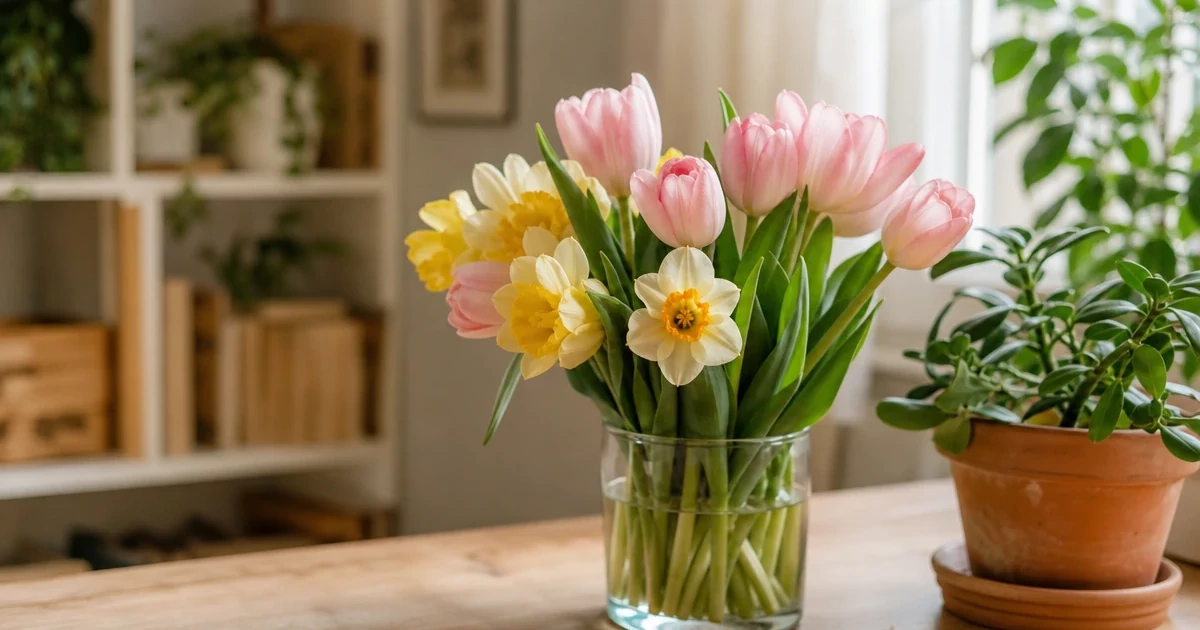
View full-size photoSeasonal flowers and a houseplant create a cozy atmosphere.
No. Flowers and houseplants do not cure illness; see a doctor if you have symptoms.
Bright seasonal flowers: tulips, gerberas, sunflowers, ranunculus. Above all, ones the recipient likes.
Only slightly in a real flat. Ventilation is more effective.

Author: Maria Svitlovir
Graduated from Taras Shevchenko National University of Kyiv, Institute of Biology and Medicine (2001). BSc in Biology, MSc in Horticulture. Writes about plants, works at a garden centre selecting and repotting plants, and contributes to plant reference guides.
© Kyiv 2026 UFL Flower Shop

Trademark UFL №191476 is used under license of the rights holder.
All rights reserved. Any use of materials without a link to the site is prohibited.


 Birthday
 Hydrangeas
