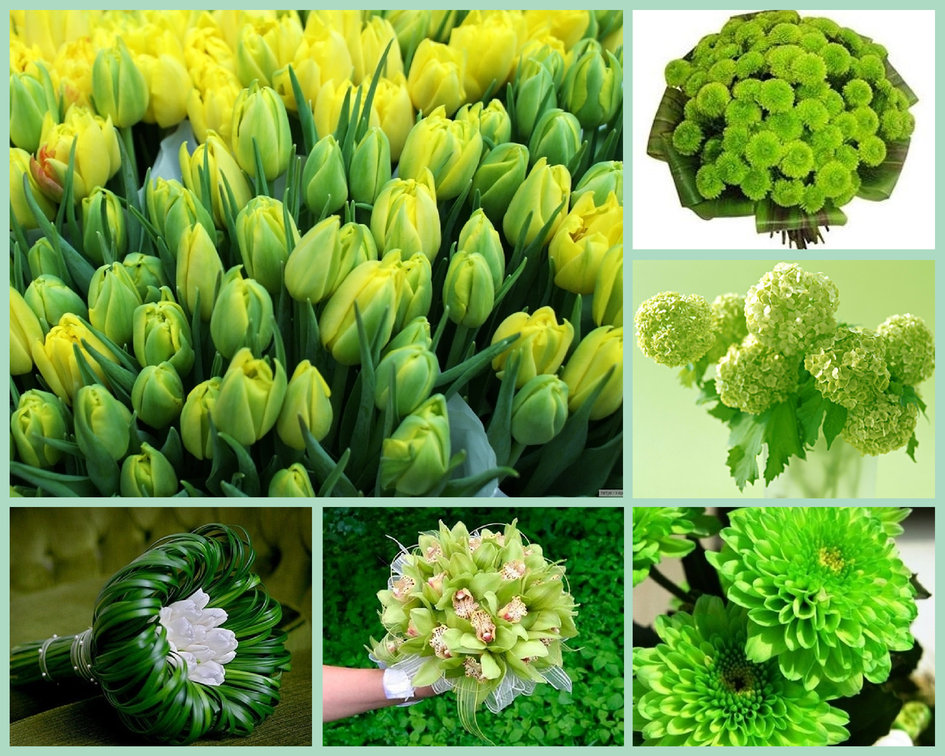
Green bouquets were long seen as "boring": greenery was the background, not the star. But green flowers have become a trend of their own. They look fresh and unusual, go with any colour and often outlast brighter blooms. Here are the flowers that are naturally green, what to pair them with and who to give a green bouquet to. More flowers with photos, names and meanings are in our guide to types of flowers.
Green and green-and-white arrangements can be found among our chrysanthemum bouquets and flowers in a box.
In these varieties the green is natural: the petals retain chlorophyll. Dyed flowers are sold too — a vivid emerald rose or chrysanthemum is almost always artificial. The most popular green flowers in floristry:
Green is associated with nature, renewal, growth and calm. A green bouquet suits wishing someone luck in a new venture, a housewarming, recovery — or simply bringing a sense of spring indoors. A crisp green-and-white bouquet also works as a business gift, including for a man.
Good foliage is half the success of such a bouquet — see our guide to bouquet greenery.
Most petals need to stand out against leaves to attract pollinators, so green flowers are uncommon, and where green appears it is usually not the petal doing the work:
In modern green roses, carnations and chrysanthemums, breeders have kept chlorophyll in the petals. That is why these flowers look fresh even in a drier bouquet and pair so well with any foliage.
The best-known “green” flower in cultural history is the carnation in Oscar Wilde’s buttonhole. In 1892, at the premiere of his play Lady Windermere’s Fan, the writer’s friends wore carnations dyed green — a bold aesthetic gesture that challenged the tastes of the day. Green carnations did not exist in nature then; the stems were stood in dye.
Today there are naturally green carnation varieties, popular in modern bouquets, and a green boutonnière still signals a bold, unconventional style — for a groom or best man at a wedding in a natural palette, for example.
Green chrysanthemums and carnations are among the longest-lasting cut flowers: 2–3 weeks in a vase with normal care. Recut the stems, change the water every 1–2 days and keep the bouquet away from fruit and radiators.
Yes, varieties such as Super Green and Jade have lime-green petals. Bright emerald roses are usually dyed.
Not if you mix textures: large chrysanthemums, fluffy carnation balls, graphic callas and delicate foliage.

Author: Maria Svitlovir
Graduated from Taras Shevchenko National University of Kyiv, Institute of Biology and Medicine (2001). BSc in Biology, MSc in Horticulture. Writes about plants, works at a garden centre selecting and repotting plants, and contributes to plant reference guides.
© Kyiv 2026 UFL Flower Shop

Trademark UFL №191476 is used under license of the rights holder.
All rights reserved. Any use of materials without a link to the site is prohibited.


 Birthday
 Hydrangeas