
This article was prepared with the support of UFL flower delivery. Irises are perennials that flower for decades when planted correctly. Most flowering problems concern bearded irises, the most popular garden group. Siberian and Japanese irises grow differently, as explained below. For more on groups and varieties see our article on types of irises.
You can delight someone today: flower baskets or flowers in a box.
Bearded irises need at least 6 hours of direct sun. In the shade of trees or by a north wall they grow leaves but no flower stems. The fix is to move them to an open, sunny spot.
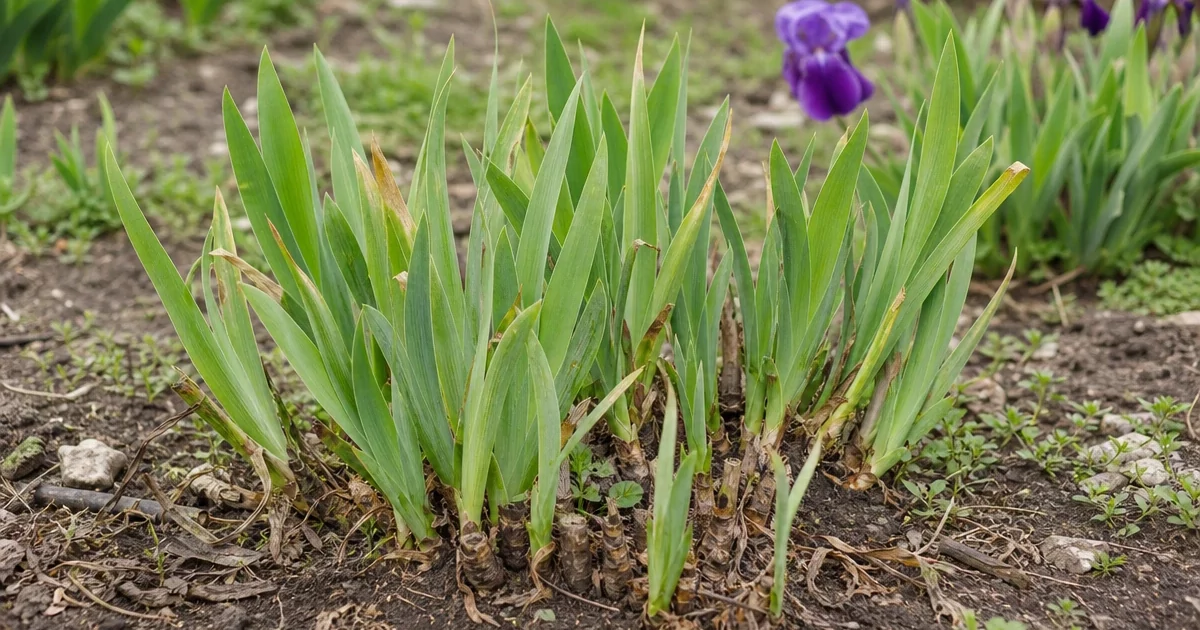
The most common mistake. A bearded iris rhizome needs to bask in the sun: its top should sit at soil level or slightly above, with only the roots underground. A buried or mulched rhizome will not flower and tends to rot. Carefully scrape away soil to expose the top of the rhizome.
After 3–5 years the rhizomes crowd each other and a bare patch of old, leafless sections forms in the middle. Lift and divide the clump.
Manure, rich compost and nitrogen fertilisers produce lush leaves instead of flowers and encourage rot. Irises need potassium and phosphorus rather than nitrogen.
A division with one small fan needs 1–2 years to build up. If irises were moved in late autumn or spring, they may skip flowering that year.
In hollows and on heavy clay rhizomes rot (bacterial soft rot with an unpleasant smell). Raise the bed, add sand and fine gravel, and cut out affected parts back to healthy tissue.
Flower buds form in autumn. A frosty winter without snow or late spring frosts can damage them. Choose hardy varieties that are proven in your area.
Thrips, slugs and leaf spot weaken the plant. Remove old leaves in autumn and keep plantings well ventilated.
Siberian irises dislike drying out, flower in light shade and moist soil, and their rhizomes are planted 3–5 cm deep. Japanese irises need acidic, rich soil that is moist in spring and summer but drier in winter. If these irises are grown like bearded ones, on dry sand, they will not flower either.
Established bearded irises overwinter without cover in most of Ukraine. In autumn cut the leaves back to 10–15 cm and clear debris. Young divisions and tender varieties can be lightly covered with conifer branches once the ground freezes; remove the cover as soon as the snow melts. A thick layer of manure or soil causes rot.
Bearded irises in May–June, Siberian irises in late May–June and Japanese irises in late June–July. Reblooming varieties flower again in September.
You can, but they will probably not flower that year. The best time is after flowering.
Bearded irises 3–5 years, Siberian irises up to 10 years without dividing.
Want an iris bouquet without the wait? Order spring flowers with flower delivery in Kyiv from UFL.

Author: Maria Svitlovir
Graduated from Taras Shevchenko National University of Kyiv, Institute of Biology and Medicine (2001). BSc in Biology, MSc in Horticulture. Writes about plants, works at a garden centre selecting and repotting plants, and contributes to plant reference guides.
© Kyiv 2026 UFL Flower Shop

Trademark UFL №191476 is used under license of the rights holder.
All rights reserved. Any use of materials without a link to the site is prohibited.


 Birthday
 Hydrangeas


