
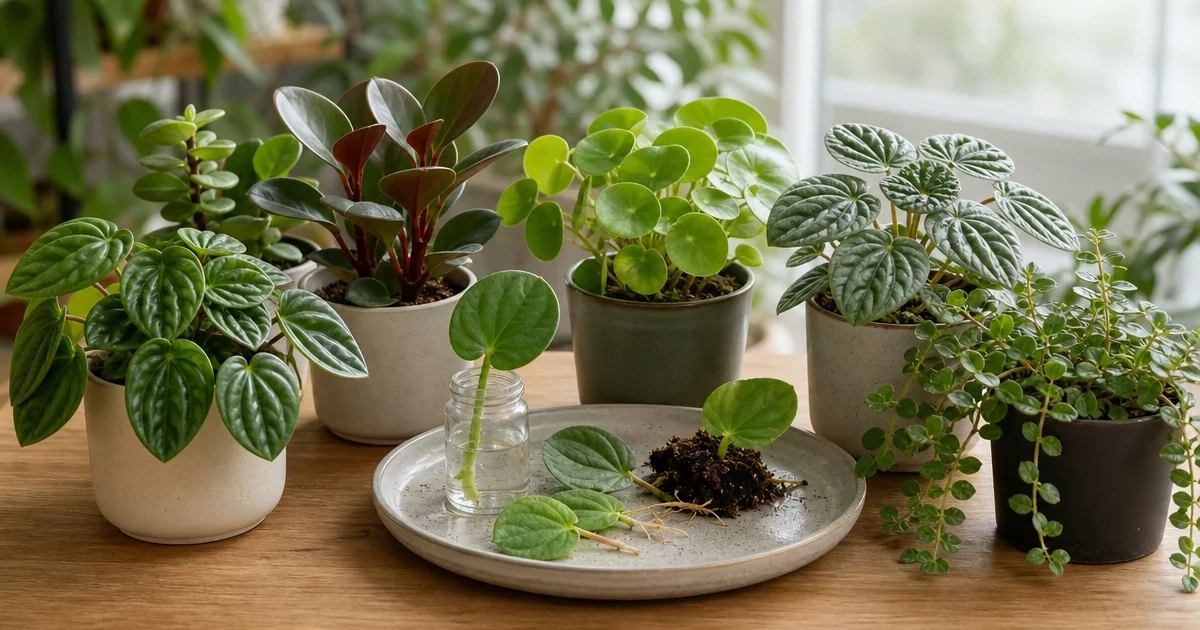
Peperomia is a compact plant with thick, succulent leaves that fits on any windowsill or desk. Its more than a thousand species include glossy little bushes, rippled “corrugated” forms, watermelon-patterned leaves and trailing “turtles”. They share one trait: peperomia forgives a missed watering but suffers from overwatering. Here is how to care for and propagate it.
Peperomia is a genus of the pepper family found across the American tropics. The most common indoor types are:
The Chinese money plant (Pilea peperomioides) is not a peperomia but a plant of another family, despite the look-alike leaves.
Peperomia needs bright indirect light: an east or west window, or 1 m from a south one. Green types tolerate light shade; variegated ones lose their pattern without light. Midday sun scorches the succulent leaves. Keep it at 18–25 °C, not below 16 °C in winter. Its compact size makes it ideal for shelves — see small houseplants.
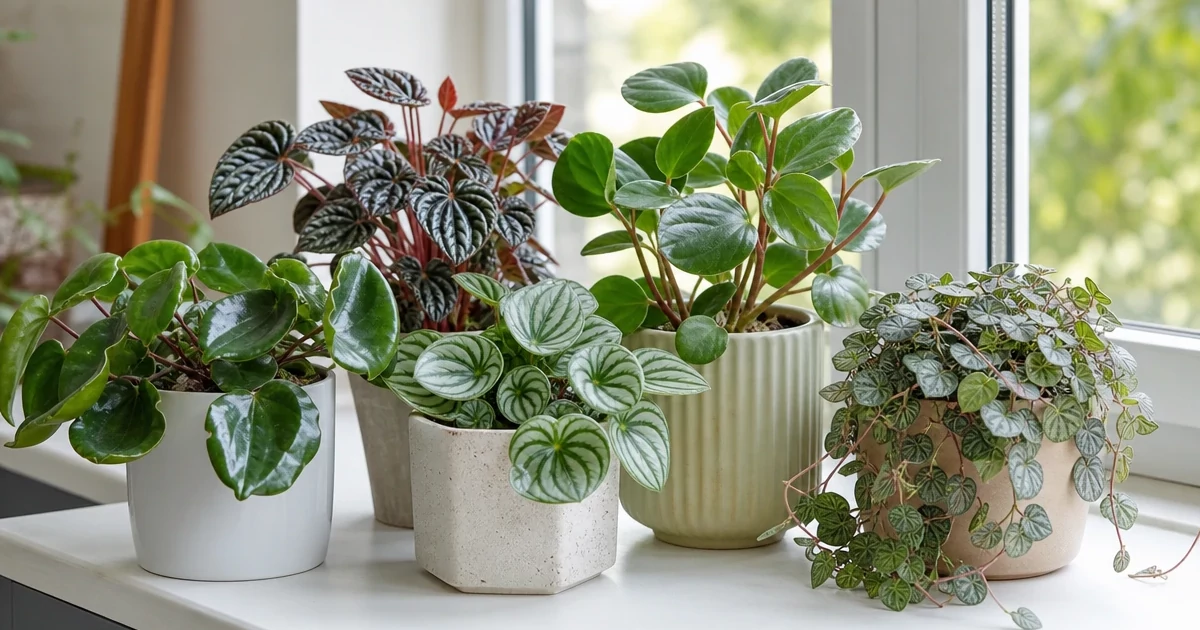
View full-size photoPeperomias with glossy, rippled, and variegated leaves on a windowsill.
Peperomia stores water in its leaves and stems, so water only when the top half of the pot is dry — roughly every 7–10 days in summer and every 2–3 weeks in winter. Overwatering quickly rots the stems at soil level. Water around the edge of the pot, not into the crown. Misting is unnecessary and can harm ripple types. Feed monthly from April to September at half strength.
Many peperomias grow as epiphytes on tree bark in the wild, so their roots are small. Use a light, very airy mix: all-purpose compost mixed half and half with perlite, bark or coco chips. Choose a small, shallow pot with drainage. Repot every 2–3 years in spring once roots fill the pot. See how to repot houseplants.
Keep cuttings warm (22–25 °C) under a clear cover: roots appear in 3–4 weeks, new rosettes in 1–2 months.
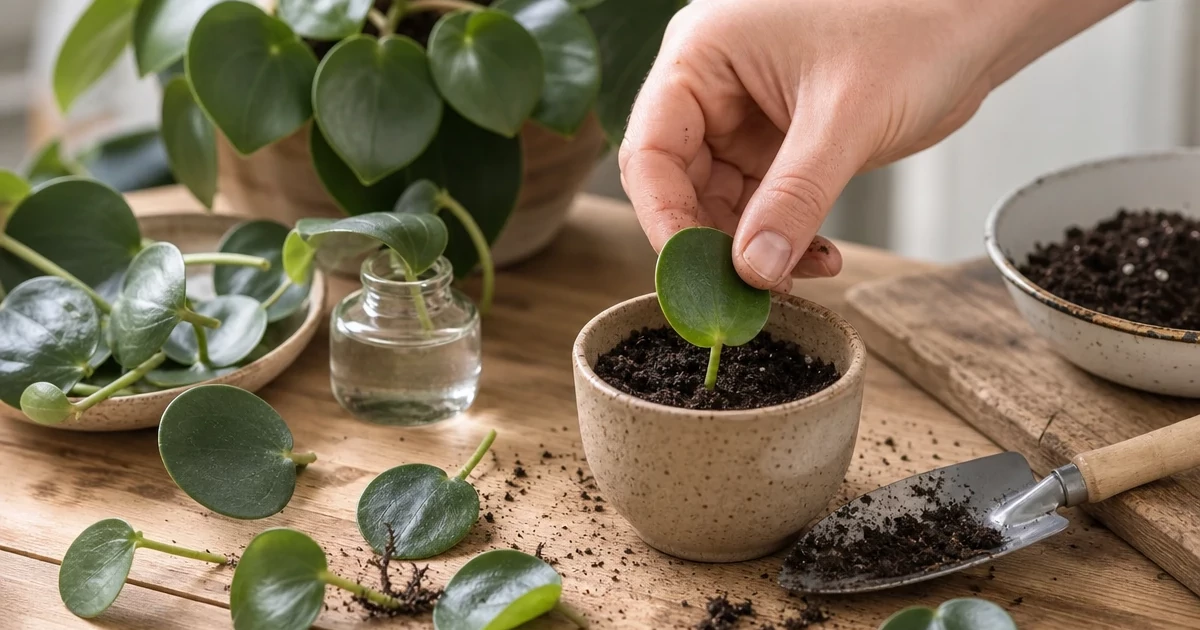
View full-size photoPropagating peperomia by leaf cutting at home.
Peperomia flowers on thin greenish-white spikes that look like mouse tails. They are inconspicuous, so feel free to snip them off.
Peperomia is considered non-toxic to people, cats and dogs, making it a good choice for children’s rooms and pet owners. More compact plants: succulents at home and houseplant names and care; browse potted plants.
When the top half of the pot is dry: about every 7–10 days in summer and every 2–3 weeks in winter.
Yes, ripple and watermelon peperomias root easily from a leaf with a short stalk in moist mix.
Yes, peperomia is considered non-toxic to cats and dogs.

Author: Maria Svitlovir
Graduated from Taras Shevchenko National University of Kyiv, Institute of Biology and Medicine (2001). BSc in Biology, MSc in Horticulture. Writes about plants, works at a garden centre selecting and repotting plants, and contributes to plant reference guides.
© Kyiv 2026 UFL Flower Shop

Trademark UFL №191476 is used under license of the rights holder.
All rights reserved. Any use of materials without a link to the site is prohibited.

 Birthday
 Hydrangeas