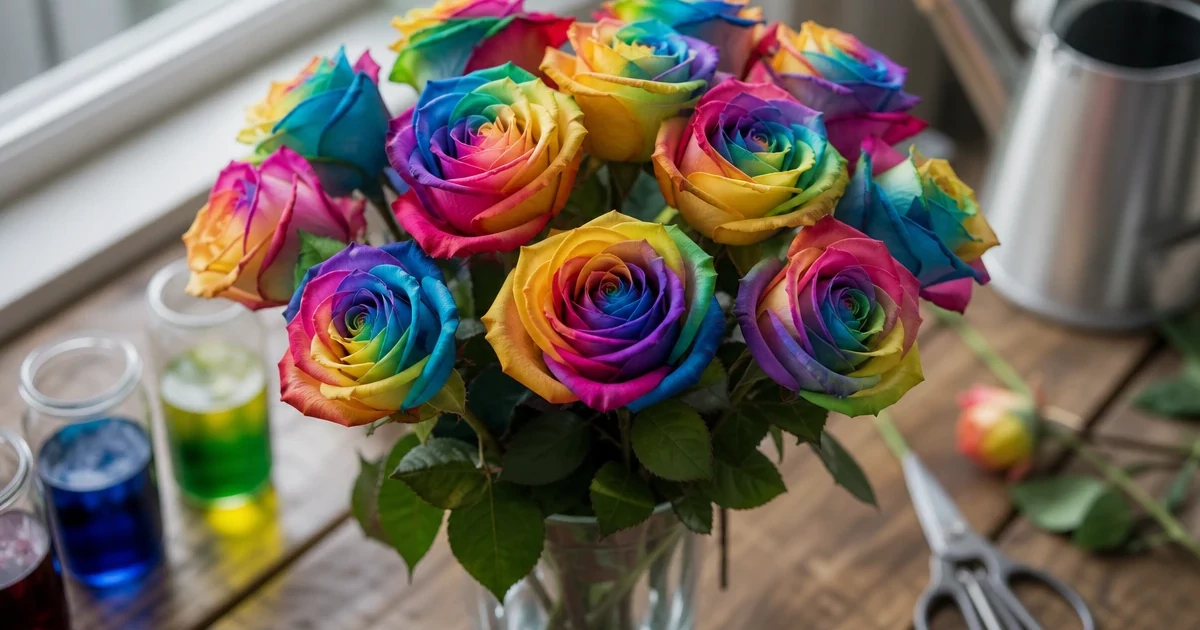
Rainbow roses, with several colours on a single bloom, look like a breeding miracle, but they are actually the result of a clever floristry technique. Here is who invented multicoloured roses, how they are dyed, whether you can grow one from seed, how long it lasts in a vase and what to choose instead if you want a bright bouquet in natural colours.
A rainbow rose is dyed, a two-tone rose is bred, and a mix is a bouquet of roses in different colours.
Who invented rainbow roses
The rainbow rose technique is credited to Dutch florist and entrepreneur Peter van de Werken. In the early 2000s he patented a method that gives one flower several colours at once and sold the roses as Happy Roses. The method soon spread worldwide, and multicoloured roses are now grown and dyed in Ecuador, Colombia and Kenya.
Keep in mind that a rose with petals in every colour of the rainbow does not exist in nature. Breeders have created varieties with two or three shades per bloom, but roses cannot make blue pigment, so a full rainbow is only possible with dyes. We cover this in detail in our article on blue roses.
How multicoloured roses are made
Growers use white or very pale roses with large heads and strong stems. The lower stem is carefully split lengthwise into three or four parts, and each part goes into its own container of food dye solution. The flower draws water up through the stem's vessels, each segment feeds its own group of petals, and so the petals take on different colours.
The process takes from a few hours to two or three days, depending on temperature, flower freshness and dye strength. Farms run it under controlled conditions, so the colours come out even and vivid. The pattern varies from rose to rose: no two blooms are identical, and that is part of their charm.
Besides splitting the stem, there is another method: spraying paint onto an open bloom. It is used for glitter, dusting or gradients, but such roses feel different, with slightly drier petals. A good rainbow rose dyed through the stem is easy to spot: the colour shows from within and the petal veins are visible through the pigment.
Can you grow a rainbow rose
No. Online shops often sell rainbow rose seeds with bright photos, but it is a scam: the colour comes from dye and is passed on neither by seed nor by cuttings. At best such seeds produce an ordinary wild rose, and often they do not sprout at all. If you root a cutting from a rainbow rose, the new flowers will look like the original variety, usually white.
If you want colourful roses in the garden, choose natural varieties with speckled, striped or two-tone petals such as Abracadabra, Hocus Pocus, Purple Tiger or Rainbow’s End. The prettiest are covered in our article on two-tone roses.
How to dye a rose at home
It is a fun experiment to try at home, especially with children. You need a fresh white rose, a sharp knife, three or four narrow glasses, food colouring and warm water. Dissolve the dye in a little water: the stronger the solution, the brighter the result. Cut the stem at an angle and split the bottom 10–15 cm into as many parts as you want colours.
Place the glasses tightly together and gently lower each part of the stem into its own colour. Keep the rose somewhere warm and bright, away from draughts. The first coloured veins appear within hours and a visible result within one or two days. Homemade shades are softer than factory ones, and that is perfectly normal.
How long a rainbow rose lasts
A dyed rose lasts slightly less than a regular one, five to seven days on average. Put it in a clean vase with cool water, trim the stem by 1–2 cm every two days and change the water. No more dye is needed. The water may tint a little, and pigment can sometimes mark fingers or light fabric, so do not lay the flower on a tablecloth.
The general rules are the same for any rose: keep the vase away from radiators and fruit, out of direct sun, and move it somewhere cooler at night. More tips are in our rose guide.
Who to give multicoloured roses to
Rainbow and multicoloured roses are about joy, celebration and good mood. They suit a birthday, a graduation, a child or teenager, a creative person or a friend with a sense of humour. A rainbow is also a symbol of diversity and hope, so such a bouquet can be a gesture of support. For a formal event or a funeral, classic single-colour flowers are a better choice.
Multicoloured roses delivered in Kyiv
Want a bright bouquet without dye? We make mixes of natural roses in different colours: pink, yellow, white, red and peach. Such a bouquet lasts longer than a dyed one and looks just as festive.
Graduated from Taras Shevchenko National University of Kyiv, Institute of Biology and Medicine (2001). BSc in Biology, MSc in Horticulture. Writes about plants, works at a garden centre selecting and repotting plants, and contributes to plant reference guides.






 Birthday
 Hydrangeas