Hybrid tea roses are the most popular rose group in the world. They are what we picture as the classic rose: a tall stem, one large high-centred bud and a long flowering season. Most cut roses in flower shops belong to this type too. Here is how hybrid teas came about, how they differ from other groups, which varieties are worth knowing and how to plant, prune and protect them for winter.
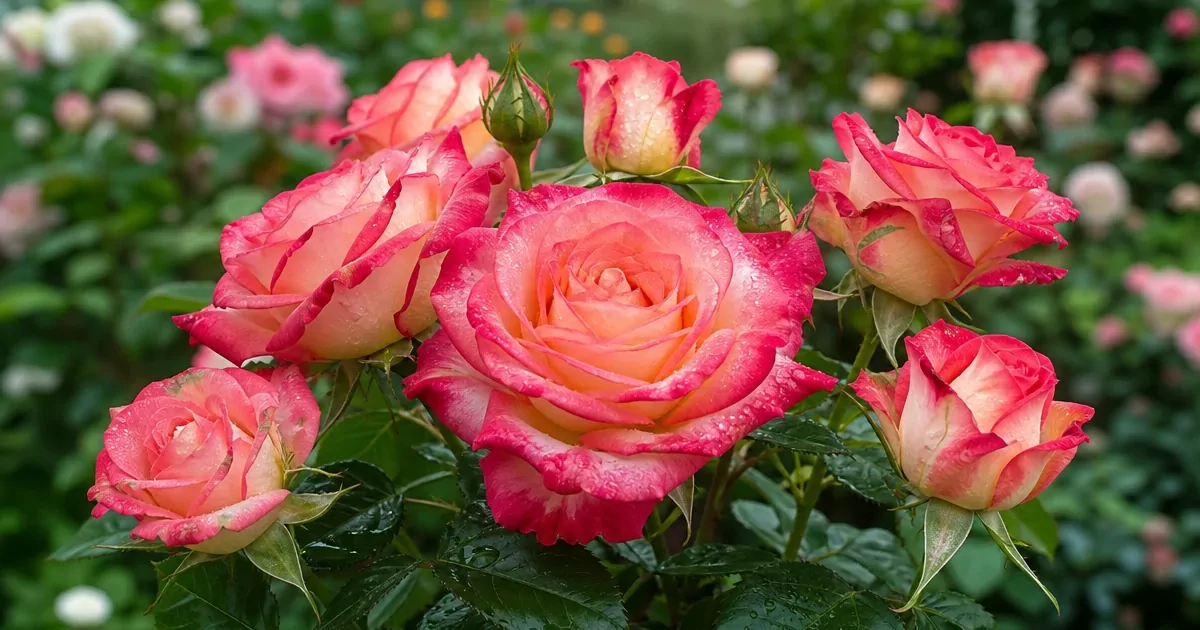
Four varieties often found in gardens and bouquets alike.
What hybrid tea roses are
Hybrid tea roses (HT in catalogues) were bred by crossing delicate southern tea roses with hardier hybrid perpetuals. From the former they inherited the elegant bud shape, delicate fragrance and repeat flowering, from the latter a sturdier bush and better winter hardiness.
The first hybrid tea is considered to be La France, introduced by French breeder Jean-Baptiste Guillot in 1867. That year is often used as the line between old and modern roses. Tens of thousands of varieties have been bred since, and hybrid teas remain the largest group.
How they differ from other roses
The key trait is one large bloom on a long stem. The bush is upright, 60–150 cm tall, the bud is high-centred, flowers are 8–15 cm across with 25 to 60 or more petals. They flower in waves from June until frost if spent blooms are removed in time.
Floribundas, by contrast, carry clusters of smaller flowers, climbers grow long canes, and English roses have cupped, very full blooms. Our articles on David Austin roses, peony roses and climbing roses help compare the groups.
Most bouquet roses are hybrid tea varieties: Explorer, Red Naomi, Mondial, Avalanche, Freedom, Pink Floyd. Cut-flower types are bred for long straight stems up to 90 cm and a tight bud that opens slowly.
How to choose a variety
For a Ukrainian garden, choose varieties with good resistance to black spot and powdery mildew, often marked as high disease resistance. Look at bush height and fragrance. Varieties from German nurseries Kordes and Tantau are usually tougher in our climate, while French Meilland roses are known for striking colour.
If fragrance matters, look at Double Delight, Augusta Luise or Papa Meilland. For bold beds choose two-tone Nostalgie or Peace, and for a romantic garden soft pink varieties such as Pink Intuition.
Planting and care
Hybrid teas need at least six hours of sun a day, shelter from wind and fertile, slightly acidic loam. Plant in spring once the soil warms up or in autumn at least a month before frost. Set the graft union 3–5 cm below soil level, then water generously and hill up the soil.
Water rarely but deeply: 10–15 litres per bush once a week, more often in hot weather, keeping the leaves dry. Deadhead regularly to trigger a new flush and watch the foliage, as this group is prone to fungal disease. How to spot and treat problems is covered in our article on rose diseases.
Pruning and winter care
The main pruning is done in spring as the buds swell. Hybrid teas are pruned moderately or hard, leaving three to five buds, or 15–25 cm above ground, and removing thin, weak and frost-damaged canes. In summer, cut spent flowers back to the first full leaf. See the full scheme in our article on rose pruning.
Most varieties survive only brief frosts down to about −15…−18 °C without cover, so in Ukraine they are protected. Stop nitrogen feeding from August, cut canes back to 40–50 cm in autumn, remove the leaves, hill the base with 20–30 cm of soil and, once frosts of −5 °C set in, cover with spruce branches or horticultural fleece.
Hybrid teas in a bouquet
Cut hybrid teas last 7–12 days in a vase. Trim the stems at an angle, strip leaves below the waterline and change the water every day or two. Tall varieties like Explorer or Mondial look especially good in simple single-variety bouquets or as single stems: one long-stemmed rose is a gift on its own.
Long-stemmed roses delivered in Kyiv
Our catalogue has classic long-stemmed hybrid teas: red Explorer, creamy white Mondial and other varieties. Order them by the stem or as a bouquet of any size.
Graduated from Taras Shevchenko National University of Kyiv, Institute of Biology and Medicine (2001). BSc in Biology, MSc in Horticulture. Writes about plants, works at a garden centre selecting and repotting plants, and contributes to plant reference guides.






 Birthday
 Hydrangeas