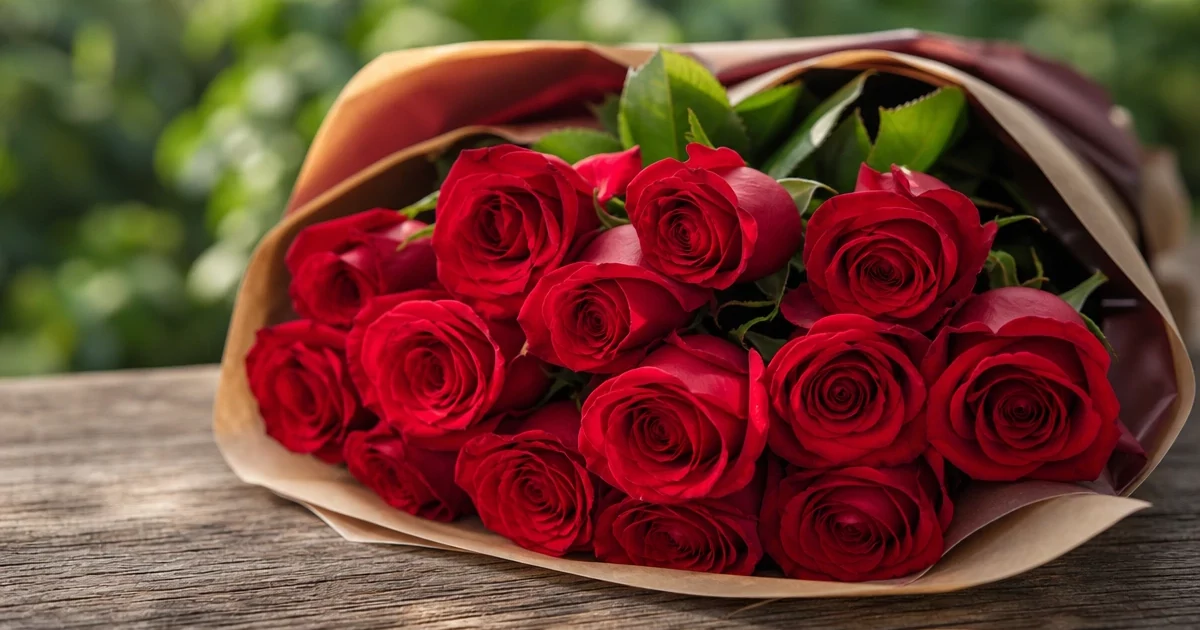
Red roses are the world’s best-known symbol of love and the most popular bouquet in our catalogue. But not all reds are the same: bright red speaks of passion, deep burgundy of profound feelings, and the number of stems adds its own meaning. Here is what red roses mean, which varieties to choose, how many to give and what such a bouquet costs. For a gentler alternative, see pink roses. For a special occasion, choose long-stemmed roses.
Since ancient times the red rose has been the flower of Aphrodite and Venus, a symbol of passionate love. In the Victorian language of flowers it meant ‘I love you’, and the meaning remains.
Bright shades mean passion and admiration; deep burgundy and near-black shades mean depth of feeling and loyalty; red with white means unity. More in rose colour meanings.
Red roses suit a partner, wife or husband, anniversaries, proposals and Valentine’s Day. For a colleague or boss, choose another colour to avoid ambiguity.
Popular red rose varieties
Freedom and Explorer are classic Ecuadorian roses with large heads and strong stems up to 90 cm; they are the usual choice for 51- and 101-stem bouquets.
Red Naomi is a velvety, lightly scented rose loved by florists for its vase life. Grand Prix and Black Baccara give deep burgundy, almost wine-like tones for a restrained but intense bouquet.
Ukrainian roses have shorter stems and smaller heads but are often fresher and more fragrant. See Ukrainian vs imported roses.
How many red roses to give
1 rose means ‘love at first sight’, 3 ‘I love you’, 7 infatuation, 11 ‘you are my other half’ and 21 devotion. In Ukraine small bouquets have an odd number of stems — see how many flowers to give.
51 and 101 roses are gestures for special moments: proposals, milestone birthdays and anniversaries. See the 101-rose bouquet for how to arrange and present one.
What a red rose bouquet costs
In our catalogue, 11 red roses cost from about 1,150 UAH, 21 around 2,000 UAH and 35 from 2,270 UAH. Price depends on variety, stem length and season; roses get more expensive before Valentine’s Day and 8 March.
Ukrainian roses, red spray roses with several buds per stem, or a box instead of bulky wrapping all help save money.
How to make red roses last
Trim the stems at an angle by 2–3 cm, strip the lower leaves and stand them in cool water with flower food. Change the water daily and keep the bouquet away from radiators and fruit.
If a head droops, wrap the rose in paper and stand it in deep water for a few hours. More revival tips in how to make a rose bouquet last.
Red roses with delivery
We deliver red rose bouquets across Kyiv and Ukraine, from 7 stems to a lavish 101, classically wrapped or boxed, with a card carrying your message.
Graduated from Taras Shevchenko National University of Kyiv, Institute of Biology and Medicine (2001). BSc in Biology, MSc in Horticulture. Writes about plants, works at a garden centre selecting and repotting plants, and contributes to plant reference guides.






 Birthday
 Hydrangeas