
 Birthday
 Hydrangeas
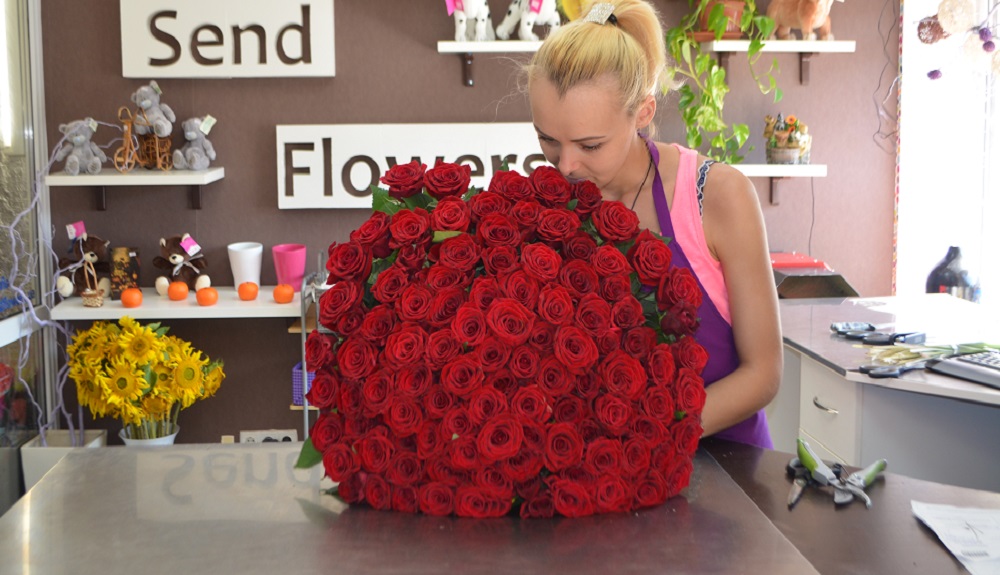
This guide was prepared by the florists of UFL flower delivery. A bouquet of 101 roses is the classic “royal” gift for a proposal, an anniversary or a milestone birthday. You can make one yourself, but it takes preparation: 101 roses weigh several kilos, and without the spiral technique the bouquet falls apart and the heads crush each other. Below is a diagram, our step-by-step photo guide and tips on avoiding common mistakes. See finished examples in our 101 rose bouquets section.
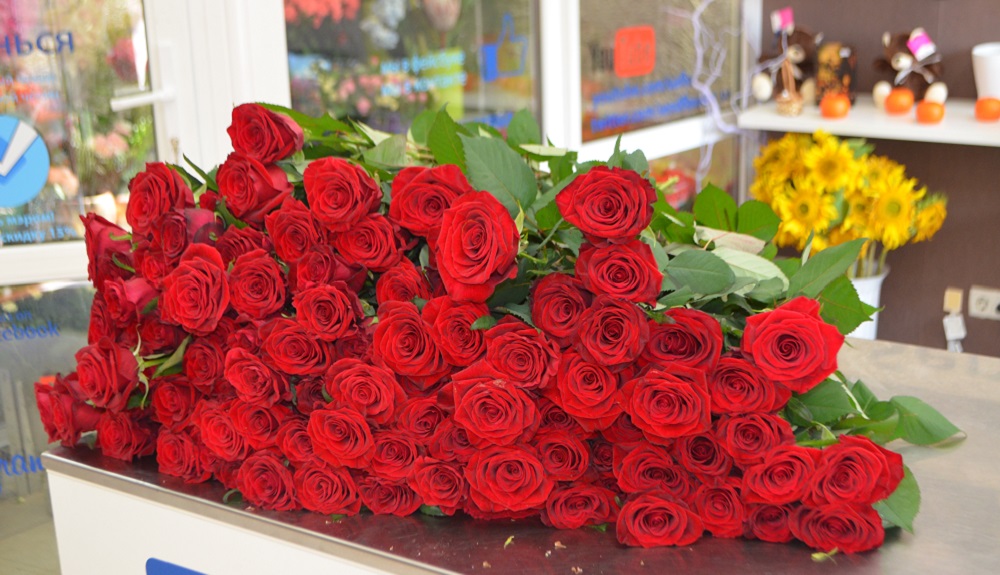
Bouquet weight and size
| Stem length | Bouquet diameter | Approx. weight |
|---|---|---|
| 40 cm | 45–55 cm | 3–4 kg |
| 50–60 cm | 55–65 cm | 4.5–6 kg |
| 70–80 cm | 60–75 cm | 7–9 kg |
| 100 cm+ | 70–80 cm | 10–12 kg |
Weight depends on the variety, head size and wrapping. For a presentation, 50–70 cm is ideal: easy to hold, while longer roses need a helper. For something more compact, choose roses in a box — no hand-tying needed.
Spiral diagram
In a spiral bouquet all stems cross at one point and lean the same way. That lets the bouquet stand on its own, keeps the heads from crushing each other and lets every stem reach the water. The technique is explained in detail in our article on spiral bouquets.
What you need and how to prep the roses
- 101 roses of one variety and length (plus 3–5 spares in case a head breaks);
- a sharp florist’s knife and secateurs;
- floral tape or twine, decorative ribbon, a stapler;
- wrapping: non-woven fabric, felt or film — 3–5 sheets;
- a tall bucket of cool water.
The day before, stand the roses in water for 3–4 hours to hydrate. Then strip leaves and thorns from the lower two thirds of each stem — from the binding point down. Keep the top leaves: they separate the heads. Remove any damaged outer (guard) petals.
Step-by-step guide with photos
Step 1. The centre
Choose the 5–7 straightest roses as the heart of the bouquet. With so many flowers, the centre is a small group rather than a single rose.
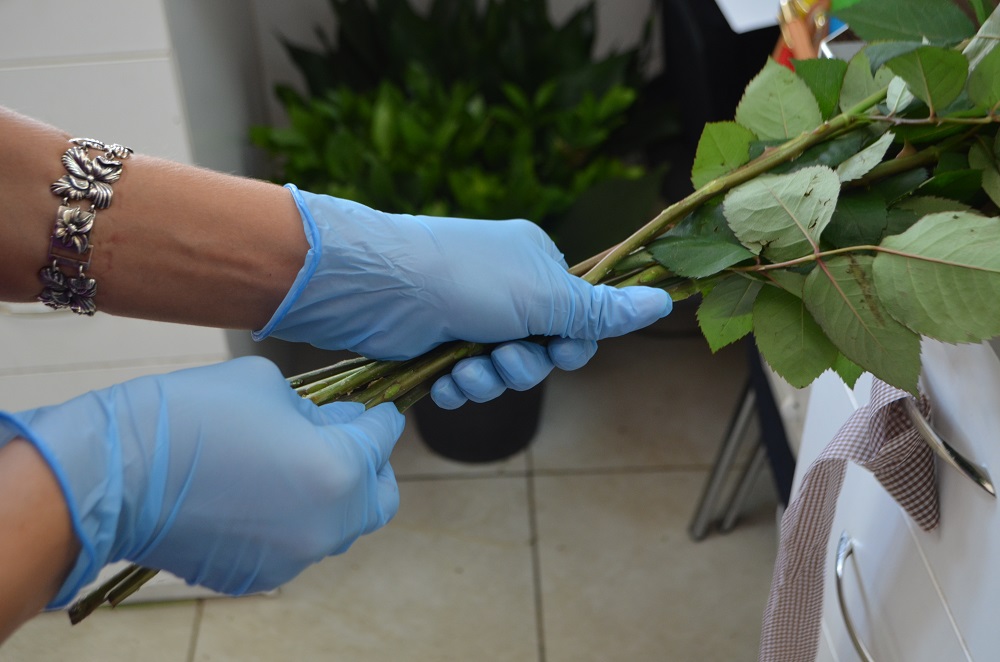
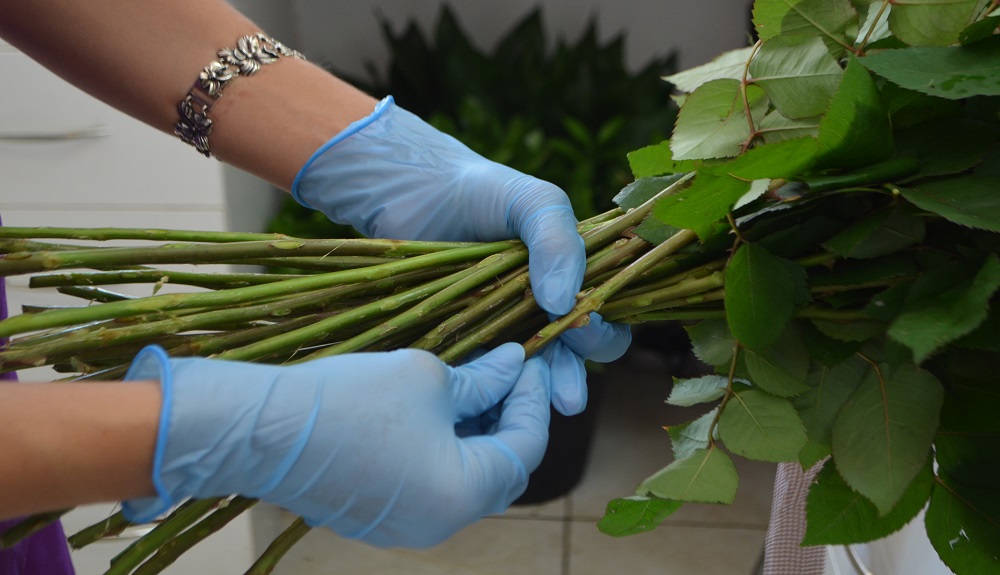
Step 2. The first round
Hold the centre in your left hand at the future binding point — about a third of the stem length below the heads. With your right hand add roses one at a time, angled to the right, turning the bouquet slightly anticlockwise each time. All stems must lie in the same direction — that is what creates the spiral.
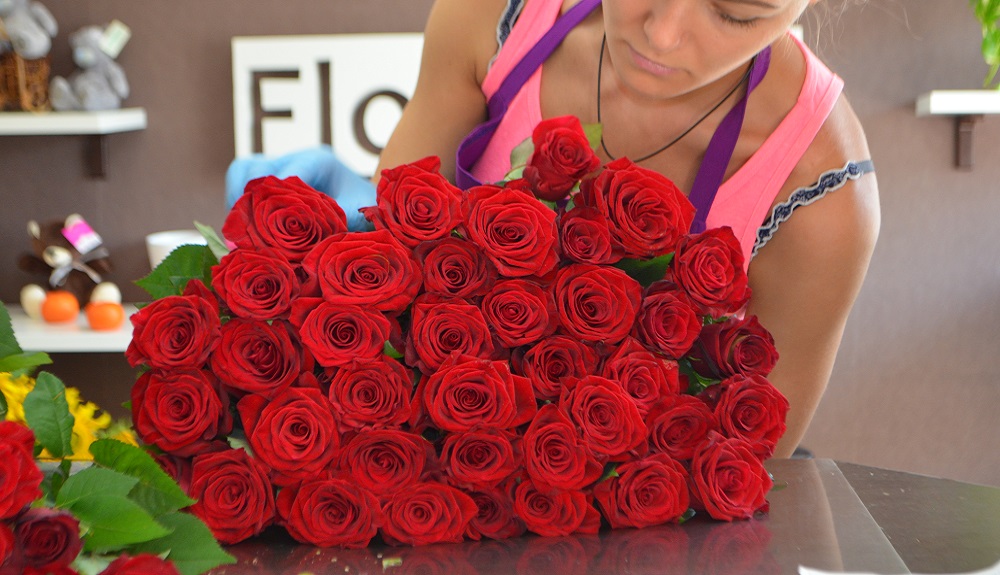
Step 3. First tie
When the bouquet becomes hard to hold in one hand (usually after 20–25 roses), wrap the binding point with floral tape or twine several times. It should be firm without crushing the stems.
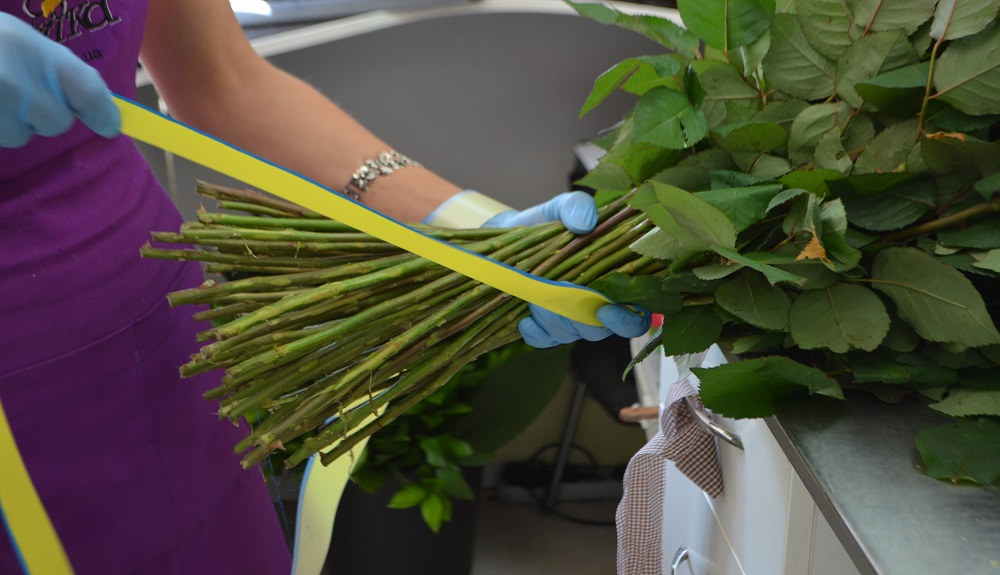
Step 4. Further rounds
Keep adding roses one or two at a time at the same angle. Look from above now and then: the heads should form an even dome. Tie again every 20–30 roses — a single tie can’t hold the weight.
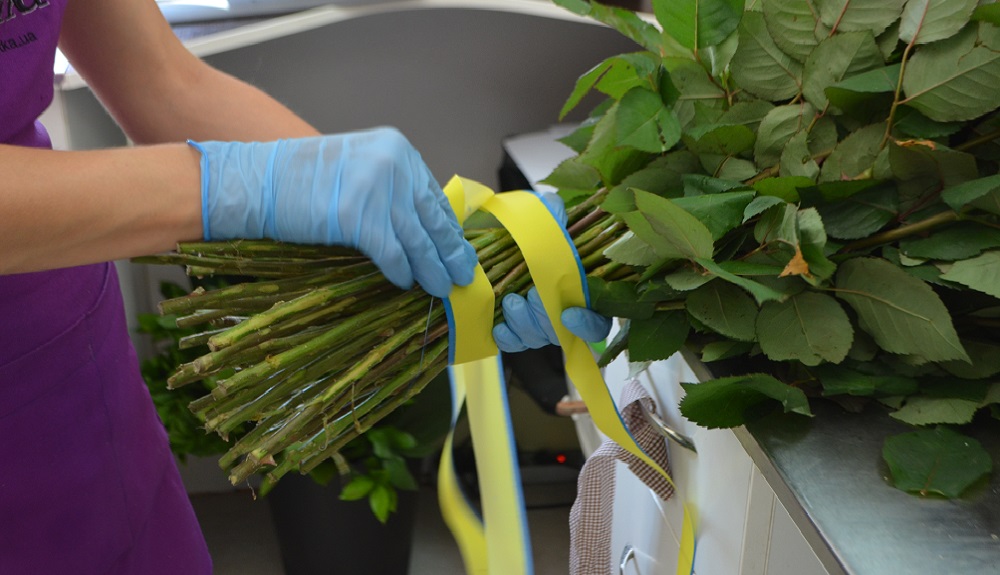
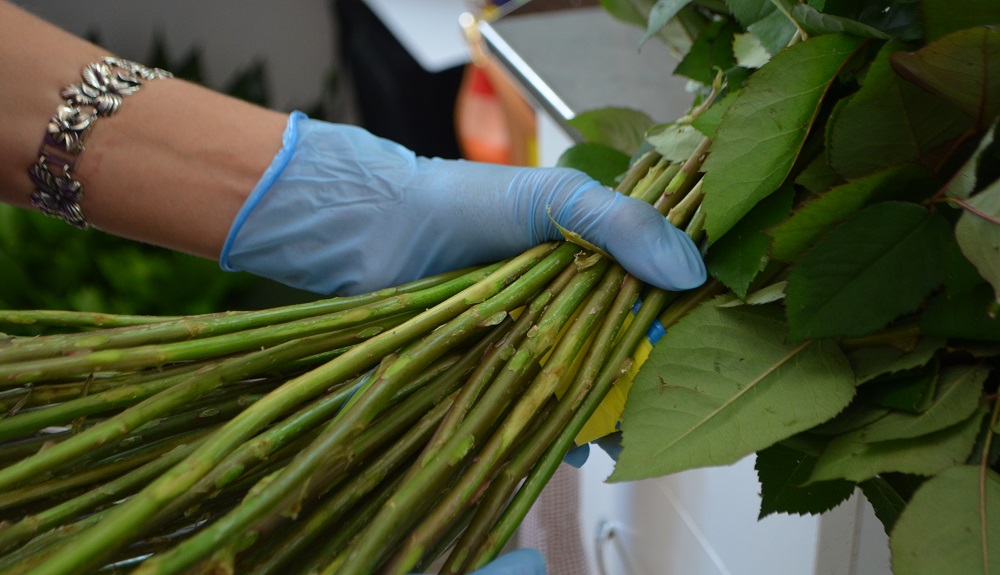
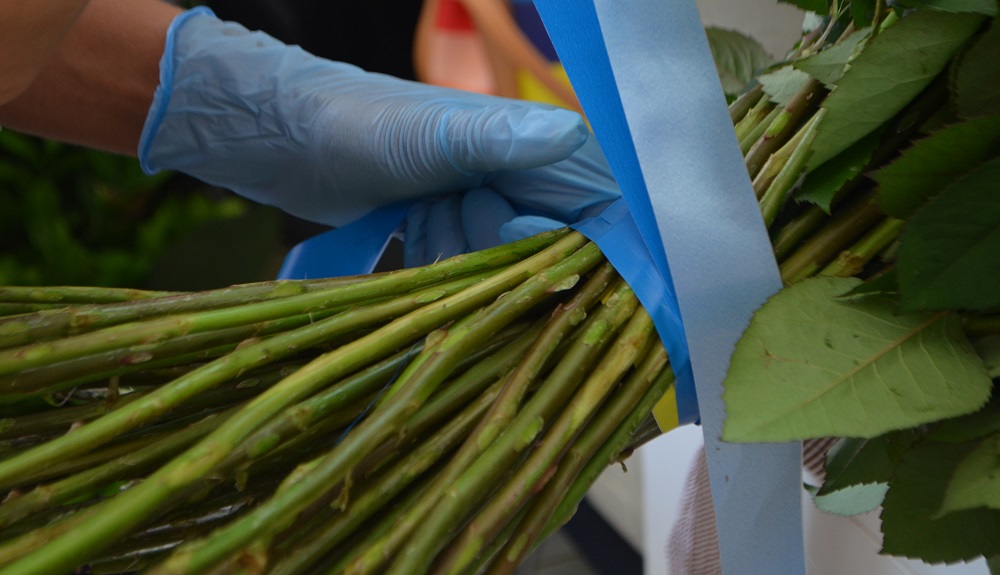
Step 5. Final tie and trimming
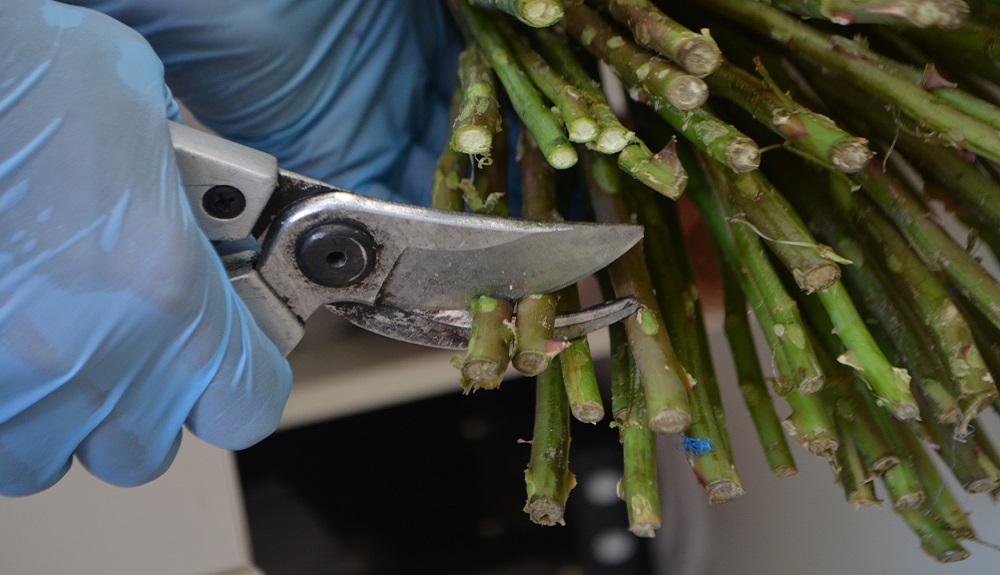
Once all 101 roses are in, secure the binding point firmly once more. Trim the stems level with secateurs so the bouquet stands upright on its own. Cut at an angle.
Step 6. Wrapping
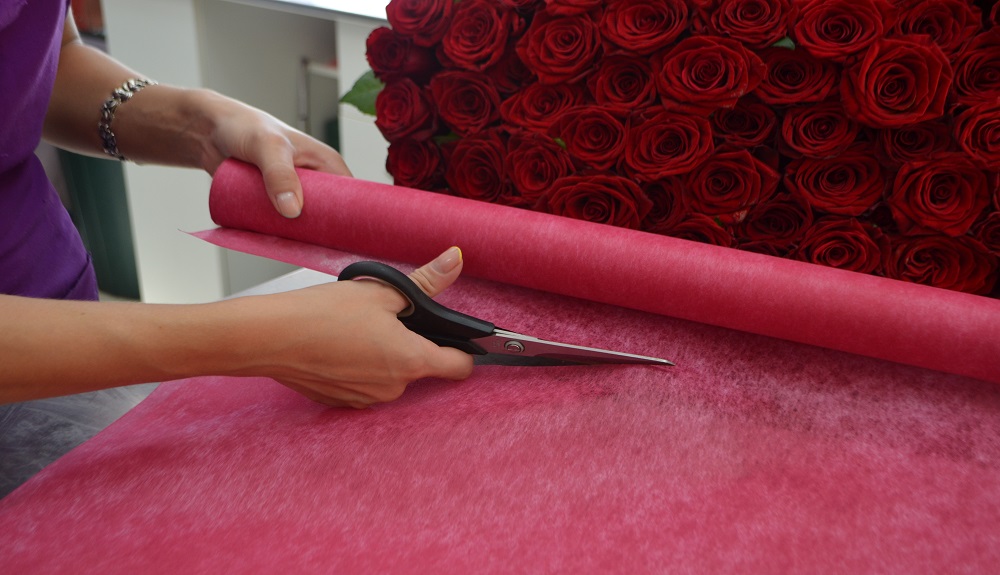
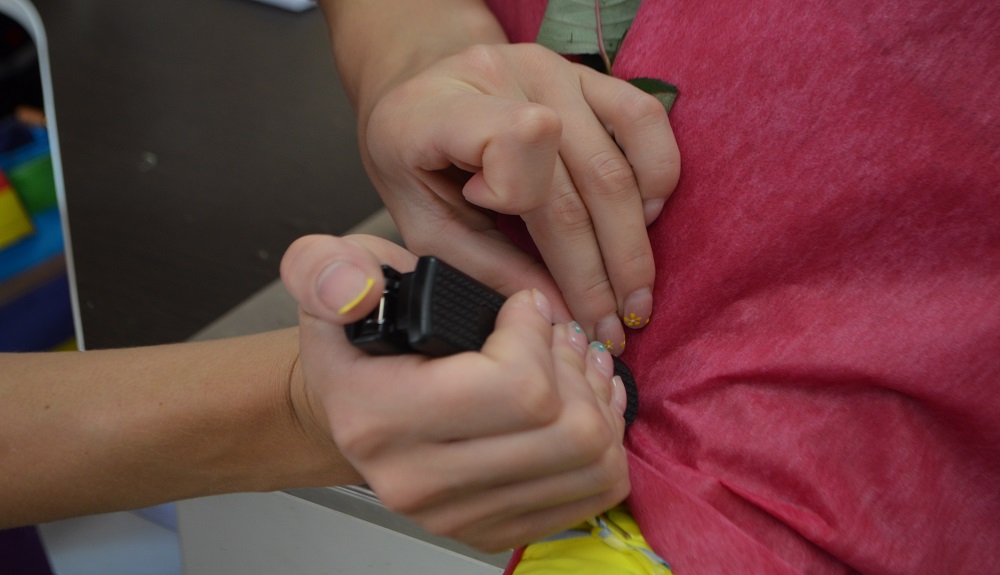
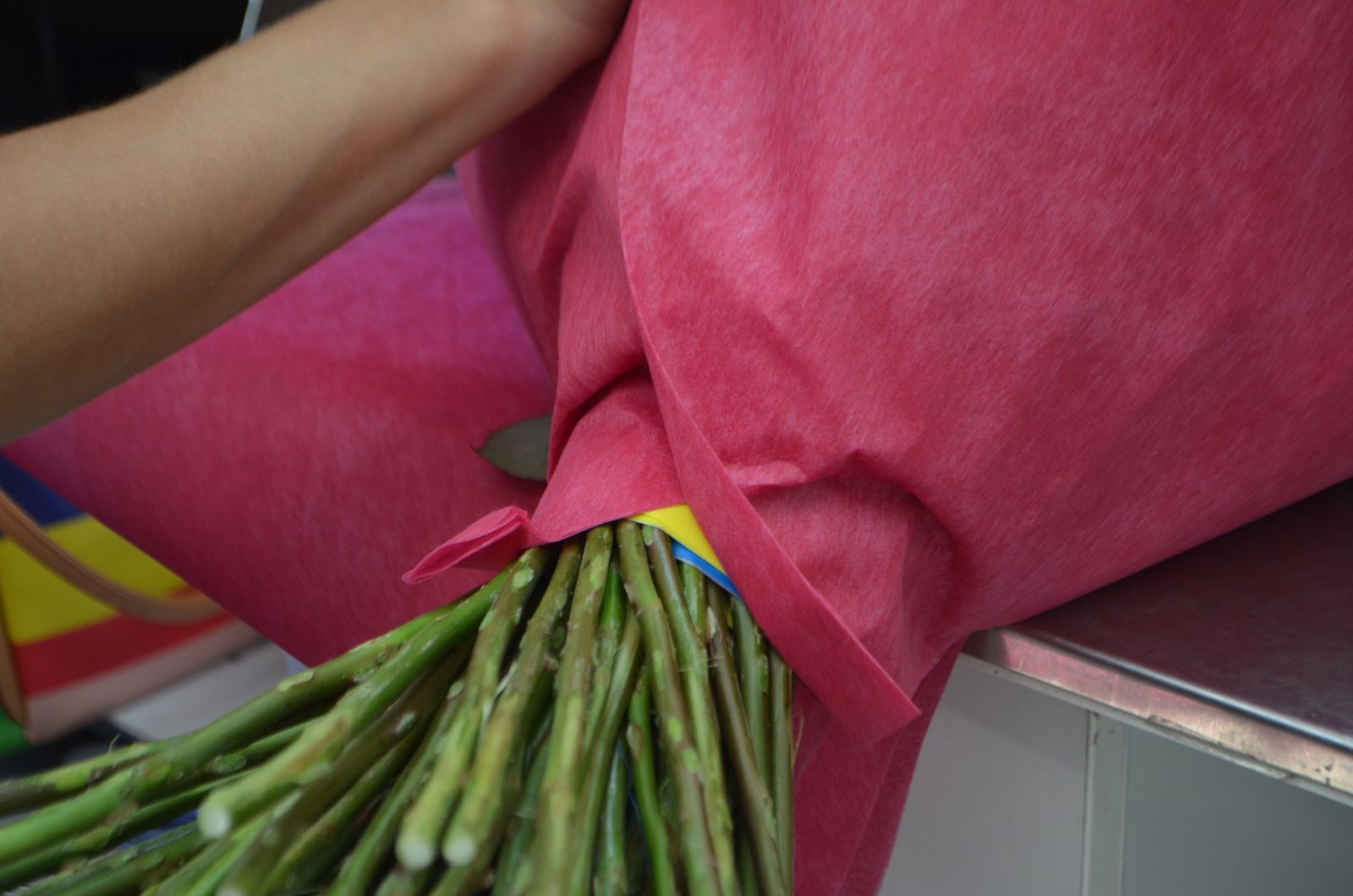
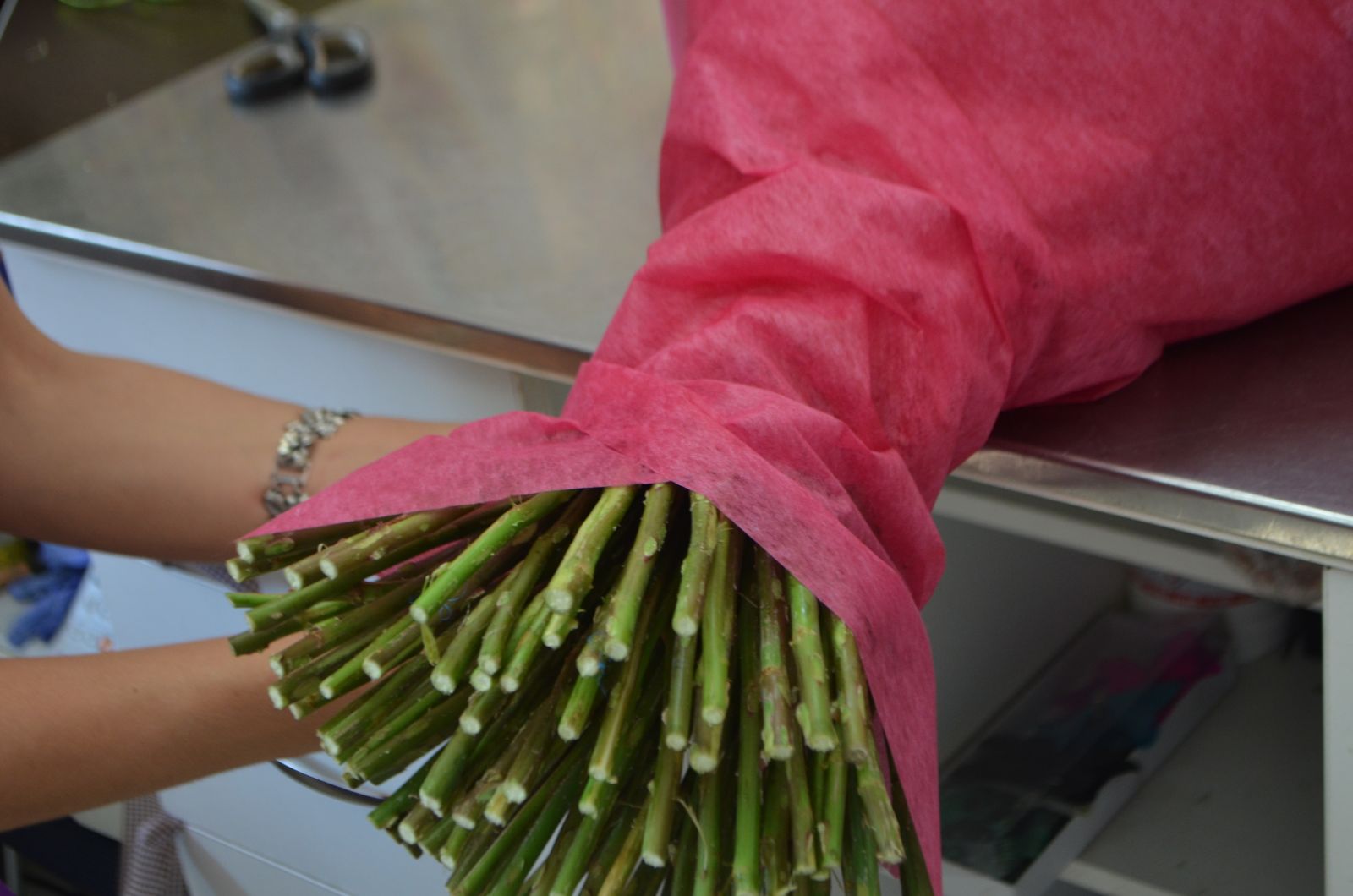
We used non-woven floral fabric, which drapes beautifully. Felt, Korean film or kraft paper work too. First make a “skirt” from two or three pleated sheets, stapling each at the binding point, then wrap the bouquet in one whole sheet or several layers.
Step 7. Ribbon and bow
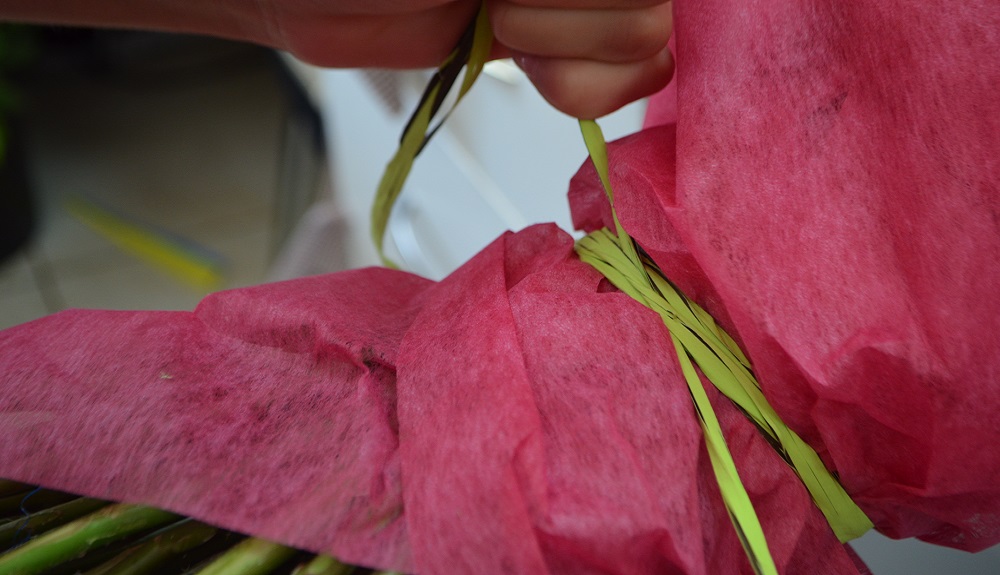
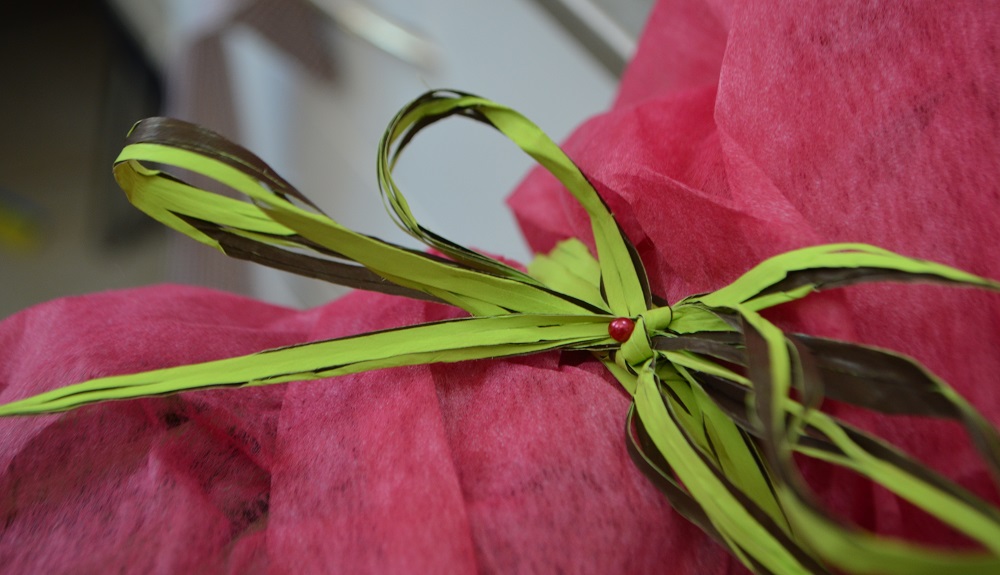
Tie a decorative ribbon or raffia over the wrapping and finish with a full bow. Tie it at the binding point, not higher, or the heads will get crushed.
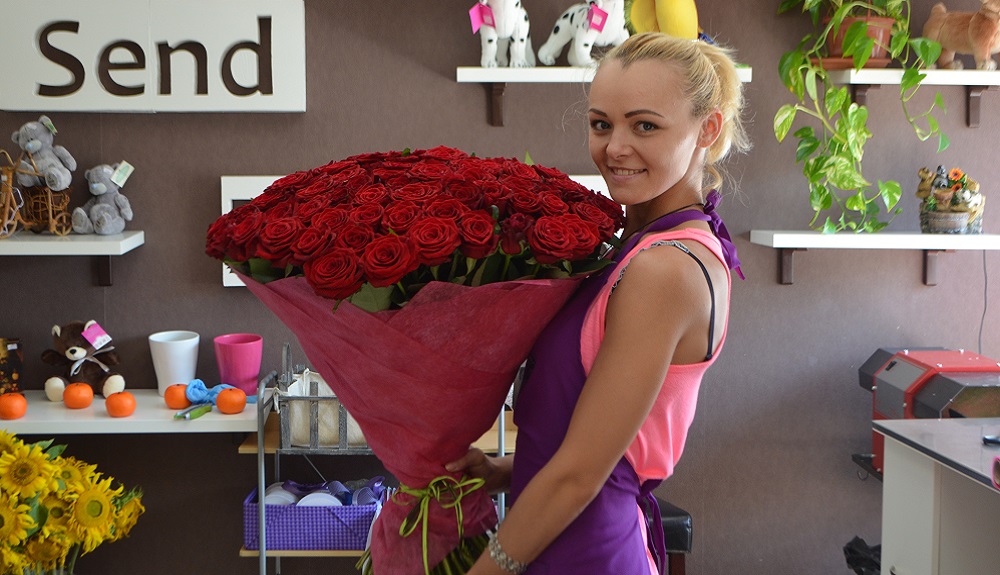
Common mistakes
- Stems going different ways. If even a few roses go against the spiral, the bouquet splays and heads stick out. Always add stems at the same angle.
- Binding point too low. The bouquet ends up loose and flat. Keep it a third of the way down from the heads.
- Leaves below the tie. They rot in water and shorten vase life.
- Mixed varieties and lengths. In a 101-rose mono bouquet, differences in head size are obvious. Use one batch.
- Crushed stems. Tape pulled too tight blocks water uptake and the roses wilt sooner.
Keeping the bouquet fresh
- Until the presentation, keep the bouquet cool (5–10 °C) and in water. Without a bucket, use an aqua pack — a water bag around the stem ends.
- At home, recut the stems 2–3 cm at an angle and stand them in a wide, stable vase or bucket: 101 roses drink up to a litre a day.
- Change the water every 1–2 days and add cut-flower food. Keep away from radiators, sun and fruit.
- If a head droops, recut the stem under water and stand that rose alone in deep water for a few hours.
More tips in our article on how to arrange a beautiful bouquet.
Order a ready-made 101 rose bouquet
Short on time? Our florists will make the bouquet for you and deliver it the same day: 101 roses in Kyiv and in Odesa, Kharkiv, Lviv, Dnipro, Zaporizhzhia, Vinnytsia, Poltava, Chernihiv, Zhytomyr, Cherkasy, Sumy, Mykolaiv, Khmelnytskyi, Rivne, Ternopil, Lutsk, Uzhhorod, Chernivtsi, Kremenchuk.
FAQ
How long does it take to make a 101 rose bouquet?
An experienced florist needs 30–40 minutes; a beginner about an hour, plus prep time.
Which roses are best?
One variety and length with medium, firm heads: Red Naomi, Freedom, Explorer, Avalanche. For a softer look — Pink Floyd or Sweet Avalanche.
Why 101 roses?
In flower tradition an odd number of roses is given to the living, and 101 stands for boundless love — “a hundred and one more”.
How much does a 101 rose bouquet cost?
It depends on the variety, length and season — see the catalogue for current options. Prices rise before Valentine’s Day and 8 March, so order early.

View full-size photo
Author: Maria Svitlovir
Graduated from Taras Shevchenko National University of Kyiv, Institute of Biology and Medicine (2001). BSc in Biology, MSc in Horticulture. Writes about plants, works at a garden centre selecting and repotting plants, and contributes to plant reference guides.


