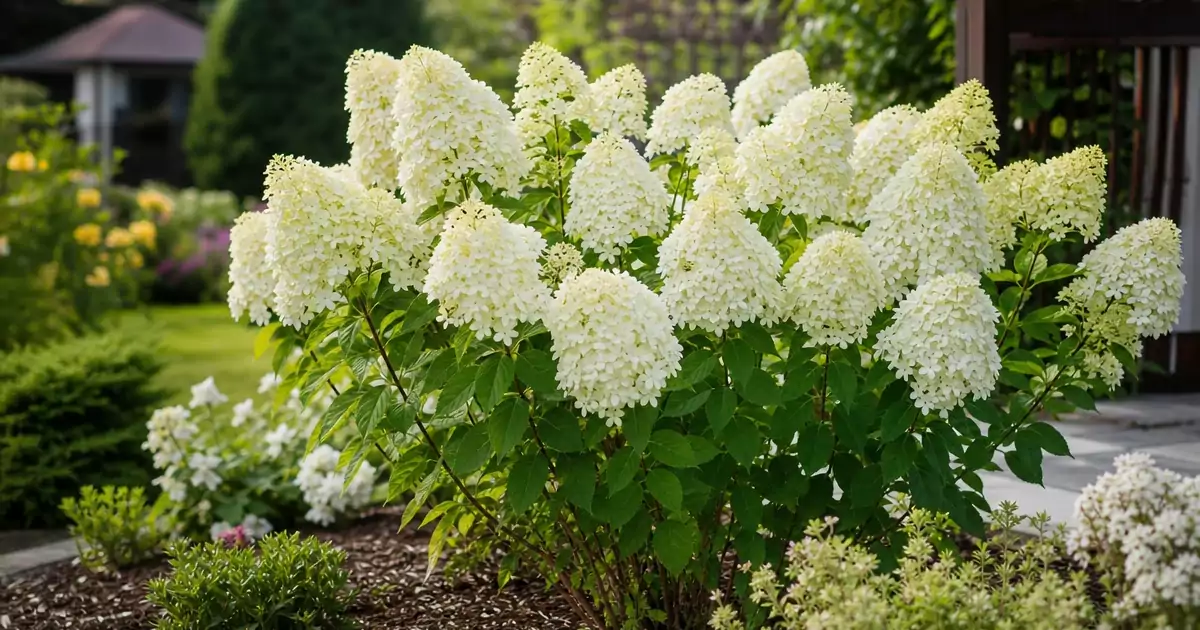
Smooth hydrangea (Hydrangea arborescens) produces the huge white balls that brighten gardens from June to September; the best-known variety is Annabelle. It is almost as hardy as panicle hydrangea, survives frost without cover and flowers every year even after hard pruning. Here are its varieties, planting, pruning and care, and how it differs from other hydrangeas. For autumn care, see preparing hydrangeas for winter.
Native to the eastern United States, it is a 1–1.5 m shrub with slim stems and rounded flower heads 15–30 cm across.
It flowers on new wood from June to September, so winter frost is no threat: even if stems freeze, it regrows and blooms.
Flowers are white, cream or lime, pink in some varieties, and unlike bigleaf hydrangea the colour does not depend on soil pH. In autumn the heads turn green and dry beautifully.
Popular varieties
Annabelle is the classic, with white balls up to 25 cm; Strong Annabelle (Incrediball) looks the same but has sturdier stems that do not flop after rain.
Pink Annabelle (Invincibelle Spirit) and Bella Anna are pink; Hayes Starburst has double star-shaped florets; Sterilis and Grandiflora are proven old white varieties.
Planting
Choose part shade or morning sun with moist but not waterlogged soil. Smooth hydrangea copes with neutral and even slightly alkaline soil better than other hydrangeas.
Plant in spring or early autumn in a 50×50 cm hole filled with garden soil, compost and peat, about 1 m apart or 60–70 cm for a hedge. More part-shade plants in shade-loving flowers.
Pruning
Prune smooth hydrangea in early spring before leaves open. Cut stems to 10–20 cm above the ground or by half: the harder you prune, the larger the heads but the thinner the stems.
To stop heads flopping after rain, leave some stems longer (30–40 cm) as a framework or use a ring support.
Watering, feeding and winter
Water generously, 15–20 litres per bush weekly and more in heat; bark mulch keeps moisture in. Feed nitrogen in spring, a flowering-shrub fertiliser from June and only potassium and phosphorus from August.
Mature plants overwinter without cover even in the north. You can leave spent heads for winter interest under frost and cut them during spring pruning. Planting ideas in ornamental shrubs.
White hydrangeas in bouquets
White hydrangea heads look just as good in a vase. We deliver single stems or lavish hydrangea bouquets across Kyiv and Ukraine.
Graduated from Taras Shevchenko National University of Kyiv, Institute of Biology and Medicine (2001). BSc in Biology, MSc in Horticulture. Writes about plants, works at a garden centre selecting and repotting plants, and contributes to plant reference guides.






 Birthday
 Hydrangeas