Spray roses carry several buds and blooms on one stem, so even a few stems make a lush bouquet. They need slightly different care from classic single-stem roses: several flowers drink from one stem, and buds open gradually. Here's how to care for spray roses in a vase so the bouquet lasts as long as possible, and what to do if the heads droop.
If the bouquet comes in a water-filled transport pack or aquabox, there's no rush: it will be fine for a few hours. As soon as you can, move the roses into a vase with clean, cool room-temperature water and a sachet of cut-flower food. We include one with UFL bouquets: it feeds the buds and slows bacterial growth.
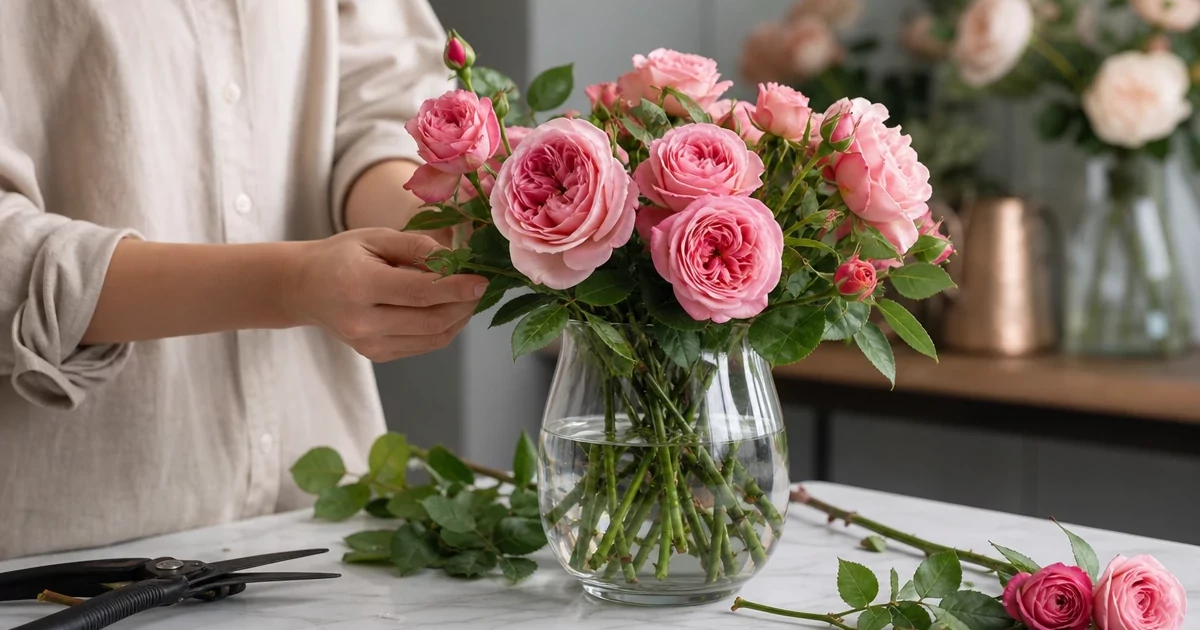
Before putting the stems in the vase, remove any leaves and thorns that would sit in water: they rot and cloud it. Trim each stem by 2–3 cm with a sharp knife or secateurs at an angle, ideally under running water, and put it straight into the vase. General rules for any bouquet are in how to make a bouquet last longer.
Daily care
Change the water every 1–2 days, rinsing the vase each time, and recut the stems by 1 cm. Spray roses drink a lot, so watch the level: water should cover at least a third of the stems. Gently snap or snip off spent blooms at the base so the stem's energy goes to the remaining buds and the bouquet stays tidy.
Keep the bouquet somewhere cool, away from direct sun, radiators, draughts and fruit: ripe apples and bananas release ethylene, which speeds up wilting. Move it to the coolest room at night. With this care spray roses usually last 7–10 days, and some varieties longer.
Drooping heads: how to revive them
Drooping heads usually mean an air lock in the stem. Recut 3–5 cm under water, wrap the bouquet tightly in paper so the heads stand straight, and place it for 2–3 hours in a deep container of cool water up to the buds. Most blooms recover after this soak. More on reviving roses in rose bouquet care.
Which spray roses last longest
Vase life depends on the variety and how fresh the cut is. Compact varieties with small buds hold up well, while lush garden-style spray roses tend to open faster. Spray roses are close to the floribunda garden group, covered in floribunda roses, and an overview of types and varieties is in our roses guide.
Common mistakes
Don't cut stems with ordinary scissors: they crush the vessels and the flowers drink less. Don't use warm water or add aspirin, sugar or coins: proper flower food works better. Don't mist open blooms, as petals can spot. And remove wilted stems promptly: they speed up wilting in the rest.
Spray roses delivered in Kyiv
Order a spray rose bouquet: we deliver it fresh with a sachet of flower food for the vase.
Graduated from Taras Shevchenko National University of Kyiv, Institute of Biology and Medicine (2001). BSc in Biology, MSc in Horticulture. Writes about plants, works at a garden centre selecting and repotting plants, and contributes to plant reference guides.






 Birthday
 Hydrangeas