
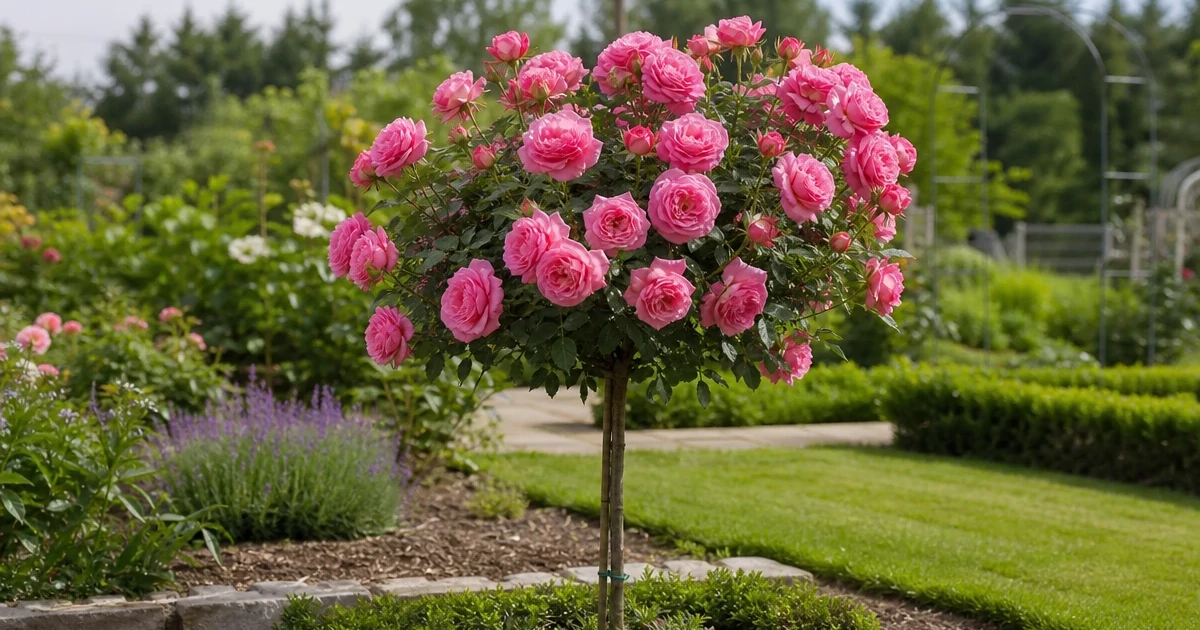
A standard rose is not a variety but a way of growing roses: a rose bush grafted onto a tall, straight stem. In the garden such a little tree crowned with flowers becomes a focal point, lines paths and entrances or stands in a large container. Here is what types of standard roses exist and how to plant, prune and protect them in winter.
A standard is a straight stem with no side branches. To make a standard rose, growers take a rootstock (usually a vigorous dog rose), train it into a straight stem and graft a garden variety on top. Within a year or two a head forms at the graft and flowers like an ordinary bush. Everything that grows below the graft is rootstock sucker growth and must be removed.
Free-flowering varieties with a compact habit are grafted onto standards: floribundas, hybrid teas, English roses and miniatures. Weeping forms use varieties with long, flexible shoots. Ideally choose a repeat-flowering variety with good disease resistance.
Plant in spring once the soil thaws or in early autumn, in a sunny spot sheltered from strong wind. Drive a sturdy stake into the hole first — it should reach the base of the head, because the stem can snap under the weight of flowers. Set the plant at the same depth it grew in the nursery and tie it in several places with soft tape. General rules are in planting roses.
The weakest point is the graft at the top of the stem. In autumn, young standards are gradually bent to the ground, pegged down, and the head and graft are covered with conifer branches and fleece. Old thick stems that will not bend are protected in place: tie the head together, wrap it in several layers of fleece or hessian and wrap the stem too. Container standards go into a cool unheated room for winter. More tips are in preparing roses for winter.
A rose grafted on top of a tall straight rootstock stem, so it grows like a small tree.
They are rootstock (dog rose) suckers. Cut them off flush with the stem, or they will smother the grafted variety.
In most of Ukraine, no: the high graft freezes faster than on a bush rose.
With good winter protection and pruning, more than ten years.

Author: Maria Svitlovir
Graduated from Taras Shevchenko National University of Kyiv, Institute of Biology and Medicine (2001). BSc in Biology, MSc in Horticulture. Writes about plants, works at a garden centre selecting and repotting plants, and contributes to plant reference guides.
© Zatobolsk 2026 UFL Flower Shop

Trademark UFL №191476 is used under license of the rights holder.
All rights reserved. Any use of materials without a link to the site is prohibited.

 Birthday
 Hydrangeas