
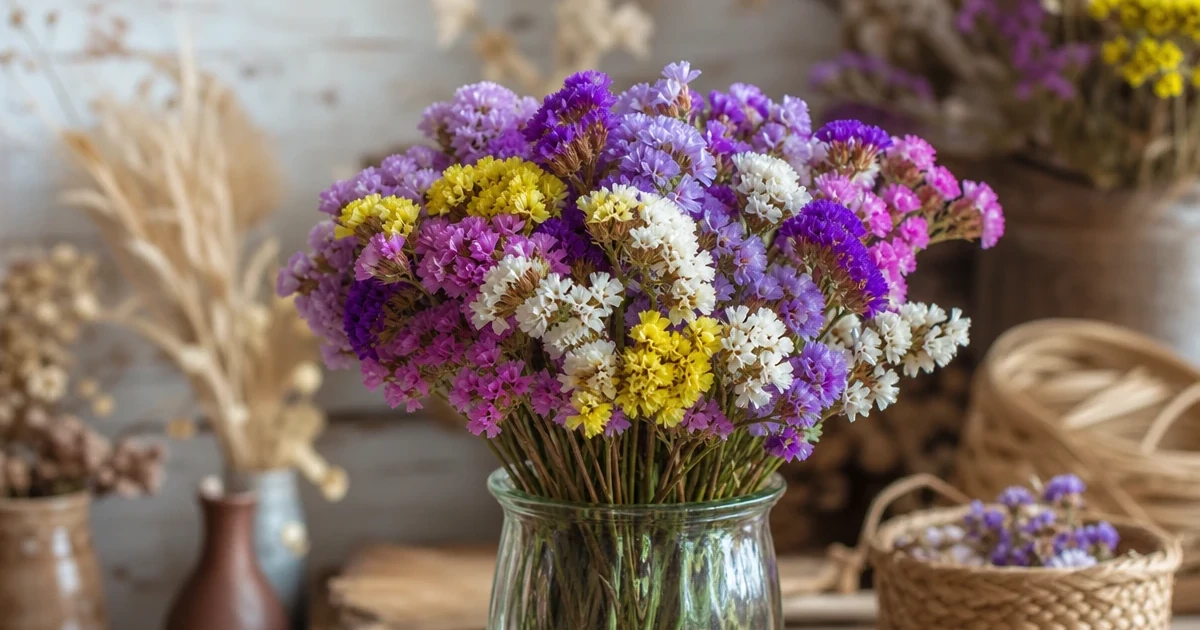
Statice is a flower you can put in a vase in summer and still enjoy in spring. Its bright papery clusters barely change when dried, so it is grown both for fresh bouquets and for dried arrangements, wreaths and home decor. Here are the main types, how to grow statice from seed and how to dry it properly.
Statice, also called sea lavender or limonium (Limonium), belongs to the plumbago family. The bright “petals” florists love are actually dry, papery calyces. The true flowers are tiny, white or cream and fade quickly, while the coloured calyx remains even after drying. That is why statice does not wilt — it simply dries and keeps its colour.
Cut statice when most clusters have opened, in dry weather after the dew has gone. Tie the stems in small bunches and hang them upside down in a dry, airy, shaded place. In 2–3 weeks they will be fully dry. Direct sun bleaches the colour, so dry and store statice away from windows.
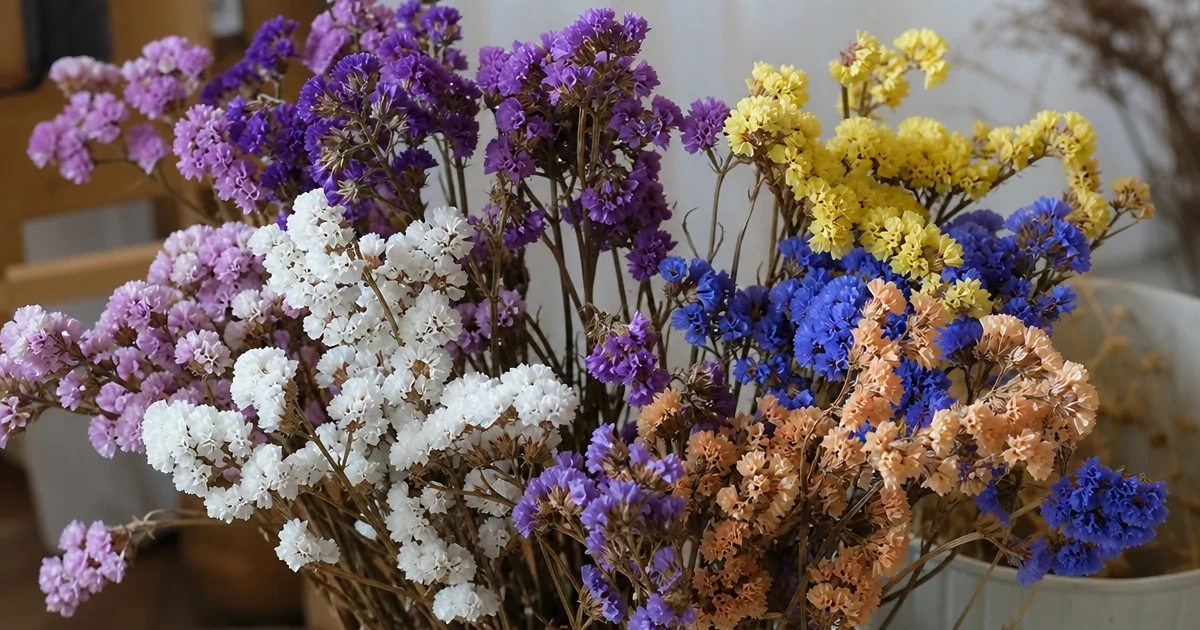
View full-size photoStatice flower clusters retain their bright colour even after drying.
In fresh bouquets statice adds bright colour and texture; it pairs well with roses, chrysanthemums, gypsophila and oxypetalum. You do not even need to throw a statice bouquet away: it will dry right in the vase. In dried arrangements, combine it with bunny tails, pampas grass, lavender, cotton and dried ruscus.
More bouquet flowers are in our florist’s glossary.
Both are names for Limonium. “Statice” usually means Limonium sinuatum, the main species for cutting and drying.
Kept dry and out of the sun, a year or more, though the colour slowly fades.
Annual statice is grown as an annual; broad-leaved sea lavender is a perennial.

Author: Maria Svitlovir
Graduated from Taras Shevchenko National University of Kyiv, Institute of Biology and Medicine (2001). BSc in Biology, MSc in Horticulture. Writes about plants, works at a garden centre selecting and repotting plants, and contributes to plant reference guides.
© Kyiv 2026 UFL Flower Shop

Trademark UFL №191476 is used under license of the rights holder.
All rights reserved. Any use of materials without a link to the site is prohibited.

 Birthday
 Hydrangeas