UFL logo

How to Water Houseplants: Water Type, Frequency, Holidays

ID:
524
Total views:
4944
Category:
Published:
Updated:


Most houseplants die not from drought but from poor watering: too often, with water that is too cold or too hard, or without drainage. Here is what water to use, how to tell when a plant needs watering, and what to do if you go away for a week, two weeks or a month. More plants with names and tips in our houseplant catalogue.

To add to your collection, browse our houseplants with delivery in Kyiv.

What water to use

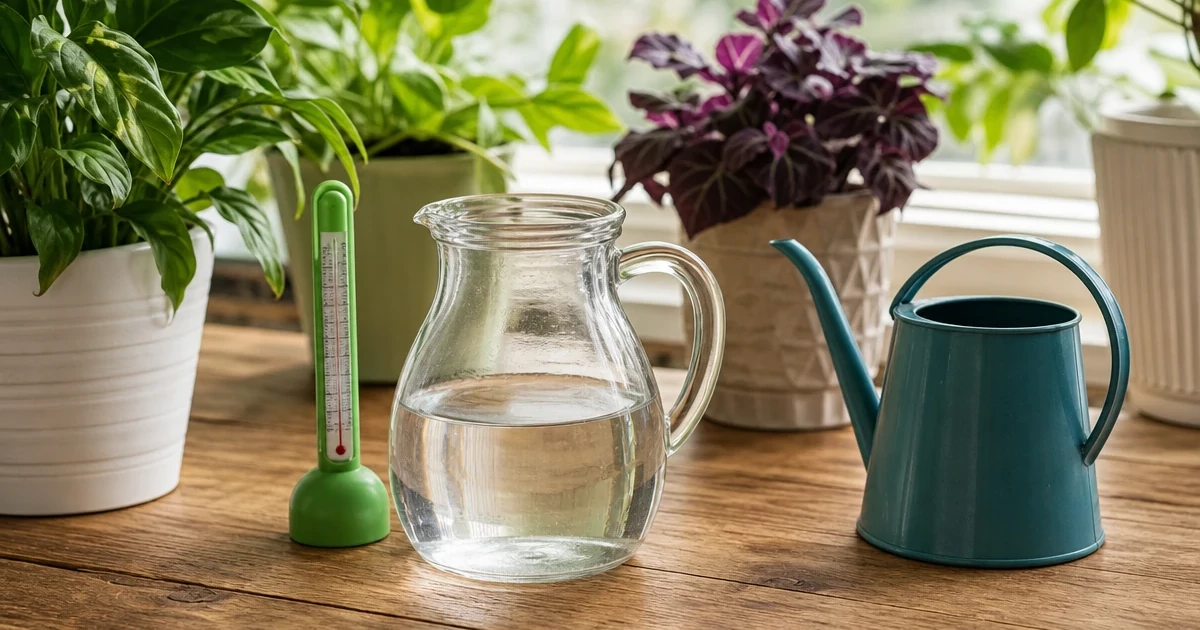
  • Tap water left to stand is the easiest option. Over 24 hours some of the chlorine dissipates and the water reaches room temperature. Chloramine, used in some supplies, does not disappear this way — a carbon filter reduces it.
  • Room temperature. Cold water shocks the roots of tropical plants, especially in winter.
  • Hard water leaves a white crust on soil and pots. Sensitive plants (calatheas, azaleas, gardenias, orchids) prefer filtered, rain or melted snow water.
  • Distilled water is needed for carnivorous plants such as the Venus flytrap.
  • Softened water from household softeners is unsuitable because it contains a lot of sodium.

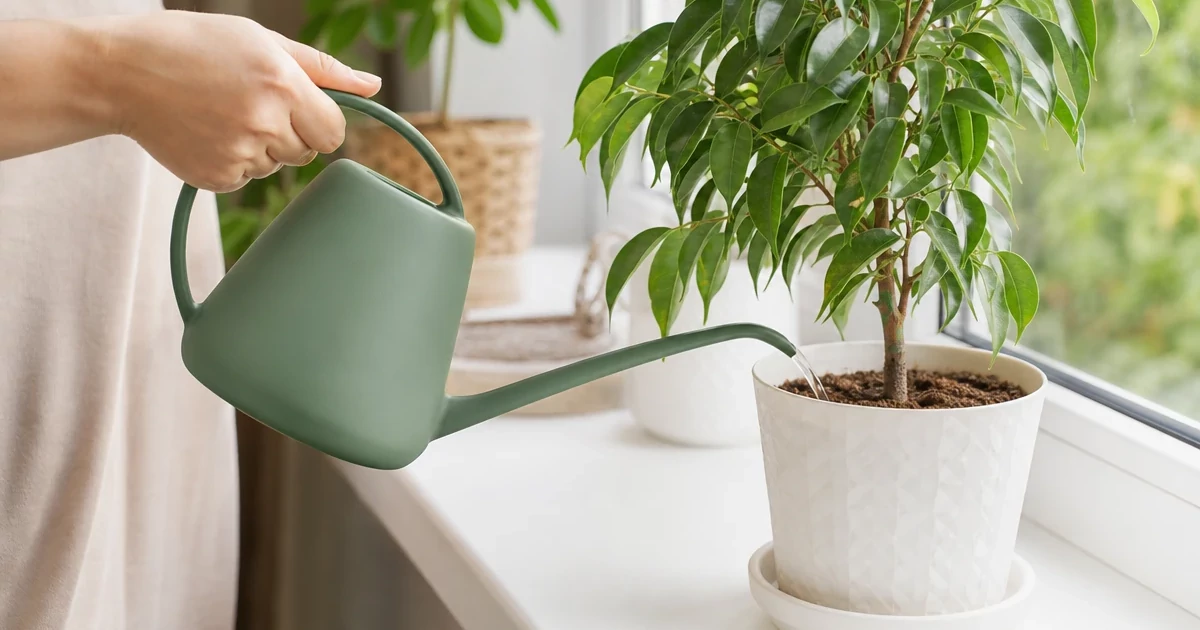
Watering a houseplant at the roots
View full-size photo

How to tell when to water

  1. Check the soil with your finger 2–3 cm deep. Dry — water; damp — wait.
  2. Feel the weight of the pot: it is noticeably heavier after watering.
  3. Consider the plant. Water cacti and succulents when the soil is completely dry; ferns and calatheas like consistently slightly moist soil.
  4. Water less in winter — plants grow more slowly and soil dries more slowly in the cool.
  5. Empty the saucer after 15–20 minutes: standing water is the main cause of root rot.

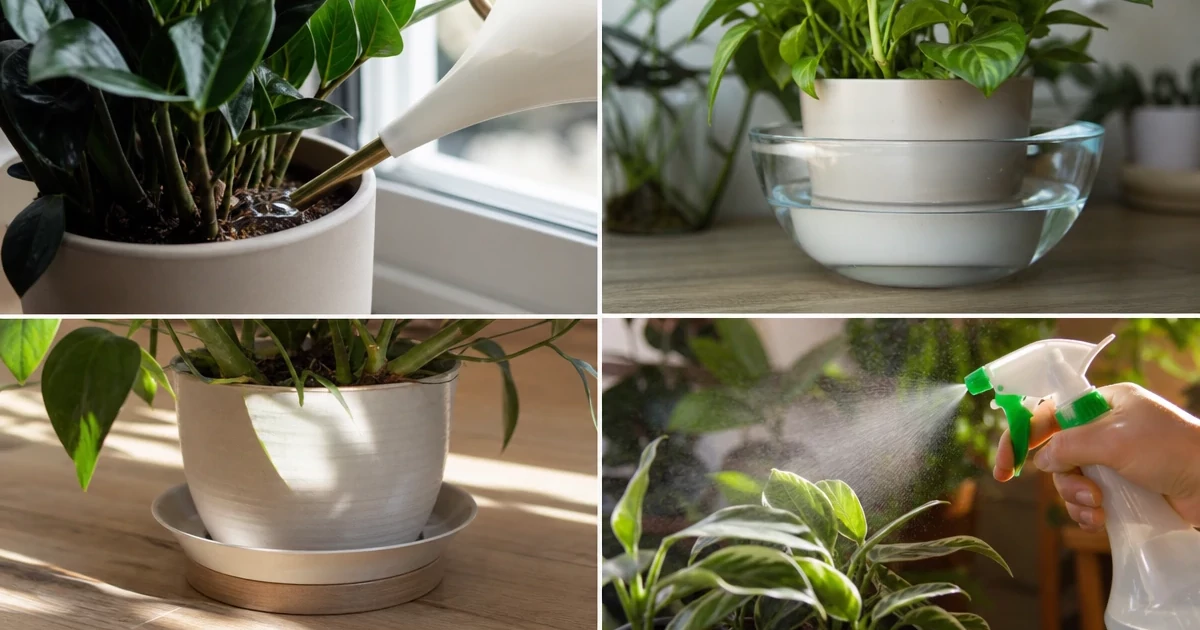
For plants that dislike water on their leaves or crown (African violets, orchids), water from below: stand the pot in water for 15–30 minutes.

Settled water in a jug and a watering can
View full-size photo

Watering plants while you are awayUp to 7 dayswater well, move from windows,tray of wet clay pebbles7–14 dayswick watering, spikes orbottles, self-watering potsOver 2 weeksdrip system on a timeror a helpful neighbourCacti, succulents2–3 weeks without wateris fine — don't overwater
Choosing a watering method by trip length

How to water popular houseplants

PlantHow to waterHow often (summer)
OrchidSoak the pot for 15–20 min once the roots turn silvery; the same while in bloom, keeping water out of the crownEvery 7–10 days
ZZ plantOnly when the soil is completely dry; the rhizomes store waterEvery 2–3 weeks, less in winter
African violet, cyclamenFrom below with lukewarm water, never onto leaves or the tuberWhen the top of the soil is dry
Ficus, dracaenaFrom above once the top 2–3 cm are dryEvery 7–10 days
Cactus, aloe, jade plantThoroughly, but only when the soil is dryEvery 2–3 weeks; monthly or less in winter
Peace lily, anthuriumKeep slightly moist; a peace lily droops to ask for water1–2 times a week
Christmas cactus, kalanchoeModerately; do not let it dry out while in budWhen the top of the soil is dry

Frequencies are approximate: plants near radiators or in hot weather need water more often, and less in cool, dim conditions. Always check the soil.

Watering methods: top, soaking, saucer and misting
View full-size photo

What to do when you go away

Up to a week

  • Water all plants thoroughly the day before you leave (except succulents — a normal watering is enough).
  • Move pots away from south-facing windows and radiators: less light and heat means less evaporation.
  • Group plants together so the air around them stays humid for longer.
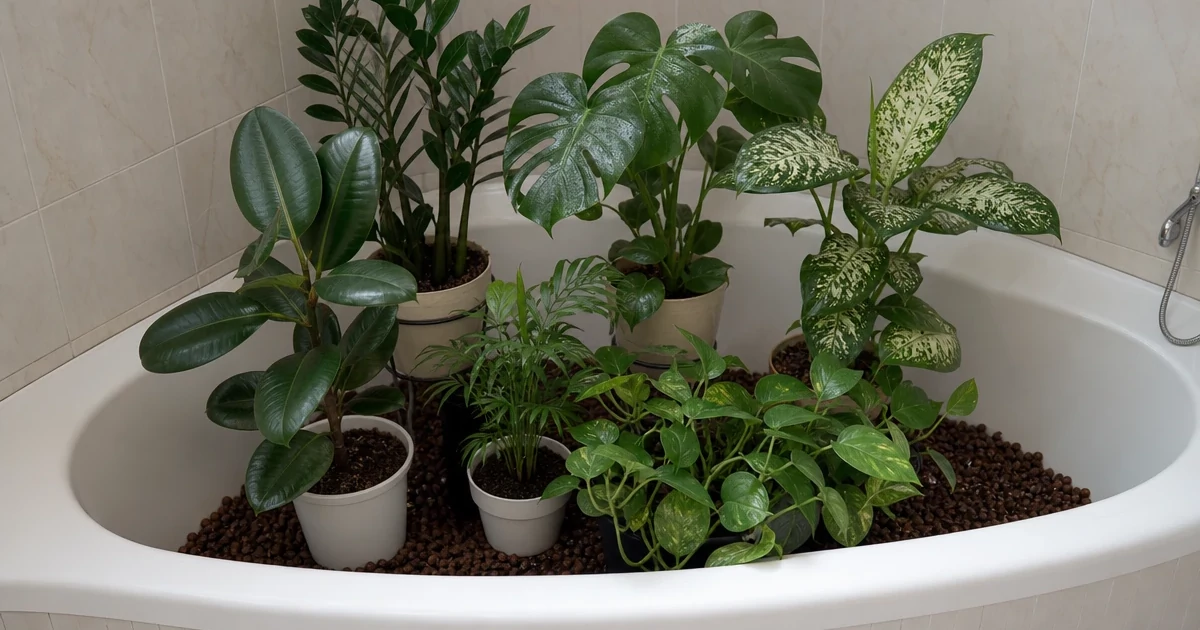
  • Stand pots on a tray of wet clay pebbles or gravel, without the base sitting in water.

One to two weeks

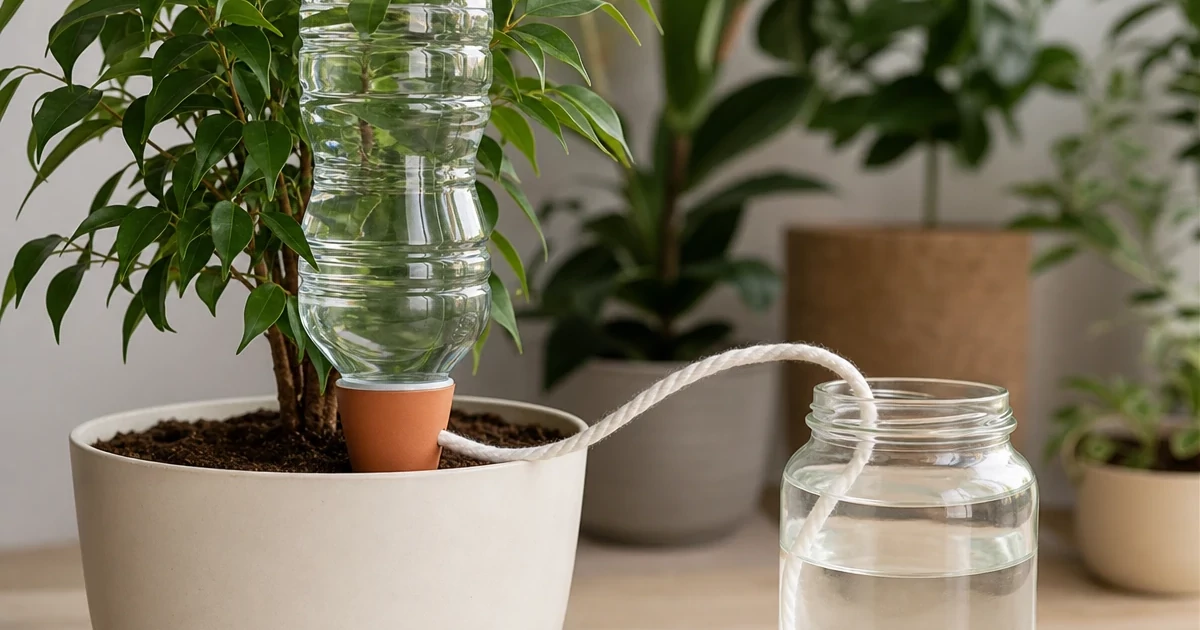
  • Wick watering. Put one end of a cotton or synthetic cord in a container of water and bury the other in the soil. Water travels up the wick as the soil dries.
  • Ceramic spikes and bottles. A spike or a plastic bottle with a pierced cap pushed into the soil releases water gradually.
  • Self-watering pots with a reservoir and water-level indicator — handy if you travel often.
  • Mini greenhouse. Small moisture-loving plants can be covered after watering with a clear bag that doesn't touch the leaves. Not suitable for cacti and succulents.

Houseplants in a bathtub on wet clay pebbles before a holiday
View full-size photo

More than two weeks

The most reliable options are a drip system on a timer or someone who can call in once a week. Leave them simple instructions: which plants, how much water and how often.

Self-watering systems for houseplants

  • Self-watering planters with a reservoir suit 1–3 moisture-loving plants; top up every 1–3 weeks depending on size.
  • Ceramic spikes with a tube are cheap and cover trips of up to 2 weeks.
  • Drip systems with a pump and timer suit a large collection or several weeks away; they run on mains or batteries.

Test any system a week before you leave to check it does not waterlog the soil and holds enough water. Cacti and succulents usually do not need one.

Self-watering with a bottle spike and a wick from a jar
View full-size photo

The key tip

Test your chosen method a week before you leave: see how much water it uses per day and whether the soil gets waterlogged. That way there are no surprises when you return.

FAQ

Can I use boiled water?

Yes, once cooled to room temperature: boiling reduces temporary water hardness.

How long can a plant survive without water?

Most tropical plants about a week, cacti and succulents 2–3 weeks or more, ferns and calatheas only a few days.

Can I leave plants in a bath of water?

Better not: bathrooms are usually dark, and pots standing in water may rot. A wet towel or clay pebbles in a bright spot is safer.

Author: Maria Svitlovir

Graduated from Taras Shevchenko National University of Kyiv, Institute of Biology and Medicine (2001). BSc in Biology, MSc in Horticulture. Writes about plants, works at a garden centre selecting and repotting plants, and contributes to plant reference guides.