
 Birthday
 Hydrangeas
This article was prepared with the support of UFL flower delivery. Jasmine is a perennial evergreen of the olive family with fragrant flowers, usually white or cream, sometimes pinkish or yellow. There are about 200 species growing in the tropics and subtropics of Asia, Africa and the Mediterranean. A few easy species do well indoors, and with the right winter rest they flower profusely and scent the whole room.
.jpeg)
Types of indoor jasmine
Pink jasmine (Jasminum polyanthum)
The most common jasmine in shops: a fast-growing climber that needs support — a hoop, trellis or frame. Pink buds open into white, strongly scented stars. It blooms in late winter and spring, but only after spending autumn and early winter somewhere cool.

Arabian jasmine (Jasminum sambac)
Native to South and Southeast Asia. Flowers are white, single or double (Maid of Orleans, Grand Duke of Tuscany), turning slightly pink as they fade. The scent is strongest in the evening. Sambac is the jasmine used for jasmine tea and is the national flower of Indonesia and the Philippines. It blooms in flushes from spring to autumn and does not need a cold rest.

Winter jasmine (Jasminum nudiflorum)
A shrub with long arching stems and bright yellow unscented flowers that appear on bare branches in winter and early spring. It is really a garden plant for mild regions and sheltered spots; a flat is too warm for it, so a glazed balcony suits it better.

Primrose jasmine (Jasminum mesnyi)
Similar to winter jasmine but evergreen, with larger (4–5 cm) semi-double yellow flowers and no scent. Blooms in late winter and spring — a good choice if you love jasmine but dislike strong fragrance.
Care calendar
Light and temperature
- The best spot is an east or west window, or a south window shaded at midday. On a north window jasmine grows but hardly flowers.
- In summer the pot can go out on a balcony or terrace, protected from harsh midday sun and draughts.
- In spring and summer it is happiest at 19–25 °C and dislikes sudden temperature swings.
- J. polyanthum needs 6–8 weeks at 8–12 °C in autumn–winter (an insulated balcony or cold windowsill) to set buds. Without it, it grows but won’t bloom.
- Keep J. sambac at 16–18 °C in winter, never below 15 °C.
Watering and humidity
In summer, water when the top centimetre of soil is dry, using soft, room-temperature water. Jasmine dislikes both drying out and standing water: use a drainage layer and empty the saucer after 15 minutes. In winter, especially in a cool room, water less, but never let the root ball dry out completely.
Aim for at least 50–60 % humidity. In hot weather mist the leaves with soft water (not the open flowers) or stand the pot on a tray of wet pebbles. Next to a radiator the leaves quickly dry and curl.
Feeding and pruning
From April to September feed every two weeks with a fertiliser for flowering plants that is higher in potassium than nitrogen. Too much nitrogen gives lots of leaves and few flowers. Stop feeding in autumn and winter.
Prune J. polyanthum straight after flowering: shorten long stems by a third to a half and tie new growth to the support. Shape J. sambac in early spring and pinch the tips in summer, leaving 6–8 pairs of leaves per shoot, for a bushier plant with more flowers.
Repotting and propagation
Repot young plants every spring and mature ones every 2–3 years, when roots fill the pot, moving up just 2–3 cm in diameter. Use a potting mix for flowering plants with added perlite, or equal parts loam, leaf mould, peat and sand.
Propagate jasmine from cuttings in spring or summer:
- Take semi-ripe cuttings 10–15 cm long with 2–3 nodes.
- Remove the lower leaves and dip the cut end in rooting hormone.
- Insert into a 1:1 peat and sand mix, cover with a bag or dome and keep at 20–24 °C in bright light, out of direct sun.
- Roots form in 4–6 weeks. When the cutting starts growing, pot it into a 7–9 cm pot.
J. polyanthum also layers easily: pin a long stem into a neighbouring pot of compost and it will root in 4–6 weeks.
Why jasmine won’t bloom or turns yellow
| Problem | Cause and fix |
|---|---|
| No flowers | Warm winter (for J. polyanthum), too little light, too much nitrogen, late pruning that removed the buds. |
| Yellow leaves | Hard or cold water, chlorosis, overwatering. Use soft water and acidify it with a few drops of lemon juice once a month. |
| Brown tips, curling leaves | Dry air, direct sun, dried-out root ball. |
| Buds dropping | Moving the pot, draughts, drying out or a sudden temperature change. |
| Webbing, sticky residue | Spider mites, aphids, mealybugs. Shower, soapy water; for heavy infestations use a miticide or insecticide. |
Harvesting jasmine for tea
Jasmine tea comes from China, where sambac flowers have been added to tea since the 13th–14th centuries; the fashion reached Europe in the 19th century. Only Jasminum sambac grown without chemical treatment is suitable for home tea. Mock orange and ornamental jasmines are not used for brewing.
Pick fully open flowers in the evening or early morning, when the scent is strongest. Sort them, spread in a thin layer on cloth in the shade and dry in a ventilated room, turning occasionally. Never use an oven: the flowers darken and lose their aroma.
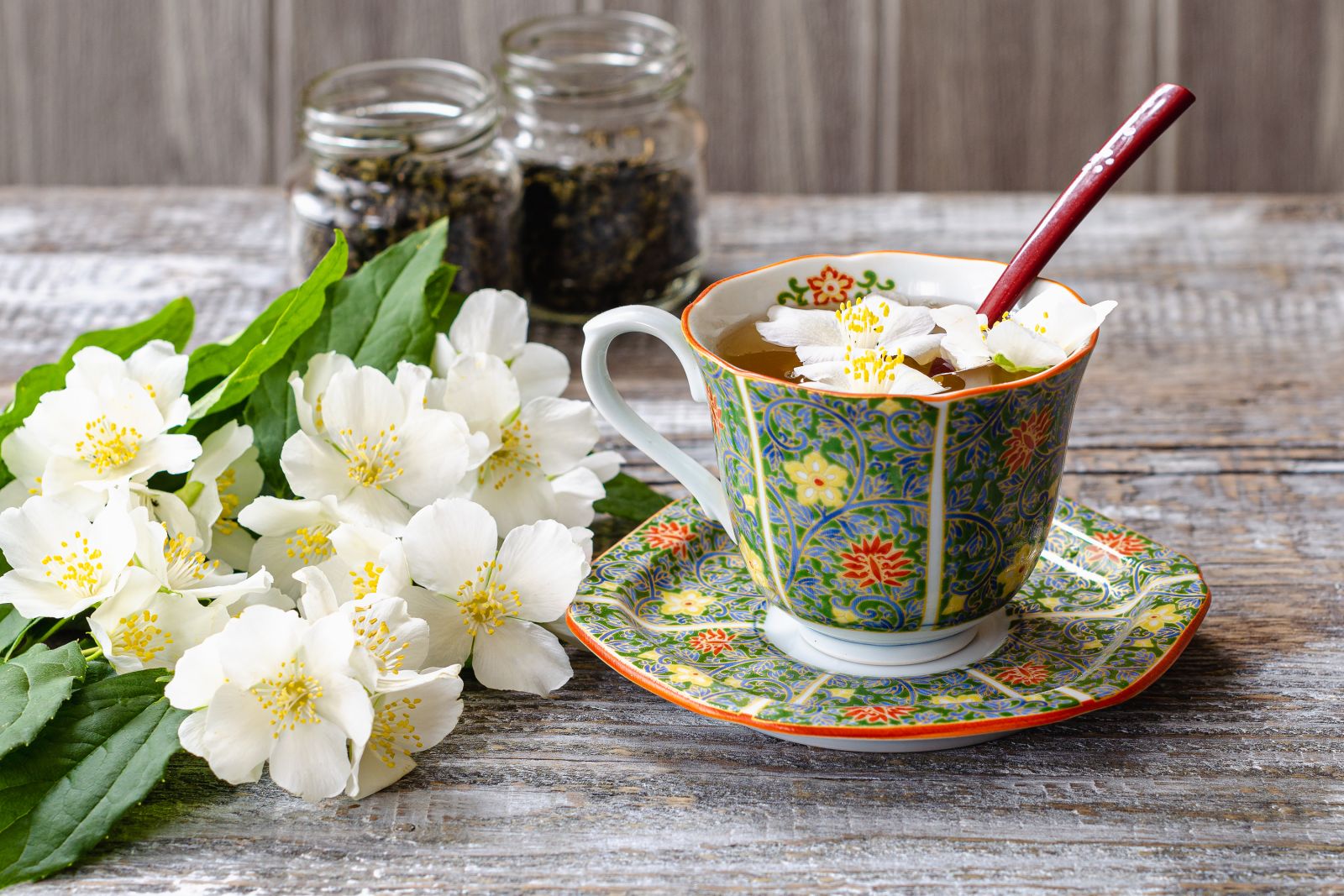
Jasmine pairs well with green, oolong and white tea. The classic method is scenting: layer fresh flowers with dry tea for a few hours, then remove them.
Interesting facts
- Jasmine is the national flower of Pakistan (J. officinale), Indonesia and the Philippines (J. sambac).
- Jasmine absolute is one of the most expensive perfume raw materials: a kilogram needs millions of flowers hand-picked at dawn.
- In India, sambac garlands are woven into brides’ hair and given to guests at celebrations.
- Don’t overdo jasmine in the bedroom: for sensitive people the strong scent at night can trigger headaches.
Looking for a gift that lasts longer than a bouquet? See our houseplants with delivery in Kyiv.
FAQ
Can I keep jasmine in the bedroom?
Yes, but move it out at night while it is flowering: the intense scent can cause headaches.
How long does indoor jasmine bloom?
J. polyanthum flowers for 3–5 weeks in late winter and spring; J. sambac blooms in flushes from spring to autumn.
Is jasmine toxic to cats?
True jasmine (Jasminum) is not considered toxic to cats and dogs. “Carolina jasmine” (Gelsemium) is a different, poisonous plant.
What is the difference between jasmine and mock orange?
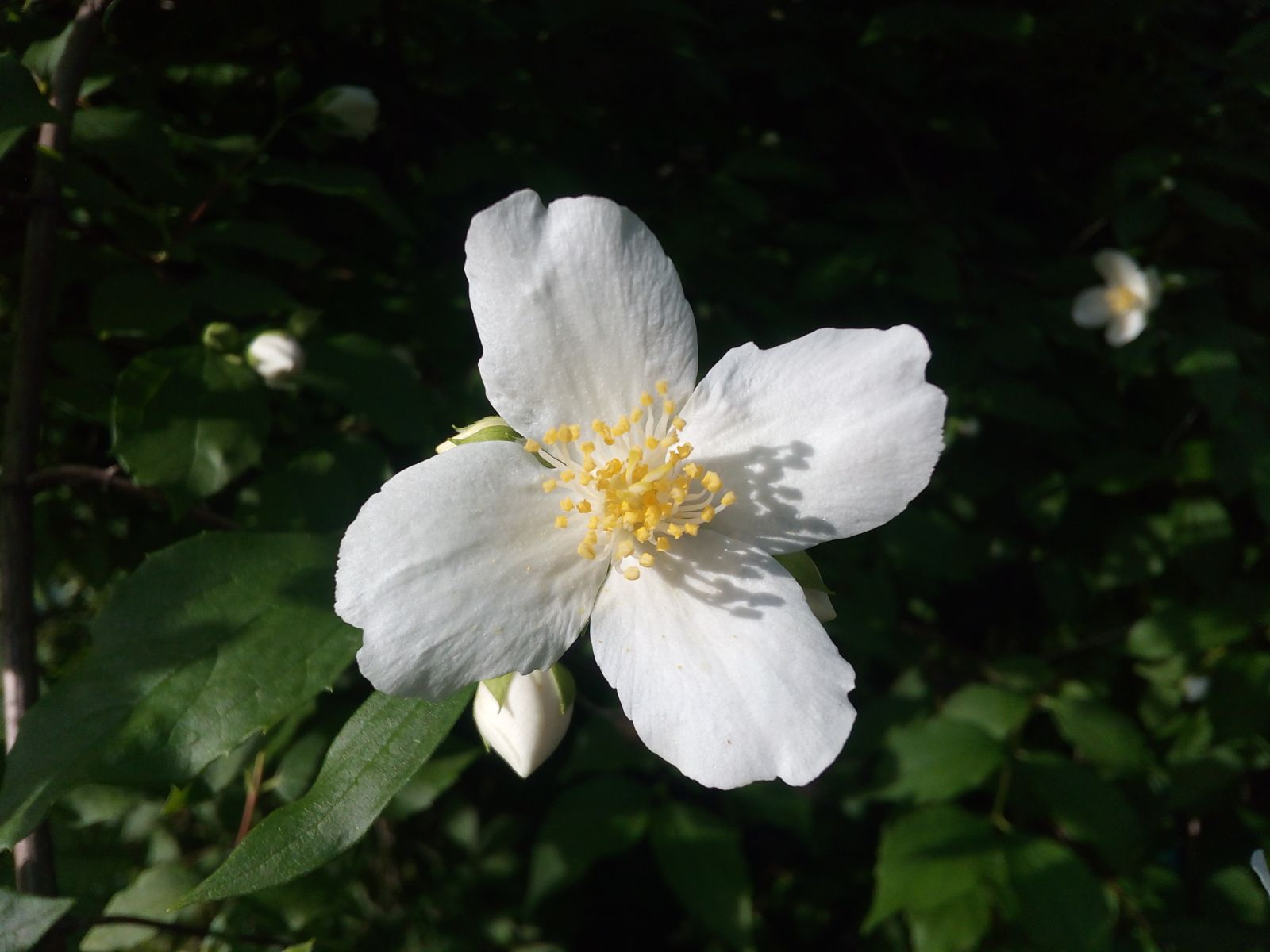
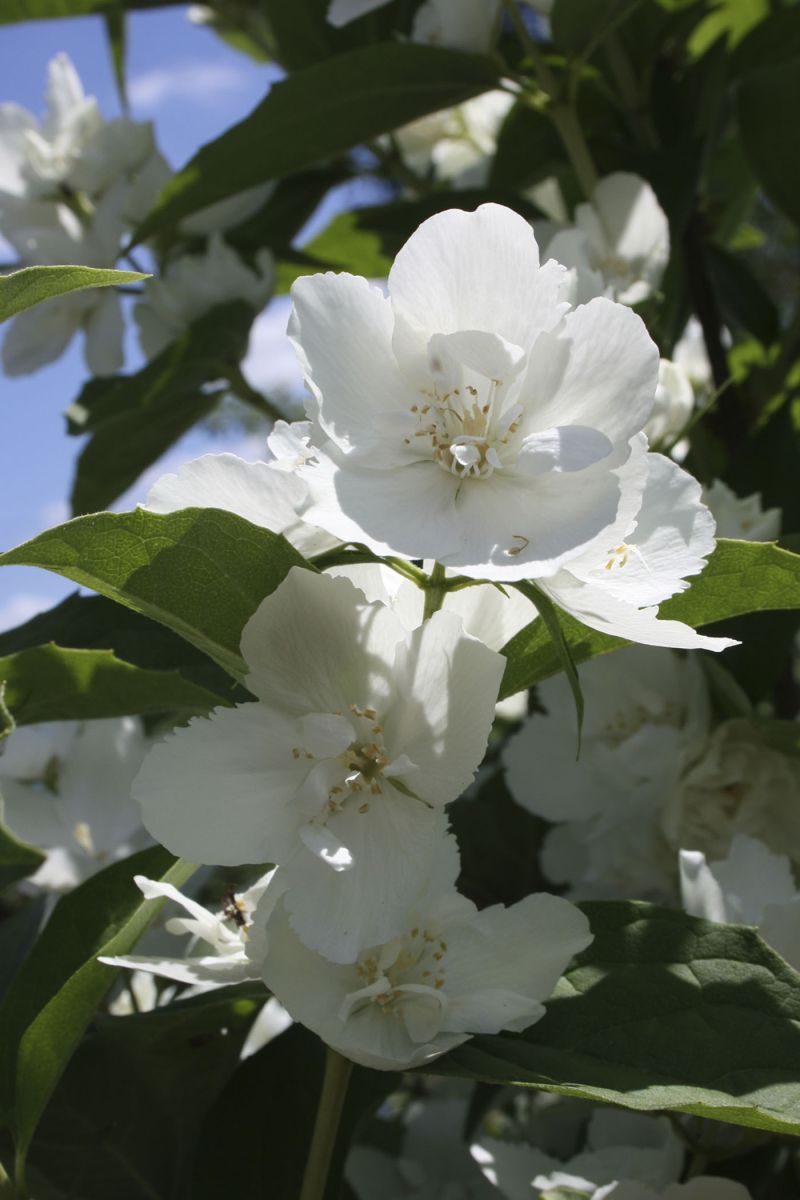
Jasmine is a climber or shrub with tubular flowers of 5–8 petals, grown mostly indoors in Ukraine. Mock orange is a hardy garden shrub with four-petalled flowers that is often wrongly called jasmine.

View full-size photo
Author: Maria Svitlovir
Graduated from Taras Shevchenko National University of Kyiv, Institute of Biology and Medicine (2001). BSc in Biology, MSc in Horticulture. Writes about plants, works at a garden centre selecting and repotting plants, and contributes to plant reference guides.