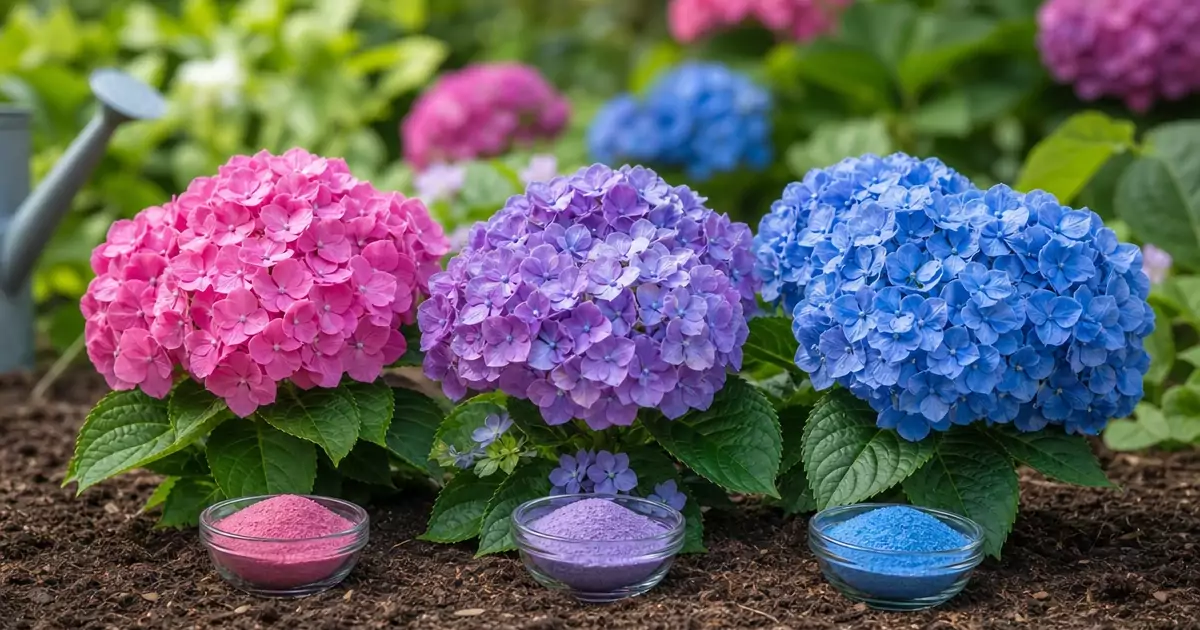
The same bigleaf hydrangea can flower blue, lilac or pink depending on the soil. It is chemistry, not magic: soil acidity and available aluminium decide the colour. Here is which hydrangeas change colour, how to turn them blue or pink, how long it takes and which folk methods do not really work. If yours is in a pot, see potted hydrangea care.
Only bigleaf (Hydrangea macrophylla) and mountain hydrangeas respond to soil, and only their pink and blue varieties. White varieties stay white whatever the pH. More in bigleaf hydrangea.
Panicle and smooth hydrangeas change shade as the heads age and nights cool, not because of the soil, so acidifying them for colour is pointless. See panicle hydrangea and smooth hydrangea.
How to make a hydrangea blue
Blue comes from aluminium, which the plant can absorb only from acidic soil (pH 4.5–5.5). So you need two things: acidity and a source of aluminium.
Acidify: apply garden sulphur (30–50 g per m² in autumn or early spring), mulch with pine bark or acidic peat, and water with rain or settled water.
Aluminium: from spring until buds form, water every two weeks with aluminium sulphate or alum (about 15 g in 5 litres), a bucket per plant. Do not overdo it — excess burns the roots.
Choose low-phosphorus fertilisers: phosphorus locks up aluminium and the flowers turn pink.
How to make a hydrangea pink
For pink, raise the pH to 6–7: in autumn apply dolomite lime (100–200 g per m²) or wood ash.
Use high-phosphorus fertilisers, water with ordinary tap water and avoid conifer mulch.
In very acidic soil a clear pink is hard to achieve; it is easier to grow the plant in a pot with a neutral mix.
How long it takes
Colour is set as buds form, so changes show only at the next flowering, and a full switch takes 1–2 seasons. You cannot recolour heads that are already open in midsummer.
Pots are quicker: repot into an acidic rhododendron mix for blue or a neutral all-purpose mix for pink.
Pink and blue heads on the same plant mean patchy soil with a pH around 5.5–6. Some varieties, such as L.A. Dreamin’, always flower like this.
Folk methods: what works and what doesn’t
Rusty nails and iron filings: iron does not make flowers blue — aluminium does. Doesn’t work.
Coffee grounds and tea leaves only slightly acidify the soil, so the effect is weak and slow. Vinegar washes out quickly and can damage roots — best avoided.
Check soil pH with test strips or a meter before you start and again after 2–3 months so you do not overdo it. General care is in our hydrangea guide.
Blue and pink hydrangeas with delivery
Don’t want to wait a season? We deliver hydrangeas in the colour you want — blue, pink, purple or white — as single stems or bouquets across Kyiv and Ukraine.
Graduated from Taras Shevchenko National University of Kyiv, Institute of Biology and Medicine (2001). BSc in Biology, MSc in Horticulture. Writes about plants, works at a garden centre selecting and repotting plants, and contributes to plant reference guides.






 Birthday
 Hydrangeas