Making a beautiful bouquet yourself is entirely doable, even with no floristry experience. You need fresh flowers, a sharp tool, a little patience and a few basic rules. Here is a starter kit: what to buy, how to prepare the flowers, how to assemble and tie the bouquet, and the mistakes beginners make most often.
Sharp secateurs or a florist’s knife — blunt scissors crush the stem so it drinks less water.
A bucket or tall vase of clean water — for conditioning the flowers.
Ribbon, twine or floral tape — to tie the bouquet.
Wrapping — kraft paper, felt or floral film if it is a gift.
Gloves — for roses and plants with irritating sap.
Choosing the flowers
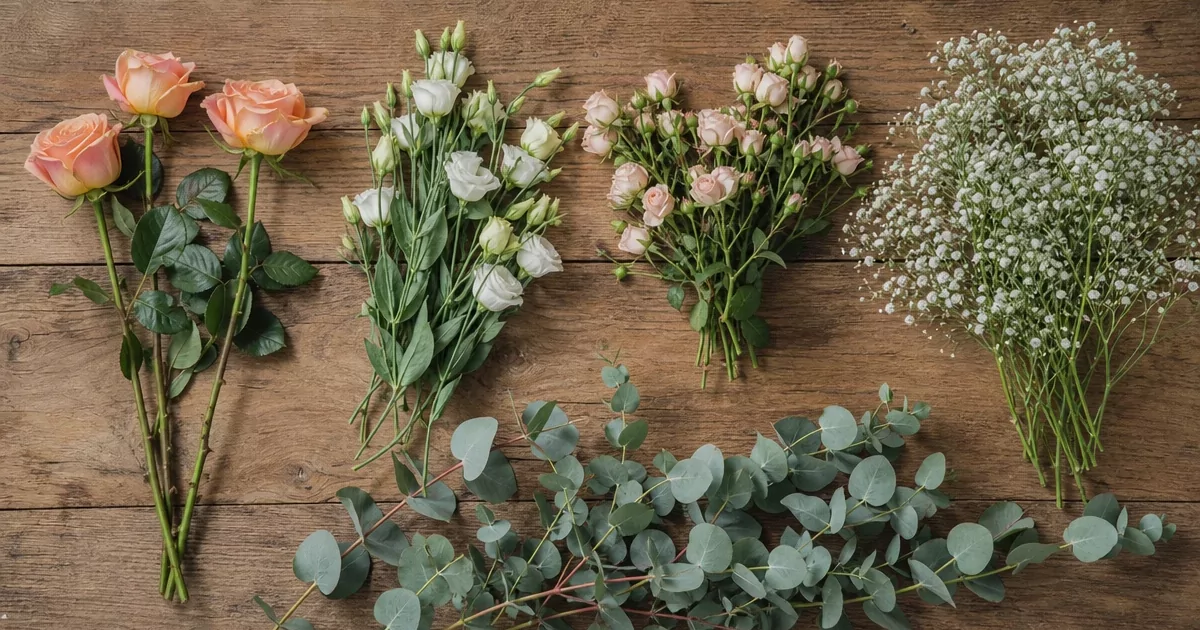
The four groups of plants a bouquet is built from
For a first bouquet, one or two kinds of focal flowers, one filler and some greenery are plenty. Choose firm stems, fresh leaves and buds that are just starting to open. An odd number of flowers is a tradition rather than a floristry rule — in large bouquets nobody counts.
Shape: compact, vertically elongated or asymmetrical; avoid round, frilly bouquets.
Wrapping: kraft, grey or black paper, twine instead of satin ribbon.
Extras: coffee beans, bark or dried citrus can be woven in.
FAQ
Which flowers are best for a first bouquet?
Spray roses, alstroemeria, chrysanthemums, lisianthus and gypsophila — they are sturdy, last well and forgive mistakes.
How do I keep the bouquet fresh?
Change the water every 1–2 days, recut the stems and keep the bouquet away from radiators, direct sun and fruit.
How long does it take a beginner?
A small bouquet of 7–11 stems usually takes 20–30 minutes, including preparing the flowers.
Author: Maria Svitlovir
Graduated from Taras Shevchenko National University of Kyiv, Institute of Biology and Medicine (2001). BSc in Biology, MSc in Horticulture. Writes about plants, works at a garden centre selecting and repotting plants, and contributes to plant reference guides.




 Birthday
 Hydrangeas