Floribundas are roses for people who want lots of flowers with little fuss. Each stem opens a whole cluster of buds rather than a single bloom, they flower almost non-stop until autumn and cope with disease and frost better than most groups. Here is what floribunda roses are, how they differ from hybrid teas, which varieties to plant and how to care for them. For big, easy bushes, choose park roses. Learn more in spray roses in a vase.
A comparison of the two most popular garden rose groups.
What floribunda roses are
The name floribunda comes from Latin for abundantly flowering. The group was created in the early 20th century when Danish breeder Svend Poulsen crossed small-flowered polyantha roses with hybrid teas, and the first Poulsen roses, including Else Poulsen, appeared in the 1920s. From polyanthas they inherited multi-flowered clusters and toughness, from hybrid teas larger blooms and a wide range of colours.
How floribundas differ from other roses
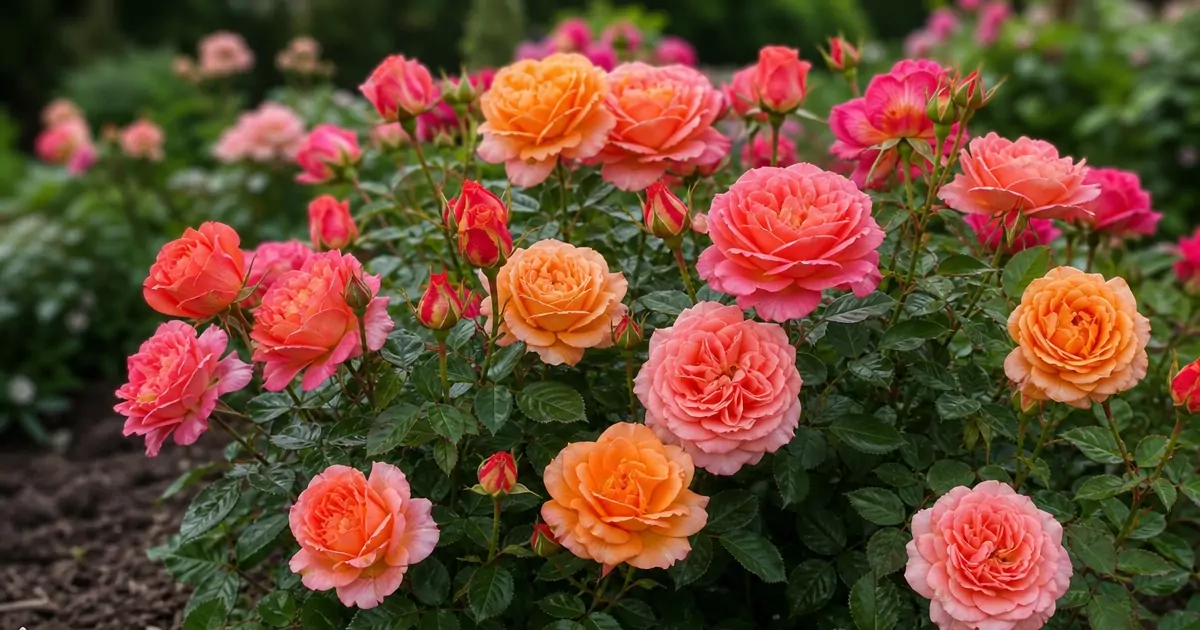
The key difference is that flowers come in clusters of 3–15 or more, so the bush looks like a solid cloud of colour. Blooms are smaller than on hybrid tea roses, usually 4–8 cm, and the bushes are compact at 40–100 cm. Floribundas flower almost continuously from June until frost, while hybrid teas bloom in flushes.
Another advantage is toughness. Most floribundas handle frost better and suffer less from black spot and powdery mildew. That is why they are recommended for beginners and used for borders, mass plantings, beds and even containers on a terrace.
The best floribunda varieties
Iceberg (Schneewittchen, Kordes, 1958) is the legendary white floribunda that blooms until frost. Friesia (Kordes, 1973) is bright yellow with a strong scent. Lilli Marleen (Kordes, 1959) is a velvety red classic for beds. Leonardo da Vinci (Meilland, 1993) is pink with very full, old-fashioned blooms.
Among unusual colours, Hot Chocolate with terracotta-brown petals, lilac and lavender varieties and two-tone types are popular. Spray roses, which florists use for light bouquets, are close relatives: they also carry several buds per stem.
Planting and care
Plant floribundas in a sunny spot with fertile soil, 40–60 cm apart, ideally in groups of three to five of the same variety for maximum impact. Timing and technique are the same as for other roses; see our article on planting roses. Water rarely but deeply and remove spent clusters to encourage new ones.
Prune floribundas moderately in spring, leaving four to six buds, roughly 20–30 cm, and removing old, thin and frost-damaged canes. Feed on a seasonal schedule, hill up and lightly cover for winter. More in our article on rose pruning.
Floribundas in the garden and bouquets
Being compact, floribundas are ideal for path edging, the front of mixed borders, beds and containers. They pair well with lavender, catmint, salvia and ornamental grasses. For cutting, take whole stems with several flowers: a single stem in a vase already looks like a small bouquet.
Spray roses delivered in Kyiv
Love roses with many buds per stem? Our catalogue has spray rose bouquets in many colours with delivery across Kyiv.
Graduated from Taras Shevchenko National University of Kyiv, Institute of Biology and Medicine (2001). BSc in Biology, MSc in Horticulture. Writes about plants, works at a garden centre selecting and repotting plants, and contributes to plant reference guides.






 Birthday
 Hydrangeas