Gypsophila, or baby’s breath, is that cloud of hundreds of tiny white or pink flowers that makes a bouquet light and airy. Brides, florists and gardeners love it. Here’s what it is, its types (perennial and annual), how to plant and care for it, how long it lasts in a vase, how to dry it and which flowers it pairs with best. Another long-lasting bouquet flower is alstroemeria: its meaning and care.
Gypsophila belongs to the carnation family. Its name means “gypsum-loving”, as in the wild it grows on chalky, limy soils.
In English it’s called baby’s breath; in Ukrainian folk speech it’s also known as tumbleweed, because the dried bush breaks off and rolls across the steppe.
The flowers are tiny, 3–6 mm, white or soft pink; dyed blue, lilac and rainbow versions are also sold.
It symbolises purity, sincerity and everlasting love, which is why it appears in so many wedding bouquets.
Growing perennial gypsophila
Site: sunny, with light, limy or neutral soil. Gypsophila hates waterlogging and acid soil.
Planting: sow seeds in spring indoors or outdoors in April–May; space plants 60–80 cm apart, as the bush spreads.
Care: moderate watering without overwatering, feeding once or twice a season, and support for tall bushes.
Flowering: June–August. Perennial gypsophila has a long taproot, so avoid transplanting mature plants.
Winter: perennial types are frost-hardy; young plants can be covered with dry leaves.
Propagating gypsophila
From seed: the easiest way for annuals. The seeds are tiny and only lightly covered; seedlings appear in 10–14 days.
From cuttings: double perennial varieties are propagated from young shoots in spring or early summer, rooted in light sandy soil.
Dividing the plant isn’t recommended, as its long taproot doesn’t tolerate damage.
Problems and care mistakes
Root rot is the main problem, caused by overwatering and heavy clay soil; add sand and drainage.
Few flowers: not enough sun or soil that’s too acidic; liming with dolomite flour helps.
Floppy bush: put a ring support in place in spring while the shoots are still short.
Cut back spent stems after the first flush and gypsophila may bloom again.
How long gypsophila lasts in a vase
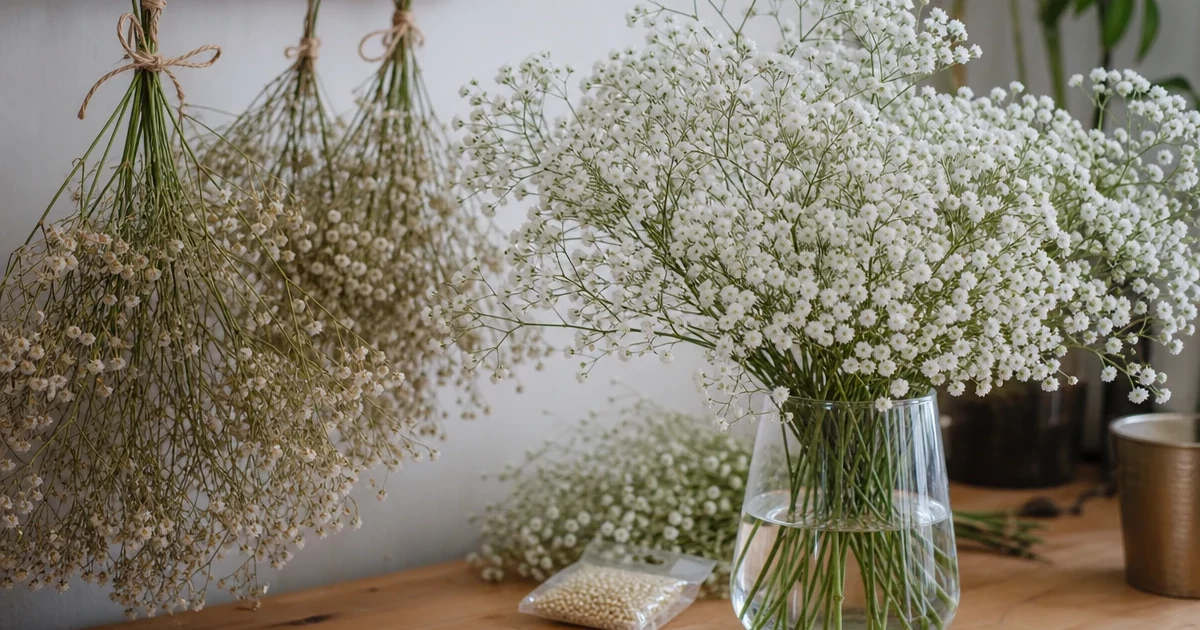
Fresh gypsophila lasts 7–10 days and then dries naturally without losing its shape.
Trim stems at an angle, strip leaves below the waterline and change the water every 2 days.
Not everyone loves gypsophila: some find it too “bridal”, and some dislike the smell of the fresh stems. For the same airy cloud with a different character, try:
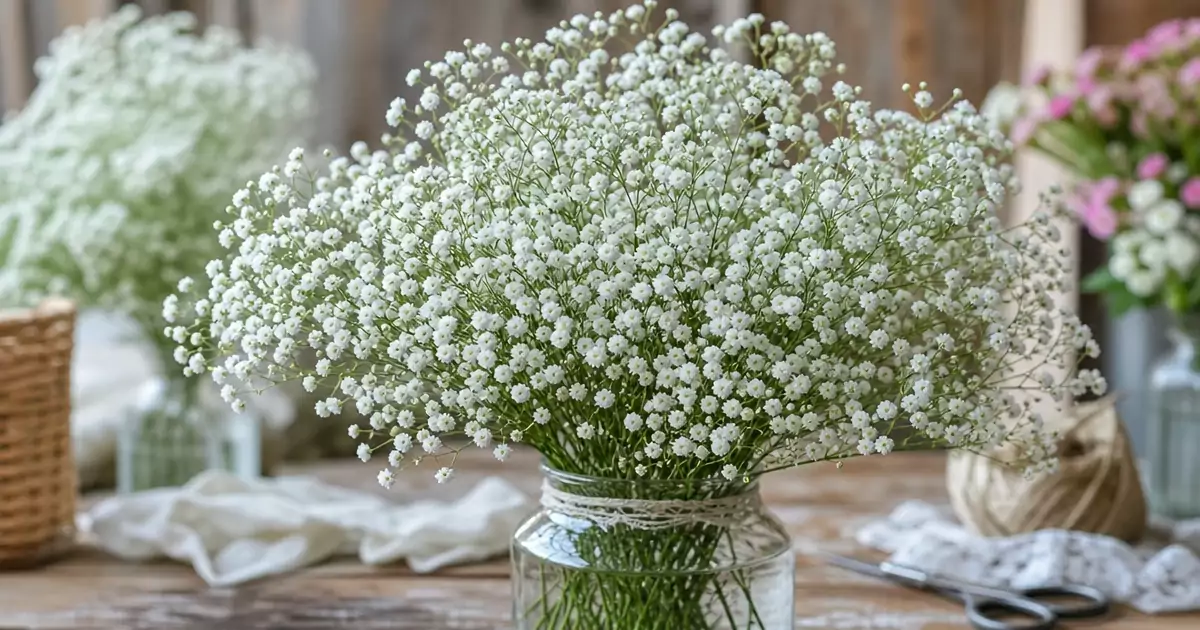
View full-size photoGypsophila can be kept fresh in a vase or dried for arrangements.
limonium (statice) — tiny white, lilac or blue flowers that dry beautifully;
waxflower (Chamelaucium) — small waxy blooms with a light citrus scent;
solidago — fluffy yellow plumes for warm autumn bouquets;
feverfew (matricaria) — mini daisies with a country feel;
astrantia and eryngium — textured accents for modern designer bouquets.
Gypsophila bouquets: what to pair it with
A mono-bouquet or gypsophila in a box: an airy cloud that looks tender and modern.
With red roses: a classic contrast of passion and tenderness.
With white roses or peonies: a wedding classic.
With daisies, lavender and grasses: a wildflower look.
Dyed gypsophila: for bright birthday bouquets.
Gypsophila at weddings
A bridal bouquet made entirely of gypsophila is light, affordable and photogenic.
Buttonholes, flower crowns, hair pieces and arches.
After the wedding, gypsophila is easy to dry as a keepsake.
Gypsophila bouquets
Gypsophila in a box or roses with gypsophila make an airy gift that lasts and later becomes a dried arrangement.
Both: baby’s breath (G. paniculata) is perennial, G. elegans is annual.
How long does gypsophila last in a vase?
7–10 days, after which it dries while keeping its shape.
Is gypsophila toxic?
It contains saponins and can upset the stomach of cats and dogs, so keep it away from pets.
When does gypsophila bloom?
In the garden from June to August; cut gypsophila is available all year.
Author: Maria Svitlovir
Graduated from Taras Shevchenko National University of Kyiv, Institute of Biology and Medicine (2001). BSc in Biology, MSc in Horticulture. Writes about plants, works at a garden centre selecting and repotting plants, and contributes to plant reference guides.







 Birthday
 Hydrangeas