
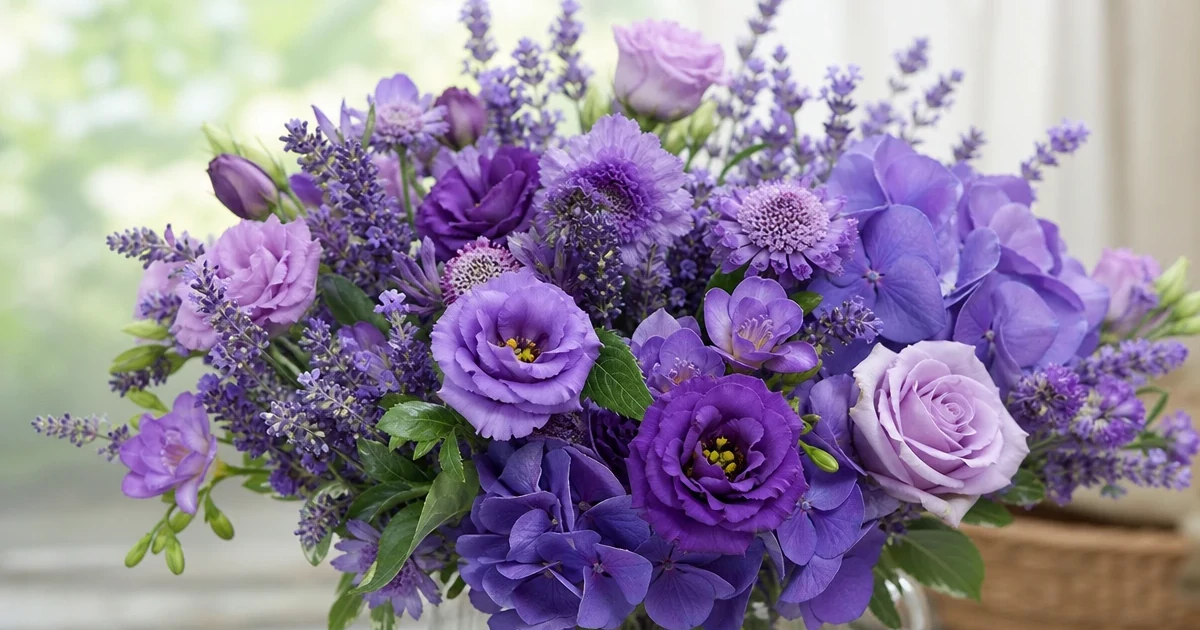
Prepared with UFL flower delivery. Purple flowers appear in bouquets less often than pink or white ones, which is a shame: the colour looks noble and mysterious and, in the language of flowers, means admiration. Here are 12 purple flowers for bouquets, the main shades and florist tips. More flowers with photos, names and meanings are in our guide to types of flowers.
Purple is a whole palette, from pale lavender to deep plum. Light shades make a bouquet tender; dark ones make it formal.
Purple and lilac roses range from lavender to deep plum. Popular cut varieties are Ocean Song, Memory Lane, Deep Purple and Cool Water; garden favourites include Blue Moon, Rhapsody in Blue and Ebb Tide. They pair well with white, pink and green flowers, eucalyptus and berries. Bouquets: ufl.ua/en/kyiv/catalog/roses-kyiv.
Lush heads from pale lilac to purple. The colour of bigleaf hydrangea depends on soil: acidic turns it blue, alkaline turns it pink, and in between it can be purple. Hydrangeas are almost scentless, so they suit allergy sufferers; roses, lisianthus and callas pair well with them. Bouquets: ufl.ua/en/kyiv/catalog/buket-z-hortenziiamy-kyiv.
Freesia comes from South Africa. Its lilac and purple flowers have a fresh citrusy-floral scent, which makes them popular in wedding bouquets. It looks good alone or with roses, peonies and tulips.
Small purple spikes with a spicy scent. In a bouquet lavender adds line and texture and goes well with wildflowers and grasses. It keeps its colour and fragrance when dried.
Purple tulips range from soft lilac to almost black (Queen of Night): a spring classic that says admiration. Bouquets: ufl.ua/en/kyiv/catalog/fioletovi-tyulpany-kyiv.
Dendrobium and vanda come in rich purples and last up to three weeks when cut; a potted phalaenopsis is a long-lasting gift. Bouquets: ufl.ua/en/kyiv/catalog/orhidei-kyiv.
Delicate rose-like flowers; purple and white-edged lilac forms are among the most popular. It lasts up to two weeks.
Blue-violet flowers with a yellow blaze, a symbol of hope and wisdom. They open quickly, so keep them cool.
Dense, fragrant spikes; in the language of flowers a purple hyacinth means «forgive me». In season from February to April.
Lilac and purple spray chrysanthemums add volume and last 2–3 weeks.
May fragrance and lush panicles from white to deep purple. Cut lilac lasts a few days; split the stem and use cool water.
Purple anemones with a dark centre look graphic; in season in winter and spring.
Purple has long been a colour of status: natural purple dye was rare and costly, so only nobility and clergy could wear it. Hence its modern associations of luxury, dignity, wisdom and respect.
In the language of flowers, shades speak differently:
That makes a purple bouquet fitting for a teacher or a female manager, an anniversary, a graduation, or as a subtle sign of affection when red roses feel too direct.
If you love purple beyond bouquets, it is easy to stretch it across the whole garden season:
Purple visually pushes the boundaries of a plot back, so plant it at the back of a border with pale or silver plants in front — lamb’s ears, wormwood, white annuals. For cutting from your own garden, lilac, asters and lavender work best.
You can keep a purple accent at home all year with a potted plant:
A plant like this is a good alternative to a bouquet when you want a longer-lasting gift, and it can be paired with a few cut flowers in the same shade.
Admiration, nobility, mystery and creativity; lilac shades also stand for first love.
A woman with a bold personality, a creative person, or a colleague or boss as a sign of respect. Add pink for romance.
Not in nature. Blue roses are either dyed or genetically engineered, and they look more lilac.

Author: Maria Svitlovir
Graduated from Taras Shevchenko National University of Kyiv, Institute of Biology and Medicine (2001). BSc in Biology, MSc in Horticulture. Writes about plants, works at a garden centre selecting and repotting plants, and contributes to plant reference guides.
© Kyiv 2026 UFL Flower Shop

Trademark UFL №191476 is used under license of the rights holder.
All rights reserved. Any use of materials without a link to the site is prohibited.


 Birthday
 Hydrangeas


