
 Birthday
 Hydrangeas
Prepared with UFL flower delivery. The African violet is one of the most popular windowsill plants, with tens of thousands of cultivars. To make sense of them, growers use several classifications: by rosette size, flower shape, colour pattern and leaf type. Here is each one with photos.
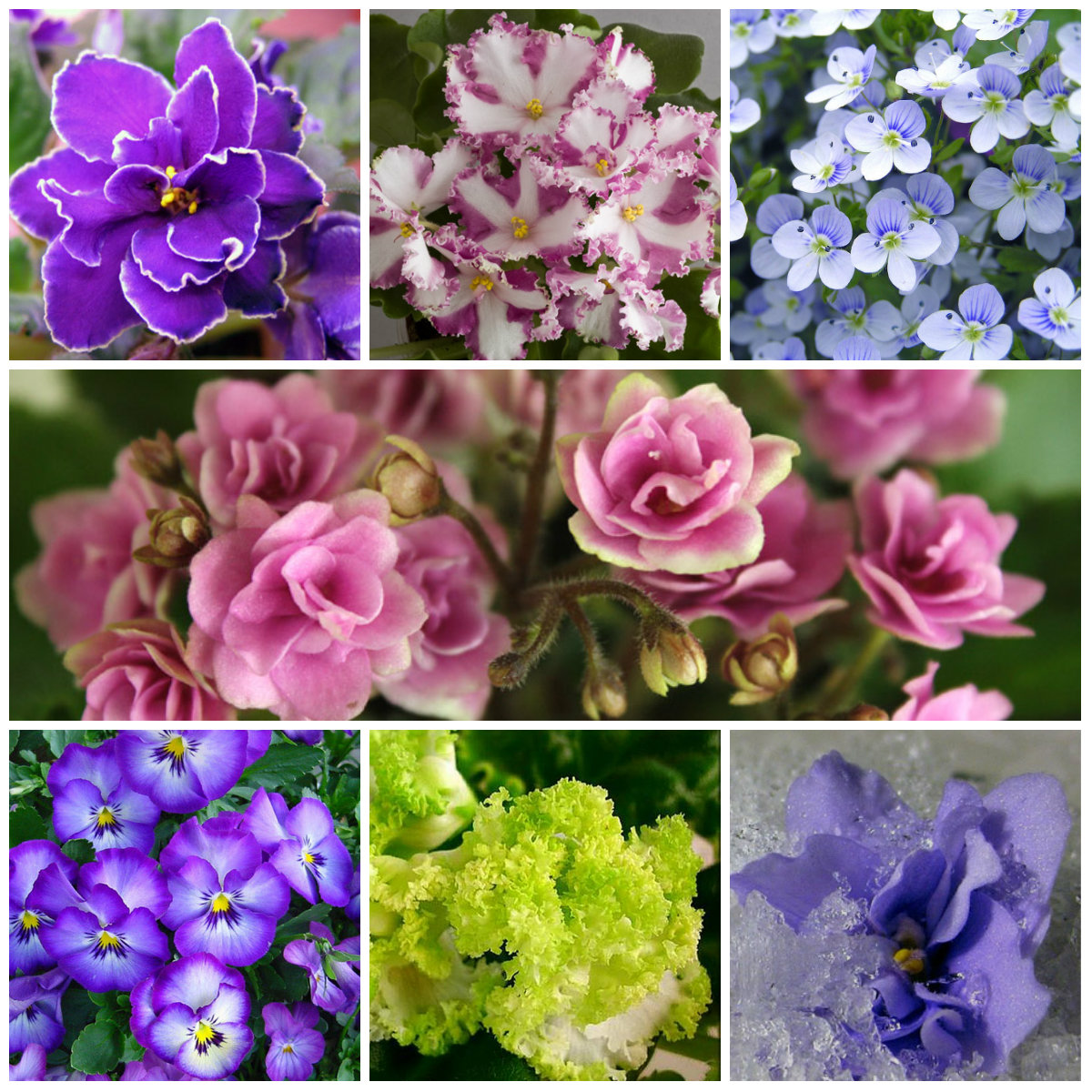
Saintpaulia or violet: what is the difference
What we call an indoor violet is the Saintpaulia, or African violet. It comes from the mountains of East Africa (Tanzania and Kenya) and is not related to true violets and pansies (genus Viola). Since 2015 botanists have placed Saintpaulia within the genus Streptocarpus, but the familiar name has stuck in shops and among collectors.
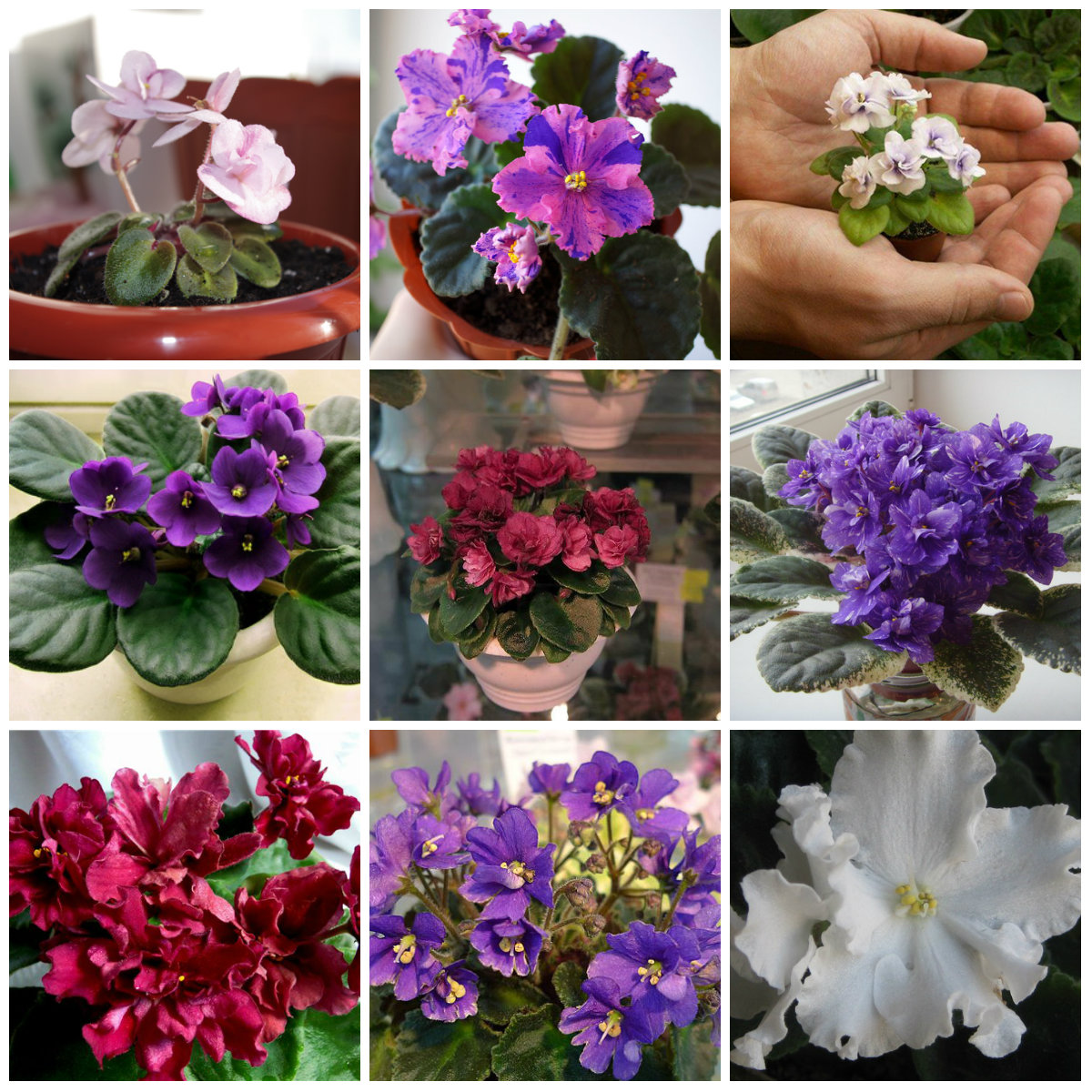
By rosette size
Size is measured as the diameter of a mature leaf rosette.
- Micro-mini — up to 8 cm, grown in thimble-sized pots.
- Miniature — 8–15 cm.
- Semi-miniature — 15–20 cm.
- Standard — 20–40 cm, the most common group.
- Large — over 40 cm, sometimes up to 60 cm.
Trailers form a separate group, with several crowns and cascading stems.
By flower shape
- Single — one row of five petals in a flat plane.
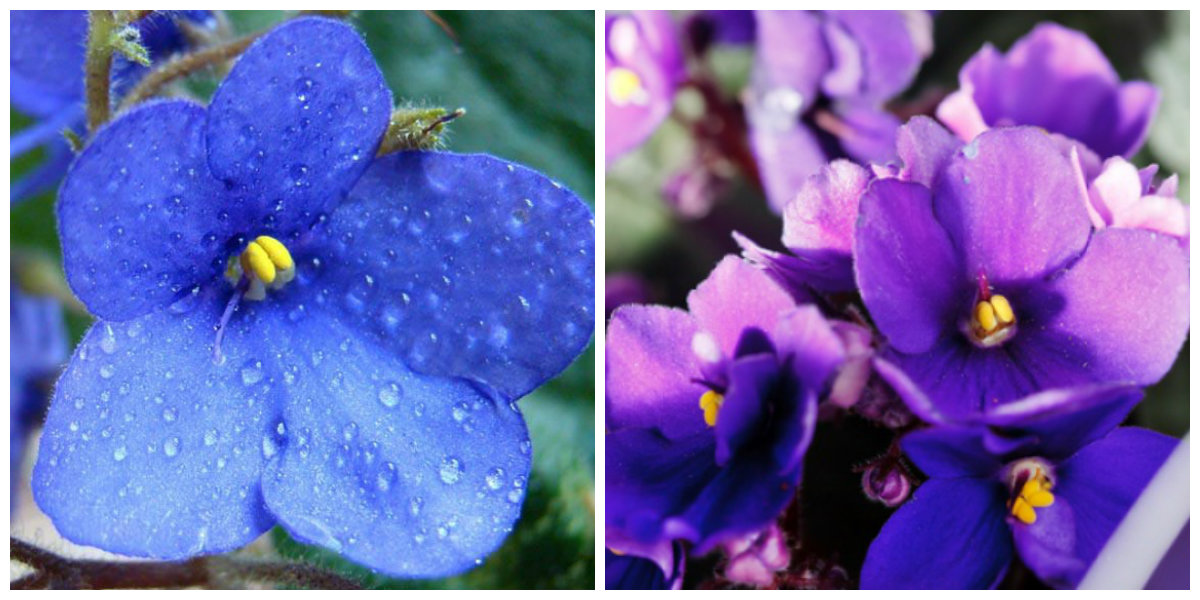
- Semi-double — a few extra small petals in the centre.
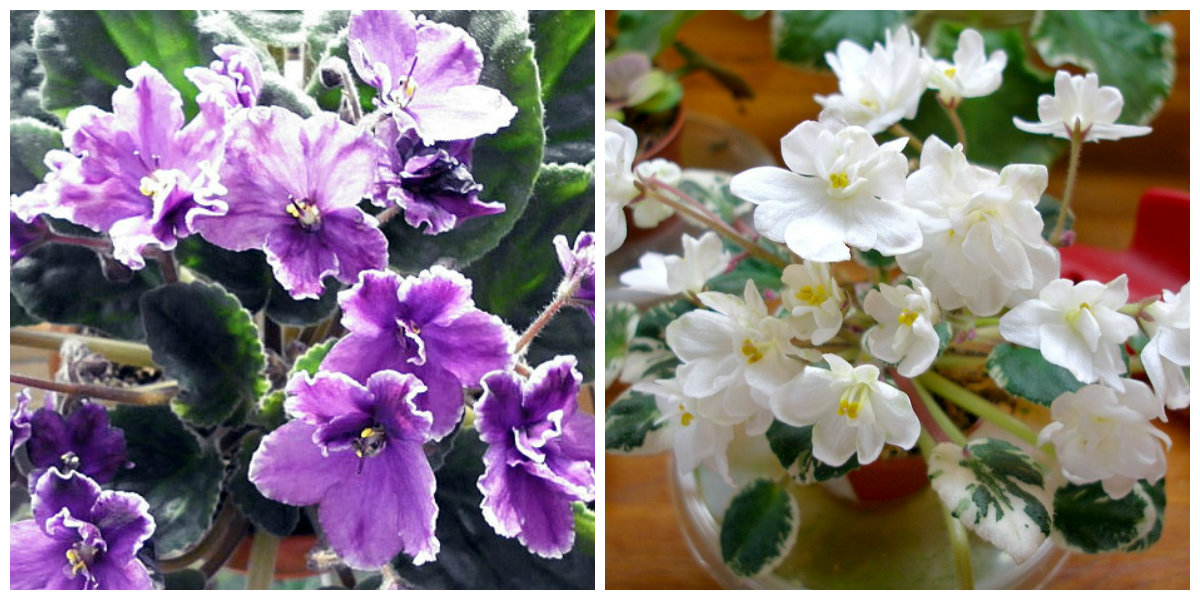
- Double — two or three full rows of petals; the flower looks like a tiny rose.
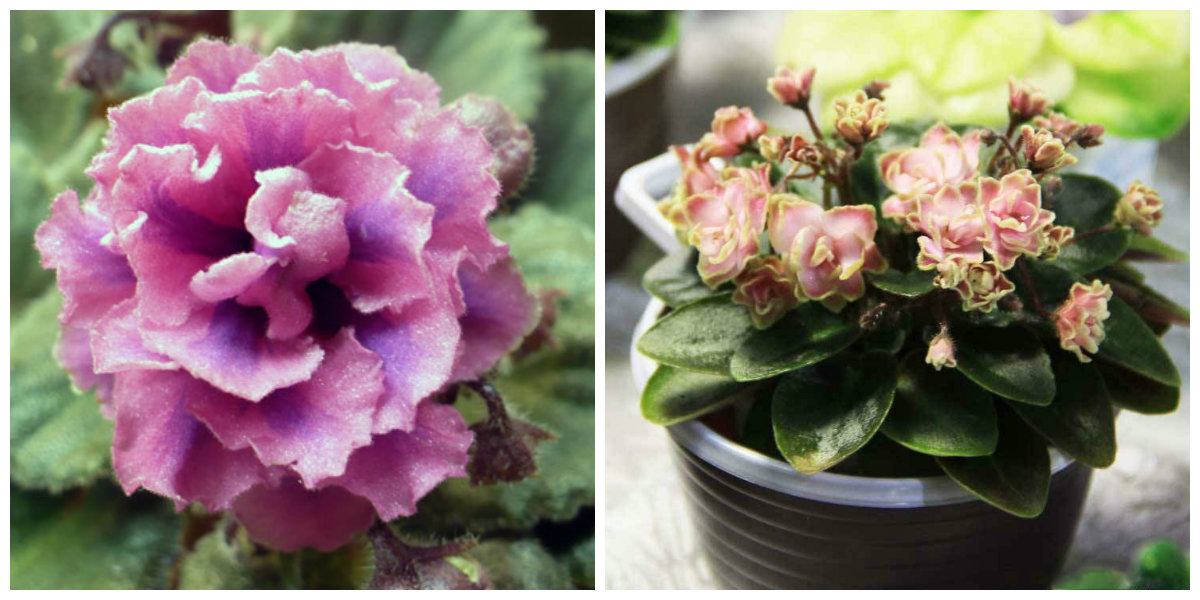
There are also star flowers with equal petals, bell flowers with fused petals, wasp flowers with narrow curled petals and ruffled types with wavy edges.
By colour pattern
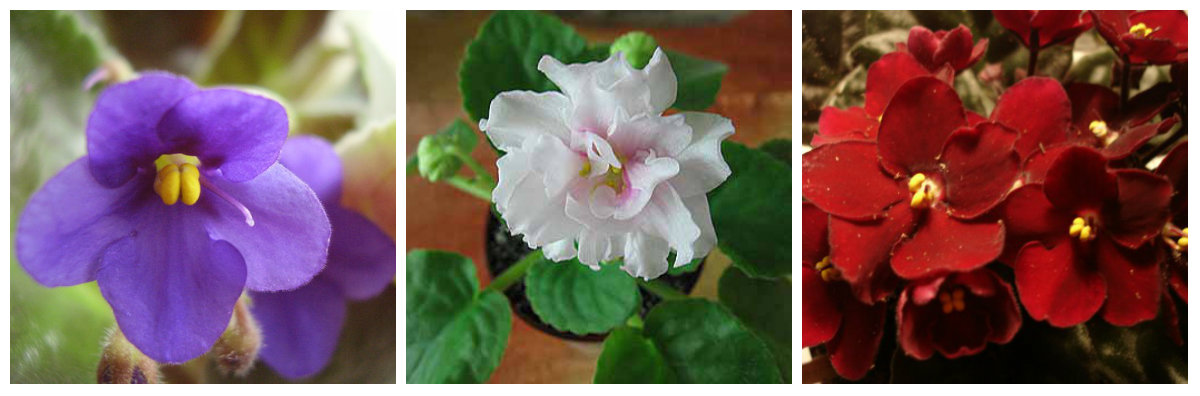
- Solid — evenly white, blue, pink, burgundy or purple.
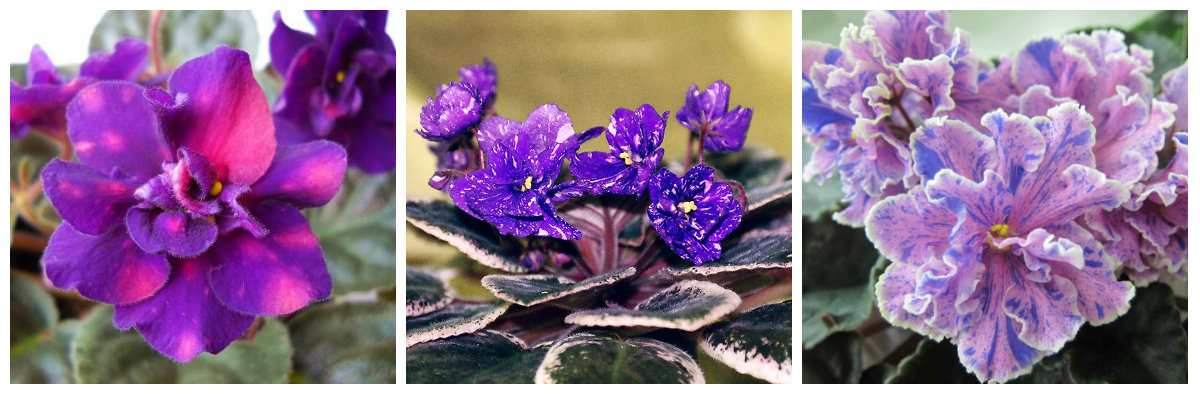
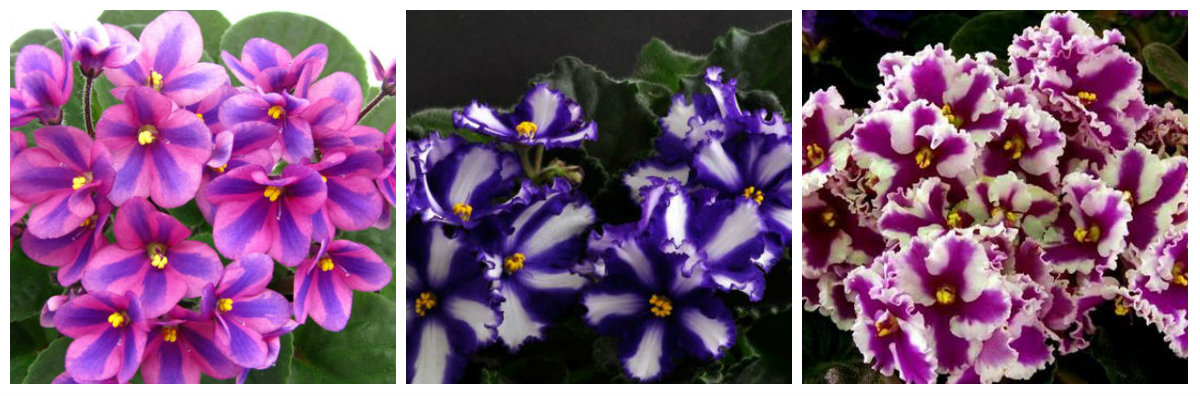
- Fantasy — petals speckled, dotted or streaked with another colour.
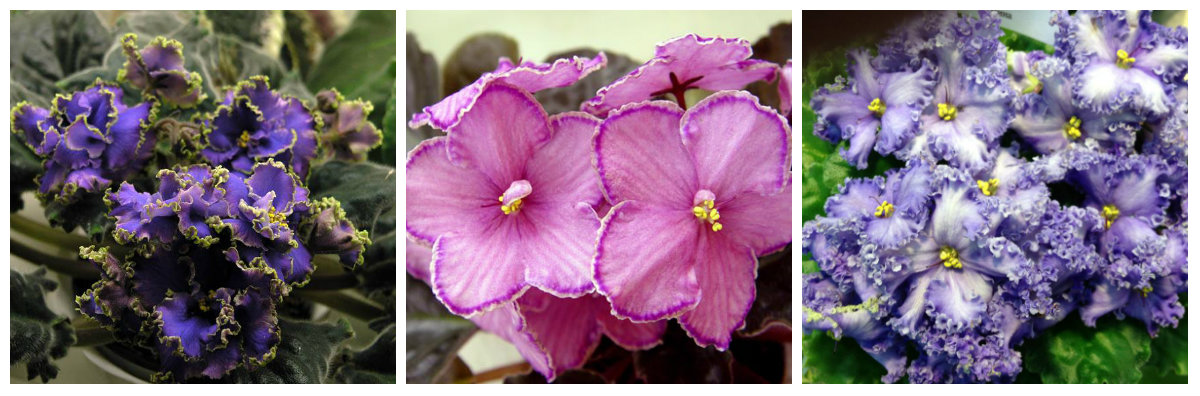
- Edged — petals with a border in another colour, often white or green.
- Chimera — a stripe of another colour running down the centre of each petal like the spokes of a wheel. Chimeras do not come true from leaf cuttings, which makes them prized by collectors.
By leaf type
People used to believe you could tell a violet’s «sex» by its leaves: «boys» have plain green leaves and «girls» have a pale spot at the base. Plants have no sex in this sense; «boy» and «girl» are simply names for leaf types in the standard classification. There are also variegated leaves (with white, cream or pink patterns), wavy, spooned and serrated ones.
Notable breeders and series
- Optimara — commercial varieties most often sold in florist shops: tough and free-flowering.
- Rob’s (Rob Robinson, USA) — miniatures and trailers such as Rob’s Vanilla Trail.
- LE- (Olena Lebetska, Vinnytsia) — one of the best-known Ukrainian breeders, whose large double-flowered varieties are grown worldwide.
A prefix before the cultivar name usually identifies the breeder.
African violet care in brief
| Factor | What it needs |
|---|---|
| Light | Bright, indirect, 10–12 hours a day; a grow light in winter |
| Temperature | 18–24 °C, no draughts |
| Watering | Settled lukewarm water from below or via a wick; keep it off the leaves |
| Pot | Small: about a third of the rosette diameter |
| Soil | Light and airy, with perlite or vermiculite |
| Feeding | Every 2 weeks while flowering, with African violet fertiliser |
If a violet will not flower, the usual causes are too little light, an oversized pot or too much nitrogen.
FAQ
How long does an African violet live?
A rosette stays attractive for 3–4 years; after that, restart it by rooting the crown or a leaf.
Can I wash African violet leaves?
Yes, under a lukewarm shower, but let the plant dry in the shade: water droplets in sunlight leave spots.
How do I propagate an African violet?
The easiest way is a leaf cutting in water or light soil. Plantlets appear in 1–2 months and flower in about a year.
Looking for a flowering plant as a gift? Browse houseplants delivered in Kyiv.
Read also

View full-size photo
Author: Maria Svitlovir
Graduated from Taras Shevchenko National University of Kyiv, Institute of Biology and Medicine (2001). BSc in Biology, MSc in Horticulture. Writes about plants, works at a garden centre selecting and repotting plants, and contributes to plant reference guides.


