
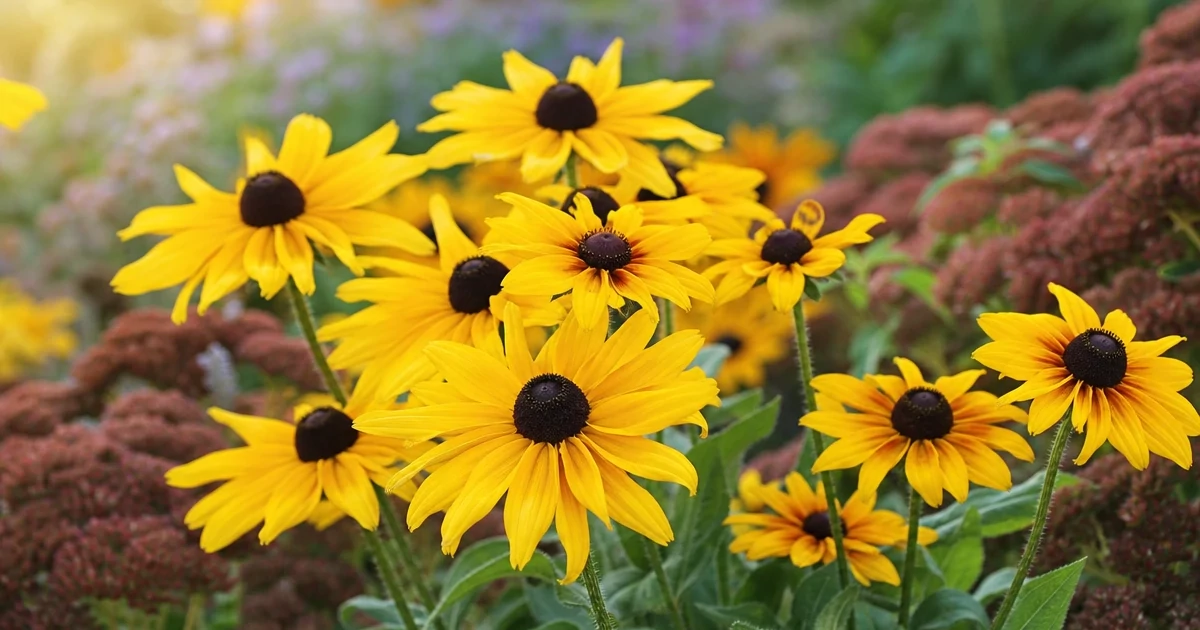
Rudbeckia gives the garden golden and terracotta daisies with a dark domed centre from July until the frosts. It is easy, drought-tolerant and combines beautifully with echinacea, grasses and asters in autumn borders. Here are the annual and perennial types, planting, care and propagation.
Rudbeckia is drought-tolerant; established plants need water only in prolonged heat. Add compost in spring and deadhead to extend flowering, leaving a few heads for birds in winter. Tall varieties need support. Perennial clumps spread, so divide them every 3–5 years in spring. R. hirta self-seeds freely.
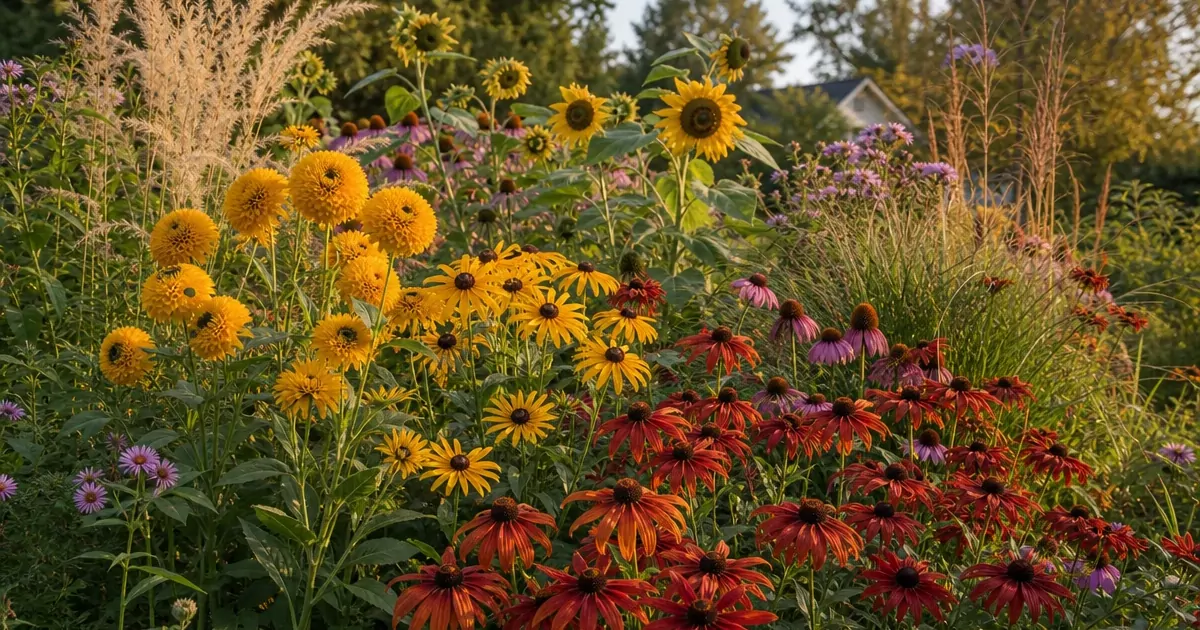
View full-size photoDifferent types and varieties of rudbeckia combined with other autumn flowers.
Cut rudbeckia lasts up to 10 days in a vase and brings warm autumn tones alongside sunflowers, chrysanthemums, hypericum and grasses. In the garden it is a star of naturalistic borders with echinacea, asters and salvia. More in autumn flowers and flowers that bloom all summer; the full A–Z is in types of flowers.
Both: black-eyed Susan is often grown as an annual, while Goldsturm and cutleaf coneflower are long-lived perennials.
From July to September–October, until the first frosts.
No, perennial types are hardy; just avoid waterlogging.

Author: Maria Svitlovir
Graduated from Taras Shevchenko National University of Kyiv, Institute of Biology and Medicine (2001). BSc in Biology, MSc in Horticulture. Writes about plants, works at a garden centre selecting and repotting plants, and contributes to plant reference guides.
© Kyiv 2026 UFL Flower Shop

Trademark UFL №191476 is used under license of the rights holder.
All rights reserved. Any use of materials without a link to the site is prohibited.

 Birthday
 Hydrangeas