
 Birthday
 Hydrangeas
Slippery jacks (Suillus) get their name from the shiny, slightly sticky cap that looks as if it has been oiled. These pored mushrooms are among the most common and tasty finds in Ukraine’s pine forests. There is no single poisonous «false slippery jack», but some mushrooms growing nearby are easy to confuse with them, so it pays to know the differences.
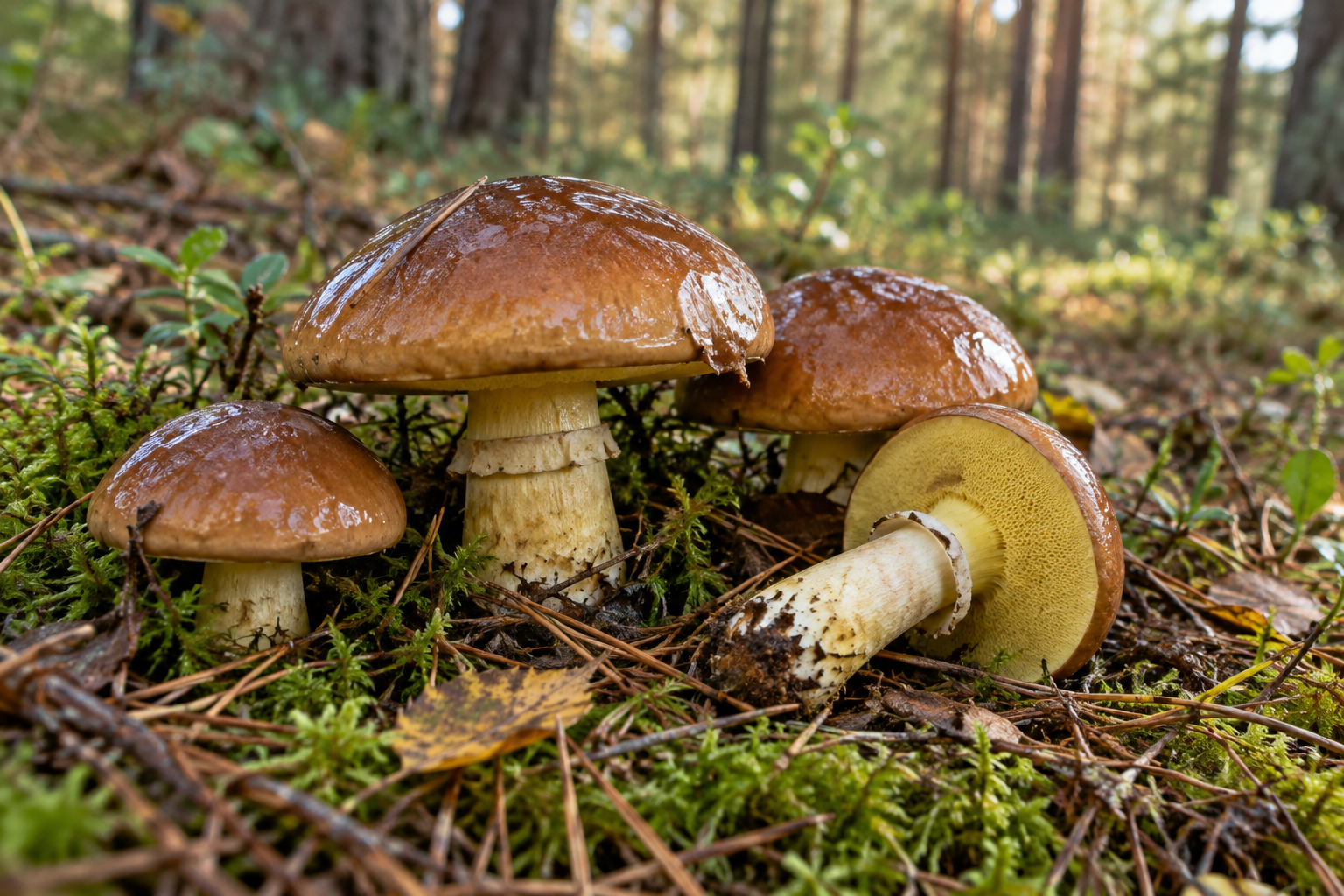
What a slippery jack looks like
- Cap: 3–12 cm, convex, flattening with age. The skin is glossy and slimy, especially after rain, from yellow to chocolate brown.
- Underside: a sponge of tubes, yellow turning olive with age — no gills.
- Stem: firm, up to 10 cm, often with a membranous ring left by the veil that covers the young pores.
- Flesh: pale yellow and juicy; in some species it turns slightly blue when cut.
Young mushrooms with caps under 5 cm taste best; older ones get watery and wormy.
Where and when to forage
Slippery jacks partner with conifers, so look in pine forests, young plantations, under larches and along sunny forest edges. The first appear in June, with the main season from August to October, especially 2–3 days after warm rain. Avoid roadsides and industrial areas: mushrooms accumulate heavy metals.
Species found in Ukraine
- Slippery jack (Suillus luteus) — slimy brown cap and a white ring; under pines from July until frost.
- Weeping bolete (S. granulatus) — orange-yellow cap, no ring, granular dots on the stem and milky droplets on young pores.
- Larch bolete (S. grevillei) — bright yellow to orange with a ring; only under larches.
- Grey larch bolete (S. viscidus) — greyish-olive cap, flesh turns blue when cut.
- Velvet bolete (S. variegatus) — almost dry, finely scaly cap, flesh bluing slightly; edible but less tasty.
- Bovine bolete (S. bovinus) — rusty cap, wide angular pores, no ring; edible, turns pinkish-purple when cooked, which is normal.
Look-alikes
- Peppery bolete — small, with rusty-red pores and a burning taste. Not seriously toxic, but one can ruin a whole dish.
- Slimy spike cap (Gomphidius) — slimy cap, but gills underneath instead of a sponge. Edible, yet a different mushroom.
- Pored mushrooms with red pores and flesh that turns sharply blue — leave them unless you are sure of the species: some are poisonous.
The most dangerous mistake is not confusing slippery jacks with their look-alikes but picking unfamiliar gilled mushrooms. Death cap, fly agarics and false honey fungi can be deadly.
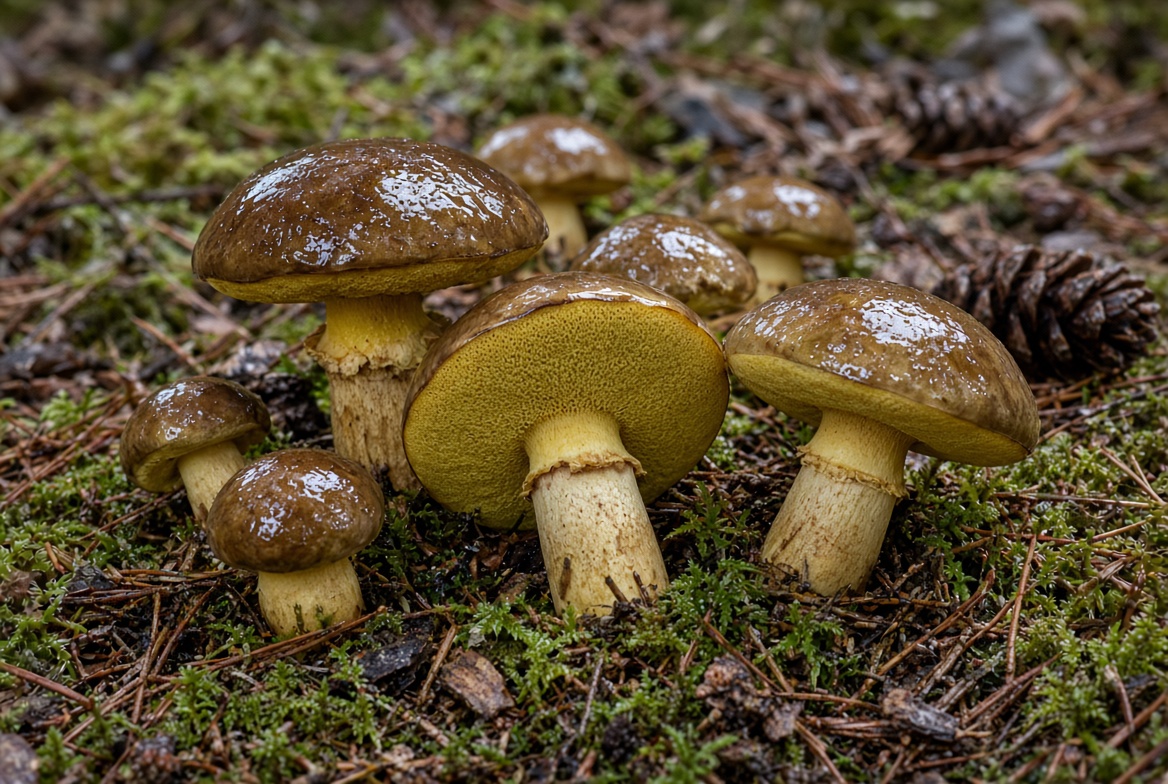
How to recognise a real slippery jack: 7 signs
- A sponge of small pores under the cap, not gills.
- The pores are yellow or olive, never red or pink.
- The cap skin is slimy and peels easily.
- It grows under a pine or larch.
- It smells pleasantly mushroomy and does not taste bitter or peppery.
- The flesh is firm and does not change colour, or turns only slightly blue or pink.
- A ring, if present, is white or yellowish and membranous.
If you feel unwell after eating mushrooms
Symptoms can appear within half an hour to several hours (6–24 hours for death cap): nausea, vomiting, stomach pain, diarrhoea, weakness, dizziness.
- Call an ambulance straight away (103 or 112 in Ukraine), even if you start to feel better.
- Keep any leftover mushrooms or food to show the doctors.
- Sip water while waiting, avoid alcohol and do not self-medicate.
Cleaning and cooking
- Sort the mushrooms on the day you pick them: they spoil and get wormy fast.
- Peel the slimy cap skin — it is bitter and stains fingers, so wear gloves. It comes off more easily while the mushrooms are dry.
- Trim the stem base, rinse quickly and do not soak: they absorb water.
- Boil in salted water (1 tsp per litre), skimming off foam: 10–15 minutes before frying, 20 for soup or freezing, 30 before pickling. A pinch of citric acid keeps them light.
- They are best fried with onion or pickled; they are dried less often because they darken.
Mushrooms are heavy to digest and are not recommended for young children, pregnant women or people with digestive conditions.
FAQ
Are there poisonous slippery jacks?
No true Suillus species is seriously poisonous; a few are only conditionally edible. The risk lies in confusing them with other mushrooms.
Why does the flesh turn blue?
In some species, such as the grey larch bolete and velvet bolete, the flesh oxidises in air. That is normal for them.
Do I have to peel the cap?
It is best to: the skin is slimy, bitter and can upset digestion. It is sometimes left on small young mushrooms.
Read also

View full-size photo
Author: Maria Svitlovir
Graduated from Taras Shevchenko National University of Kyiv, Institute of Biology and Medicine (2001). BSc in Biology, MSc in Horticulture. Writes about plants, works at a garden centre selecting and repotting plants, and contributes to plant reference guides.