
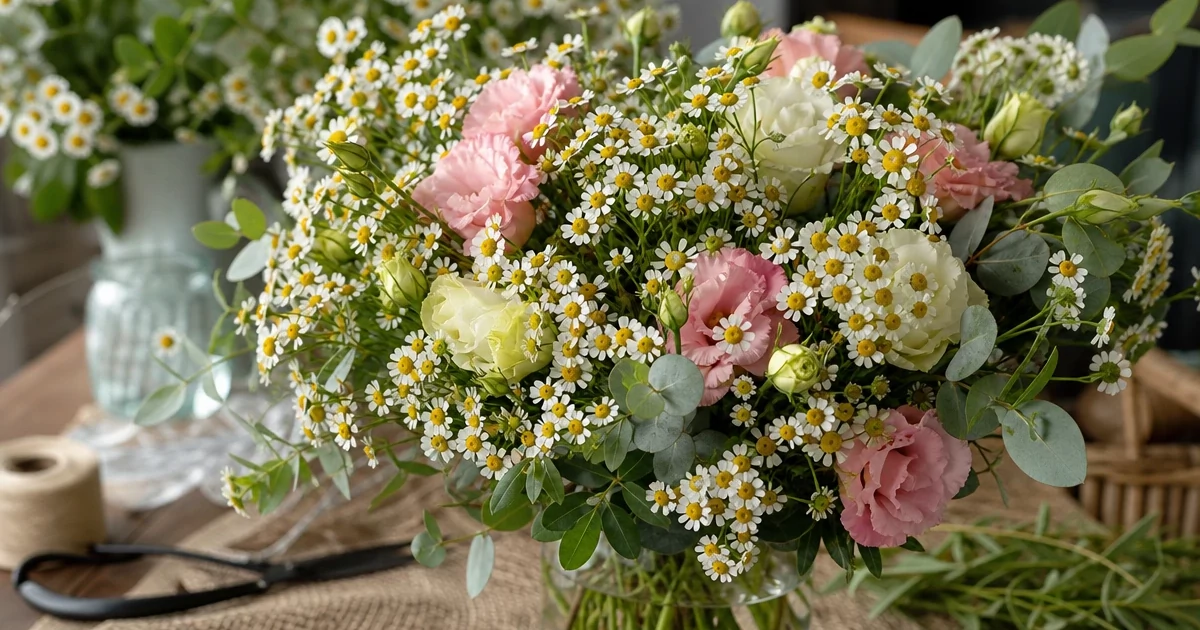
Tanacetum gives you those tiny yellow-centred “daisies” that make a bouquet look freshly picked from a meadow. Unlike true field daisies, it lasts well in a vase and does not drop petals, so florists use it all year round in both soft and bright summery arrangements. Here is what the plant is, which varieties exist and how to grow tanacetum in your own garden.
In floristry, tanacetum usually means feverfew (Tanacetum parthenium), a perennial of the daisy family and a close relative of tansy. It forms bushy plants 40–70 cm tall with lacy light-green foliage, topped by dozens of flower heads 1.5–2 cm across.
The leaves and flowers have a distinctive bitter scent — that is normal and barely noticeable in a bouquet. It is also the easiest way to tell tanacetum from similar daisies.
Tanacetum adds lightness and air, so it is tucked between larger blooms:
Find bouquets with small daisies in daisies.
Cut tanacetum usually lasts 7–10 days. Cut the stems at an angle, strip leaves below the waterline and change the water every 2 days. Yellowing leaves are the first sign the water needs refreshing. Tanacetum travels well, which is why it is popular in delivered bouquets.
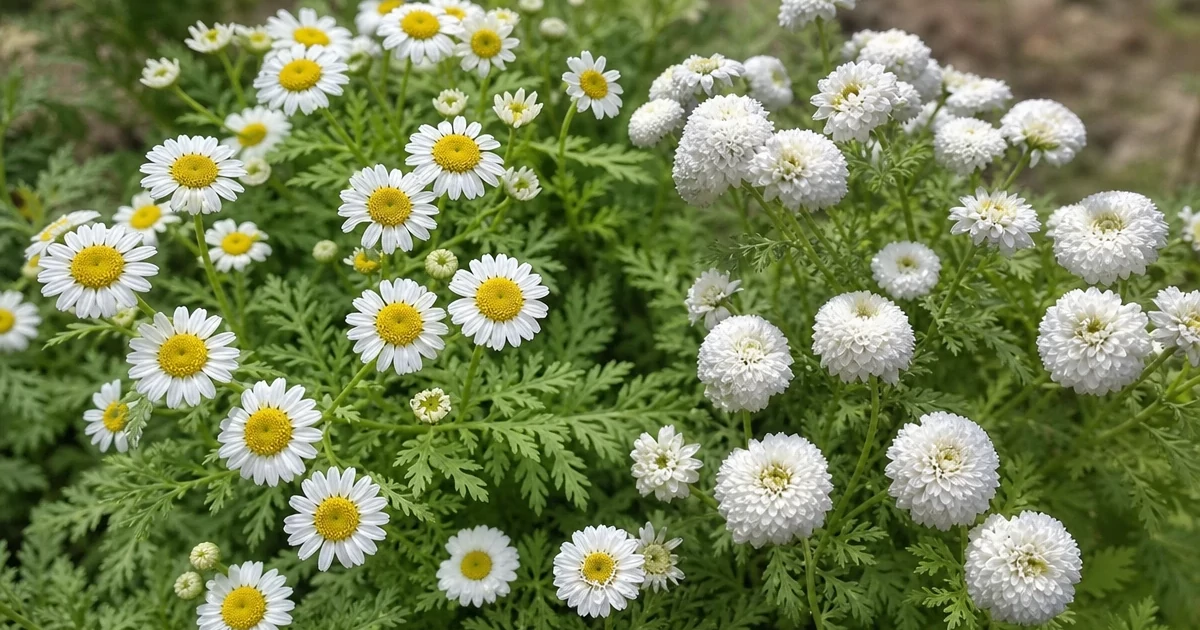
View full-size photoTanacetum comes in single and double varieties with different flower shapes
Feverfew is undemanding and suits beginners:
More bouquet flowers are in our florist’s glossary.
No. Tanacetum (feverfew) is a separate species of the daisy family. It looks similar but has smaller flower heads, a distinctive scent and a longer vase life.
The plant contains essential oils with a bitter scent. In a mixed bouquet it is barely noticeable.
No, cut stems will not root. Grow it from seed via seedlings instead.

Author: Maria Svitlovir
Graduated from Taras Shevchenko National University of Kyiv, Institute of Biology and Medicine (2001). BSc in Biology, MSc in Horticulture. Writes about plants, works at a garden centre selecting and repotting plants, and contributes to plant reference guides.
© Kyiv 2026 UFL Flower Shop

Trademark UFL №191476 is used under license of the rights holder.
All rights reserved. Any use of materials without a link to the site is prohibited.

 Birthday
 Hydrangeas