A peony can grow in one spot for 10–15 years, but sooner or later the clump needs moving: it has outgrown its space, stopped flowering or you are redesigning the garden. When and how you do it decides whether you see flowers next year or wait three. Here is when to transplant and divide peonies, how to get the planting depth right, how to cut them back in autumn and prepare them for winter. If yours will not flower, read why peonies don’t bloom. Woody varieties follow their own rules — see tree peony.
The clump is over 8–10 years old, has a bare centre and the flowers have become smaller.
The peony has not flowered for years, usually because it was planted too deep or nearby trees now shade it.
You want more plants of a favourite variety: dividing a mature peony gives 3–5 good divisions. Learn about peony types in our peony guide.
Autumn or spring?
The best time is from late August to late September, or until mid-October in the south. The heat has passed, next year’s buds have formed and there are 4–6 weeks before frost for new feeder roots to grow.
You can also move a peony in April, but only with a large root ball and without dividing it. It will take longer to recover and probably will not flower that year.
Avoid moving peonies in summer while they are growing and flowering: the plant puts its energy into leaves and flowers, so the roots establish poorly.
How to transplant and divide a peony
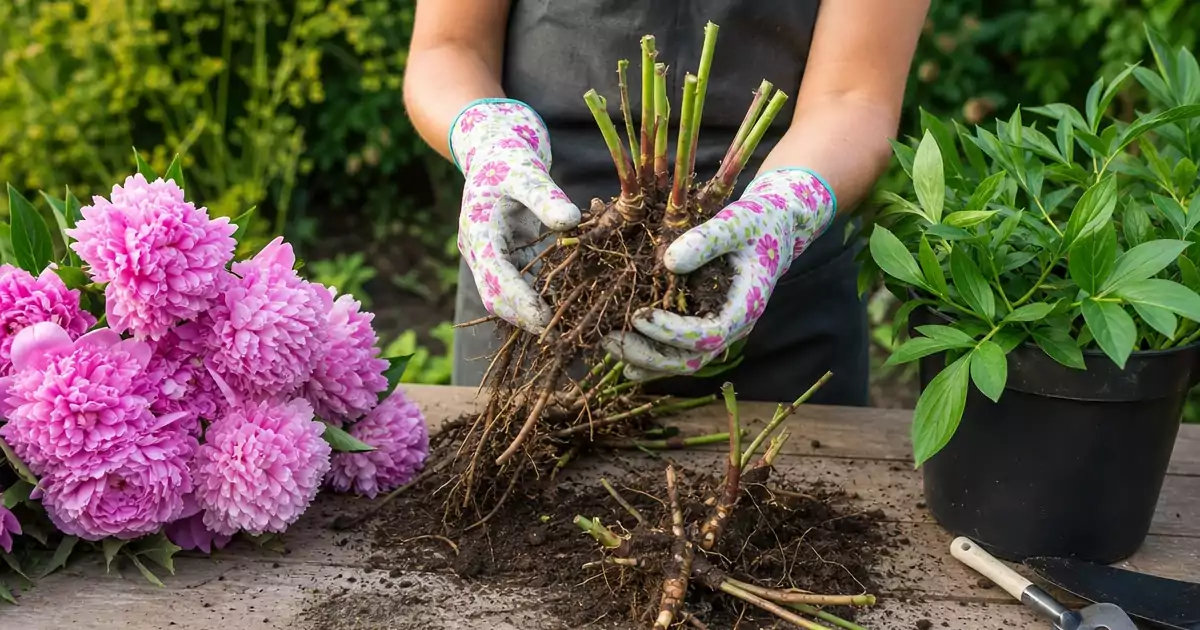
Cut the stems back to 10–15 cm, loosen the clump with a fork 25–30 cm from the stems and lift it gently without pulling on the stems. Peony roots are brittle, so take your time.
Rinse the roots and let them wilt in the shade for 2–3 hours so they become more pliable. With a disinfected knife, cut the clump into pieces with 3–5 buds and several 10–15 cm roots each.
Dust the cuts with charcoal or treat them with fungicide. Divisions that are too large establish poorly, and very small ones take years to flower.
Planting in the new spot
Choose a sunny spot with at least 6 hours of direct light, good drainage and away from tree roots and heat-reflecting walls. In shade a peony grows but does not flower.
Dig a hole 50–60 cm wide and deep and fill it with garden soil, well-rotted compost and sand, plus a handful of superphosphate and a cup of wood ash. Do not use fresh manure.
The key rule: the top buds of a herbaceous peony should sit 3–5 cm below the surface. Deeper and it will not flower; shallower and the buds may freeze. Tree peonies are the opposite: plant the graft union 10–15 cm deep.
Water well after planting and mulch with peat or compost. In its first year a moved peony focuses on roots, so expect flowers in 1–2 seasons.
Autumn pruning and feeding
Do not cut the leaves right after flowering: until autumn they feed next year’s buds. Cut stems after the first frosts once leaves yellow, leaving 3–5 cm stubs.
In autumn, use only phosphorus-potassium fertiliser without nitrogen, which reduces frost hardiness. Save nitrogen for spring growth.
Remove the cut foliage from the garden, and cover young plants with 10–15 cm of peat or compost for winter. Established peonies overwinter in Ukraine without cover. More autumn jobs in autumn garden care.
Peonies out of season
The cut peony season in Ukraine is short: late May and June. The rest of the year, peony roses with equally lush blooms take their place in bouquets. Read about them in peony roses, and see other peony look-alikes in flowers that look like roses, lilies and peonies.
Lush peony-style bouquets
While your peonies settle in, we can deliver a peony rose bouquet across Kyiv and Ukraine — just as soft and lush.
Graduated from Taras Shevchenko National University of Kyiv, Institute of Biology and Medicine (2001). BSc in Biology, MSc in Horticulture. Writes about plants, works at a garden centre selecting and repotting plants, and contributes to plant reference guides.






 Birthday
 Hydrangeas