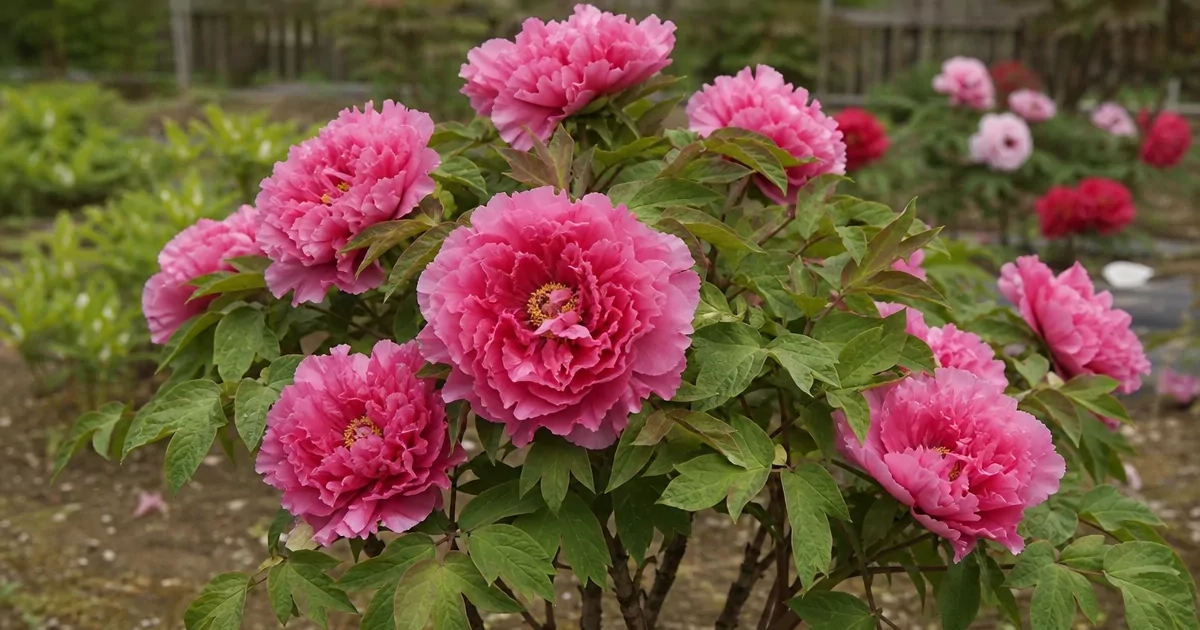
A tree peony is not a herbaceous plant that dies back every autumn but a true shrub with woody stems up to 1.5–2 m tall. Its huge flowers, up to 25 cm across, open in May about two weeks before ordinary peonies, and the plant can live and bloom for more than 50 years. Here are its varieties, planting, pruning and winter care. For hybrids of both groups, see Itoh peonies. Bloom dates and order of varieties: when do peonies bloom.
Native to China, where it is called the ‘king of flowers’ and has been grown for over 1,500 years. The stems become woody and do not die back, so the plant gets taller and fuller each year.
Flowers are larger, 15–25 cm, single, semi-double or double, in colours herbaceous peonies lack: yellow, lilac and near-black. It blooms in mid-May, 10–14 days earlier.
Crosses between tree and herbaceous peonies are called Itoh hybrids: sturdy stems, yellow and coral flowers, and they die back in winter like ordinary peonies. All groups are covered in our peony guide.
Varieties
Sino-European varieties with large double pink, white and red flowers adapt best to the Ukrainian climate.
Japanese varieties have lighter semi-double flowers with bright centres and suit an oriental-style garden.
Lutea hybrids produce rare yellow, apricot and deep maroon flowers and bloom slightly later than other tree peonies.
Planting
The best time is late August to September. Choose morning sun with light shade in the heat and shelter from wind. Tree peonies dislike being moved, so pick a permanent spot.
Soil should be loose, neutral to slightly alkaline and well drained. Fill a 70×70 cm hole with garden soil, compost, sand and a cup of dolomite lime over a drainage layer.
Unlike herbaceous peonies, a tree peony’s graft union goes 10–15 cm deep so the plant forms its own roots. For planting depth of ordinary peonies, see when to transplant peonies.
Pruning and care
Pruning is minimal: in spring as buds break, cut dead tips back to the first live bud. Rejuvenate old shrubs gradually by removing one or two of the oldest stems a year.
Water rarely but deeply (7–10 litres every 1–2 weeks); excess water is more dangerous than drought. Feed nitrogen in spring, a balanced fertiliser at budding and phosphorus-potassium after flowering.
Expect the first flowers 2–4 years after planting. If it takes longer, check the causes in why peonies don’t bloom.
Winter care
Mature plants survive −25…−30 °C, but the main threats are spring frosts that damage early buds and snow that breaks branches.
Cover young plants for their first 2–3 winters: mulch the base with peat, tie the stems together and wrap them in fleece. Remove the cover gradually in spring once warmth settles.
Lush bouquets with delivery
The peony season is short, so the rest of the year we make equally lush peony-rose bouquets and deliver them across Kyiv and Ukraine.
Graduated from Taras Shevchenko National University of Kyiv, Institute of Biology and Medicine (2001). BSc in Biology, MSc in Horticulture. Writes about plants, works at a garden centre selecting and repotting plants, and contributes to plant reference guides.






 Birthday
 Hydrangeas