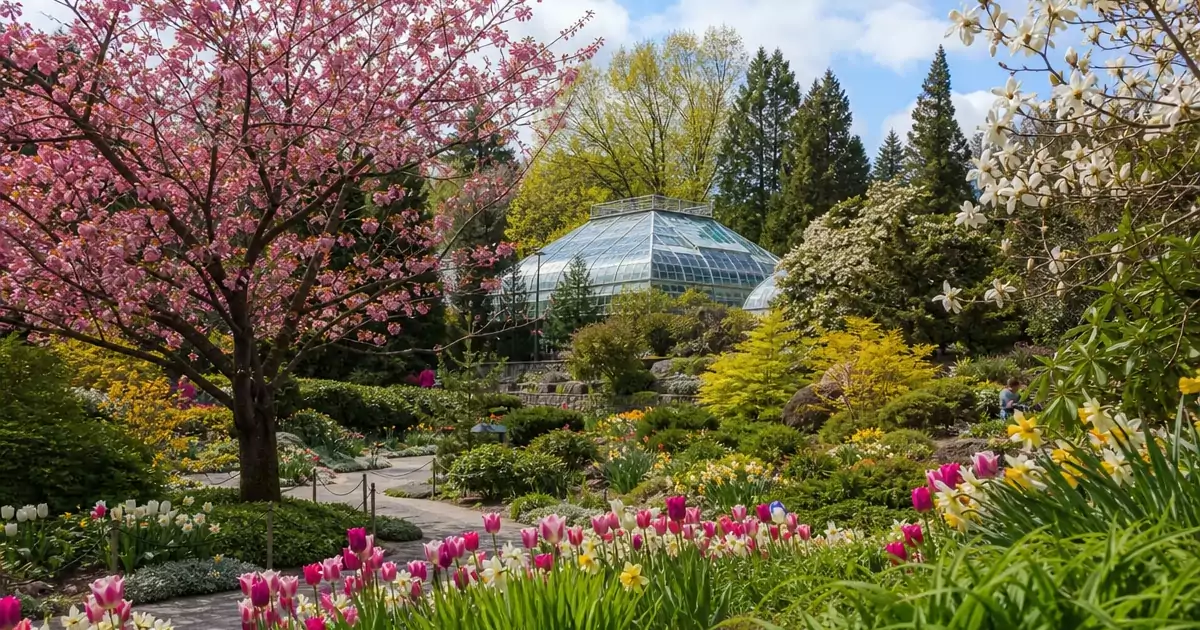
The M. M. Hryshko National Botanical Garden of the NAS of Ukraine (locally just “Hryshko botanical garden”) is Ukraine’s largest botanical garden and a favourite spring walk for Kyiv residents. Magnolias, a lilac collection, hundreds of peony varieties and the country’s largest rose garden bloom here, with views over the Dnipro and Vydubychi Monastery. Here is what blooms when, how to get there by metro, what a ticket costs, when the greenhouses are open and where to take the best photos.
Botanist Volodymyr Lypskyi proposed a large botanical garden for Kyiv back in 1918, and in 1935 the decision was made to create it at Zvirynets, on the Pechersk slopes above the Dnipro. Its collections were looted during the Nazi occupation, and after the war director Mykola Hryshko, whose name it now bears, rebuilt it. It officially opened to visitors in 1964.
Today it is the National Botanical Garden of the NAS of Ukraine, almost 130 hectares — the country’s largest by the diversity of its collections, with over 10,000 species, forms and cultivars from around the world. It sits on the hills between Zvirynets and Vydubychi Monastery, offering some of the best views of the Dnipro and the Left Bank. The address is 1 Sadovo-Botanichna St.
What to see: the gardens within the garden
Hryshko is really several themed gardens, each with its own season. The main ones:
The magnolia garden — planted in 1966; 10 species and over a dozen cultivars. Peak bloom is mid-April and lasts about two weeks.
The lilac garden — since 1948; over 1,500 bushes of about 90 cultivars, some bred in Ukraine. Loveliest in early May against the domes of Vydubychi Monastery. More in when lilac blooms.
The peony garden — about 565 cultivars of 9 species; blooms from mid-May to mid-June.
The rose garden — 3.5 hectares, Ukraine’s largest, over 500 cultivars; flowers in waves from June to October.
The Korean garden — opened in 2012; azaleas, rhododendrons and peonies, flowering April to June.
The mountain garden — plants of the Carpathians, Crimea and other mountain regions; interesting all year.
The glasshouse complex — over 2,000 m² of tropical and subtropical plants, including over 80 orchid species and cultivars, azaleas and camellias.
The cornelian cherry collection, which the garden calls one of the best in the world.
What is in bloom at Hryshko Botanical Garden: month by month
In spring people most often ask what is in bloom at the Kyiv botanical garden right now, but the garden is worth a visit all year. Below is an approximate calendar: dates shift by 1–2 weeks each year depending on the weather, so check the garden’s news before you go.
January–February: azaleas and camellias bloom en masse in the greenhouse, along with orchids — the best “tropical” walk in winter.
March: early spring bulbs and cornelian cherry, which flowers yellow before its leaves appear; the first magnolias open at the end of the month.
April: peak magnolia bloom, fruit trees flower and rhododendrons begin.
May: lilacs in the lilac garden, azaleas and rhododendrons, tree peonies; more in our article when lilac blooms.
June: herbaceous peonies and the first flush of roses in the rose garden.
July–August: roses and summer flower beds.
September–October: the second flush of roses, autumn colour on maples and oaks, cornelian cherry fruit. In autumn the garden often hosts chrysanthemum shows — look for announcements on its website.
November–December: the main draw is the greenhouses with tropical plants and orchids.
Opening hours, ticket prices and greenhouses (2026)
Hryshko Botanical Garden is open daily. The details below are current at the time of writing (2026); hours and prices can change, so check the garden’s official website before you go.
May (lilac season): 7:00–22:00, ticket office 8:00–21:30.
June–August: 8:30–21:00.
September–April: from 8:30 until dusk.
Greenhouses: in the warm season Wed–Fri 11:00–17:00, Sat–Sun 10:00–17:00 (last tickets 16:30); in winter Wed–Fri 11:00–16:00, Sat–Sun 11:00–17:00. Closed Monday and Tuesday.
Ticket prices: adults and students — 150 UAH, schoolchildren — 100 UAH. Greenhouse entry is paid separately — another 100 UAH. Free entry for children under 6, pensioners by age, war veterans, people with group I–III disabilities and combat veterans with ID.
During an air-raid alert ticket sales may be paused and the greenhouses closed, so check the situation in the city before setting off.
How to get to Hryshko Botanical Garden: address and metro
Address: 1 Sadovo-Botanichna St, Kyiv (Pecherskyi district). The nearest metro stations are Pecherska and Zvirynetska on the green line.
From Pecherska metro: bus 62 or trolleybus 14 to the last stop, “Botanichnyi Sad”; the ride takes 15–20 minutes.
From Zvirynetska metro: you can walk to the garden.
By car: there is parking by the garden, but it fills up at weekends and during peak bloom, so the metro is easier.
A 2–3 hour route through Hryshko
The garden is large and hilly, so plan your route. A convenient option from the main entrance:
The glasshouse complex — start here if you come Wednesday–Sunday: orchids, palms, azaleas and camellias.
The magnolia garden — the key stop in April; then head down the slope.
The Korean garden — azaleas, ponds and Far Eastern-style bridges.
The lilac garden — a viewpoint over Vydubychi Monastery and the Dnipro; busiest in May.
Taras Shevchenko’s mulberry by Vydubychi Monastery — 150–200 years old, about 10 m tall with a 3.4 m girth; legend says the poet rested beneath it.
The rose and peony gardens — at the end of the route in June.
The mountain garden — Carpathian and Crimean plants and fine views.
There is another entrance near Vydubychi Monastery, so you can walk right through and leave from the other side — just check that entrance is open on the day.
What visitors value most
Kyiv guides and media reports about Hryshko Botanical Garden most often mention a few things:
Views — a panorama of the Dnipro and Vydubychi Monastery from the hills, especially in lilac season.
Size — almost 130 hectares, enough to walk for half a day without repeating a route.
Seasonal events — magnolias, lilacs and peonies that bring Kyiv residents back every year.
The greenhouse in winter — azaleas and camellias bloom while there is still snow outside.
Photo spots — the lilac garden, the rose garden and the Korean garden.
The most common tip is to come on a weekday morning at peak bloom, because weekends are very crowded.
In the city centre, by Universytet metro, is Kyiv University’s O. V. Fomin Botanical Garden, the oldest in Kyiv, with a tall palm house and a cactus collection. It is smaller but easy to combine with a city walk.Read more in Fomin Botanical Garden, and see our guide to botanical gardens of Ukraine.
Tips for your visit
Magnolias: late March–April; lilac: early May; peonies: late May; roses: summer.
Come on a weekday morning; peak-season weekends are crowded.
Wear comfortable shoes: the garden is large and hilly.
Do not pick flowers or branches; it harms the collections and is forbidden.
Check opening hours and air-raid alerts before you go.
Flowers after your walk
You can’t take the garden’s peonies, lilac and roses home, but you can order a similar bouquet: flowers delivered in Kyiv, delivered on the day of your date.
At the time of writing (2026), 150 UAH for adults and 100 UAH for schoolchildren. Check before visiting.
When do the magnolias bloom?
Roughly late March to mid-April.
How do I get there?
Walk from Zvirynetska metro, or take bus 62 or trolleybus 14 from Pecherska. Address: 1 Sadovo-Botanichna Street.
When does the lilac bloom?
Usually early May, or late April in warm years.
When did the garden open?
It was created by a 1935 decision and officially opened to visitors in 1964.
How many species does it have?
Over 10,000 species, forms and cultivars — about 565 peony cultivars and over 500 roses alone.
Where is Shevchenko’s mulberry?
Near Vydubychi Monastery within the garden; the tree is 150–200 years old.
Author: Maria Svitlovir
Graduated from Taras Shevchenko National University of Kyiv, Institute of Biology and Medicine (2001). BSc in Biology, MSc in Horticulture. Writes about plants, works at a garden centre selecting and repotting plants, and contributes to plant reference guides.







 Birthday
 Hydrangeas


