Hydrangea is one of the most striking bouquet flowers: a single flower head replaces several roses. It's also one of the fussiest in a vase: hydrangeas drink a lot and lose water through their petals, so without proper care they can wilt within a day. The good news is they're easy to revive. Here's how to care for hydrangeas in a vase so the bouquet lasts up to two weeks, and how to rescue a drooping head.
Hydrangeas have a huge petal surface that constantly loses moisture, and the woody stem contains sap that can block its vessels after cutting. Water simply can't rise fast enough to the flower head, so it loses firmness. That's what sets hydrangeas apart from roses and chrysanthemums, which do fine with the standard care described in how to make a bouquet last longer.
How to care for hydrangeas in a vase
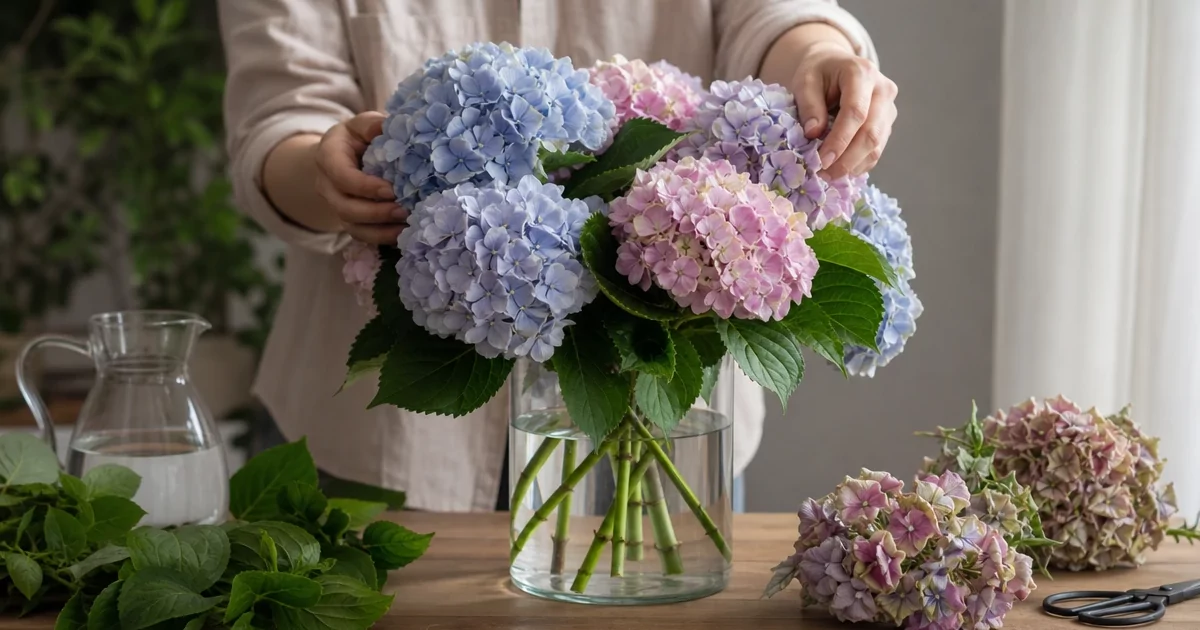
Choose a tall, deep vase and fill it almost to the top with cool water. Dissolve a sachet of cut-flower food; we include one with UFL bouquets. Cut the stem at an angle with a sharp knife and split the end by 2–3 cm to increase the drinking surface. Some florists also dip the stem end in boiling water for 20–30 seconds to dissolve the sap; protect the petals from steam if you do.
Top up the water daily and change it fully every 1–2 days, recutting the stem. Mist the flower head morning and evening: hydrangeas absorb moisture through their petals. Keep the bouquet away from radiators, air conditioning and direct sun. With this care hydrangeas last 7–10 days, sometimes up to two weeks.
How to revive a hydrangea
If the head droops and the petals go soft, don't throw it out. Recut the stem under water, fill a bath or bowl with cool water and fully submerge the flower head and stem for 1–3 hours. Then gently shake off the water and stand the hydrangea in fresh water with flower food. It usually regains its shape within a few hours.
Hydrangeas in bouquets
Bouquets mostly use bigleaf hydrangea with its round heads in white, pink, blue and purple. We covered this species in bigleaf hydrangea, and everything about hydrangeas in the garden and vase is in our hydrangea guide. To combine hydrangeas nicely with other flowers, see flower arranging basics.
How to dry a hydrangea
When the petals start to feel papery, you can dry the hydrangea: leave it in a vase with a little water to evaporate slowly, or hang it head down in a dry, dark place. Dried hydrangeas keep their shape and muted colour for months and look lovely at home.
Hydrangea bouquets delivered
Order a hydrangea bouquet: we deliver it fresh across Kyiv with flower food for the vase.
Graduated from Taras Shevchenko National University of Kyiv, Institute of Biology and Medicine (2001). BSc in Biology, MSc in Horticulture. Writes about plants, works at a garden centre selecting and repotting plants, and contributes to plant reference guides.






 Birthday
 Hydrangeas