A mixed bouquet combines different flowers: roses with chrysanthemums, hydrangea with eucalyptus, tulips with gypsophila. It's bright and lively, but every flower has its own temper: some drink a lot, some release sap, some outlast their neighbours threefold. Here's how to care for a mixed bouquet so it stays beautiful to the last bloom, and how to refresh it as some flowers fade.
That's why flowers in a mixed bouquet fade at different times.
The first hours: preparing a mixed bouquet
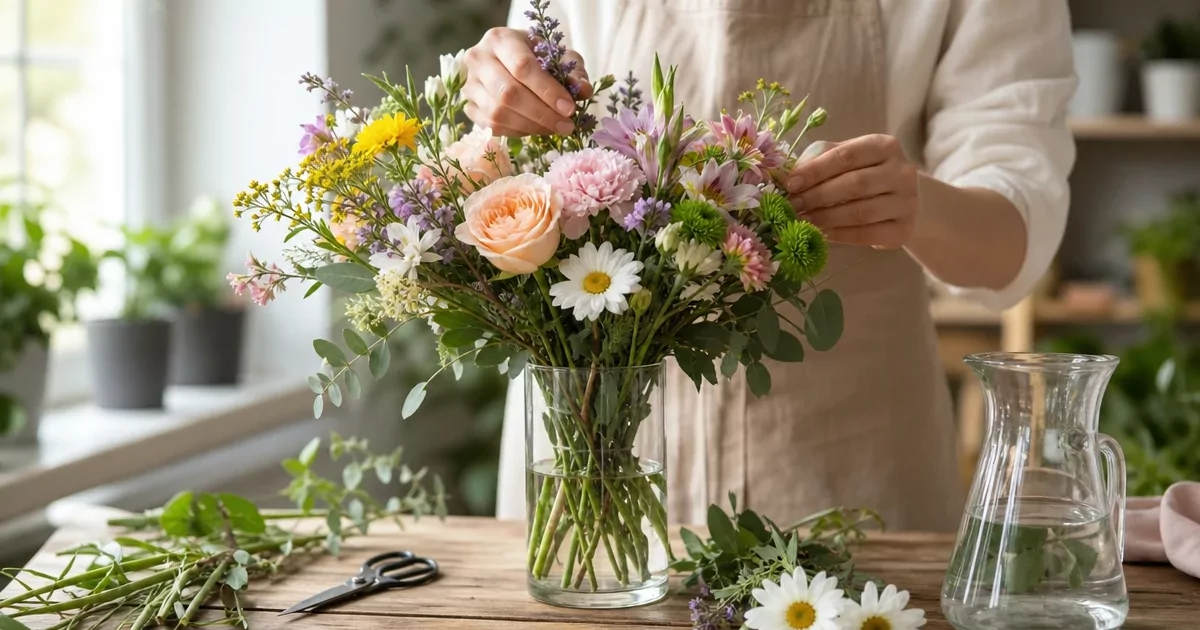
If the bouquet is spiral-tied with ribbon, leave it tied so the flowers keep their shape. Trim all stems together by 2–3 cm at an angle with a sharp knife, strip leaves below the waterline and stand the bouquet in a clean vase of cool water. Dissolve a sachet of flower food; we include one with UFL bouquets, and it suits most flowers in a mix.
The vase should be wide enough not to squeeze the stems and tall enough to support the bouquet. More on choosing a vase and arranging flowers in flower arranging basics, and the basic rules for any bouquet in how to make a bouquet last longer.
Flowers that don't mix well
Daffodils release a slime that harms other flowers, so florists condition them separately for 6–12 hours before adding them to a bouquet. Tulips keep growing in the vase and bend towards light, so trim them more often than their neighbours. Hydrangeas drink more than the rest, so watch the water level closely in a mix that includes them.
Refreshing the bouquet as flowers fade
Flowers in a mixed bouquet fade at different times: chrysanthemums and alstroemerias can last two or three times longer than roses or tulips. Remove each flower as soon as it starts to wilt: it releases ethylene and speeds up wilting in its neighbours. As the bouquet thins out, move the remaining flowers to a smaller vase for a fresh arrangement. The most durable flowers are listed in long-lasting cut flowers.
Box arrangements and floral foam
Mixed arrangements in boxes and baskets sit in floral foam that holds water. There's no need to move them to a vase: just water the foam daily so it stays moist without water pooling at the bottom. Don't pull flowers out of the foam, as a re-inserted stem drinks poorly. How to check that flowers were fresh in the first place is covered in how to check bouquet freshness.
Common mistakes
Don't split the bouquet into several vases unless needed: the florist arranged the flowers to support each other. Remove wilted flowers and greenery, keep the mix away from fruit, radiators and sun. And change the water every 1–2 days: mixed stems cloud the water faster.
Mixed bouquets and arrangements delivered
Order a mixed bouquet or a boxed arrangement: we deliver fresh across Kyiv with flower food.
It depends: roses and tulips up to a week, chrysanthemums and alstroemerias two to three.
Should I untie a mixed bouquet?
No, if it's spiral-tied: the ribbon holds its shape.
What about flowers that fade early?
Remove them straight away and later move the rest to a smaller vase.
How do I care for an arrangement in foam?
Water the foam daily, without removing flowers, so it stays moist.
Author: Maria Svitlovir
Graduated from Taras Shevchenko National University of Kyiv, Institute of Biology and Medicine (2001). BSc in Biology, MSc in Horticulture. Writes about plants, works at a garden centre selecting and repotting plants, and contributes to plant reference guides.






 Birthday
 Hydrangeas