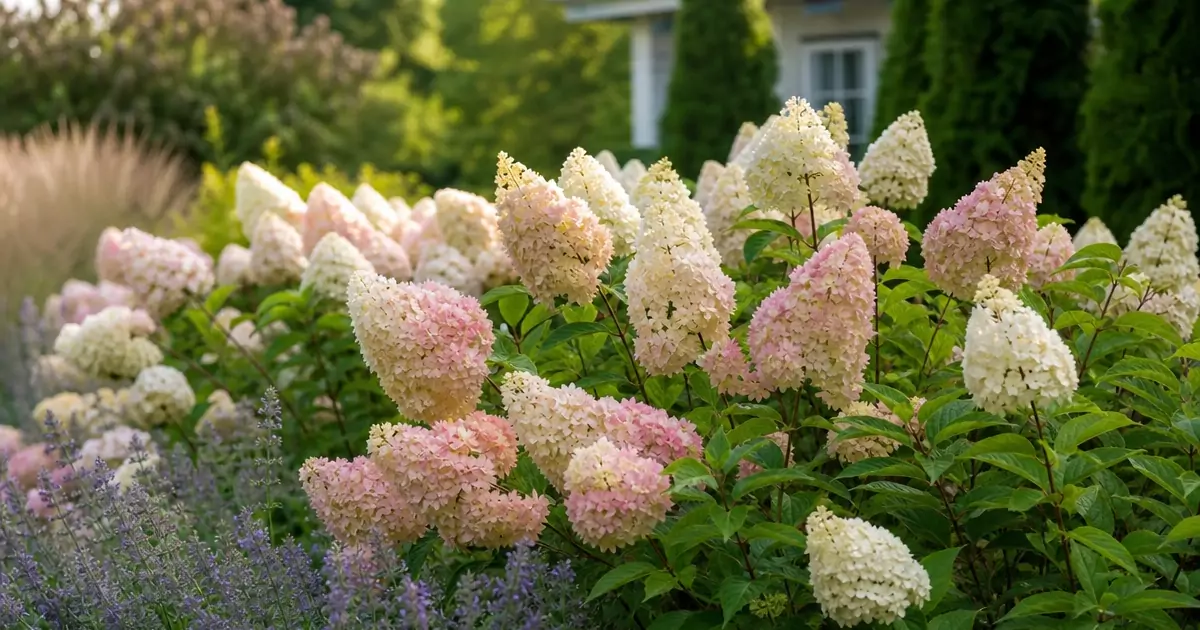
Panicle hydrangea (Hydrangea paniculata) is the hardiest and easiest hydrangea, which is why it is the most common in Ukrainian gardens. It survives −30 °C without cover and flowers from July into autumn with huge cone-shaped panicles that turn from white to pink over time. Here are the best varieties, planting, pruning and care tips, plus how to dry the flower heads for winter arrangements. Another hardy type is smooth hydrangea, with big white balls. For step-by-step instructions, see how to change hydrangea colour. To multiply a favourite variety, see propagating hydrangeas from cuttings. For shady spots, see flowers that grow in shade.
It is a shrub or small tree 1.5–3 m tall with cone-shaped flower heads 20–35 cm long. It flowers on new growth, so even a frost-damaged bush will still bloom.
Its colour does not depend on soil pH as with bigleaf hydrangea: heads open white or lime and turn pink and red as nights cool in late summer.
It tolerates more sun than other hydrangeas and copes with neutral soil, though it flowers best in light shade and slightly acidic soil.
Best varieties
Vanille Fraise has creamy-white panicles that gradually turn strawberry pink from the base; one of the most popular varieties in Ukraine.
Limelight has lime-green heads that blush pink in autumn, and Little Lime is its compact 1 m version. Phantom has huge creamy panicles and Polar Bear snow-white ones.
For small gardens and pots, choose Bobo (up to 80 cm). Diamond Rouge and Wim’s Red give the deepest reds, and Pinky Winky has bicolour white-and-pink heads.
Planting
Choose morning sun and light afternoon shade, sheltered from strong wind that snaps heavy heads. Space plants 1.5–2 m apart, or 70–100 cm for a hedge.
Fill a 50×50 cm hole with garden soil, acidic peat and compost. Container plants go in from April to October; bare-root ones in spring or early autumn.
Keep the root collar at soil level, water well and mulch with pine bark. For planting combinations see ornamental shrubs for the garden.
Pruning
Prune in early spring (March to early April) before leaves open. In autumn just remove spent heads so branches do not break under snow.
Hard pruning to 2–4 buds gives fewer but the largest heads; pruning by a third gives many medium ones. Remove weak and crowded shoots at the base.
Panicle hydrangea is easy to train as a standard: keep one strong stem, tie it to a stake and remove lower side shoots each year.
Watering and feeding
Water a mature bush 1–2 times a week with 10–15 litres, more often in heat. Bark or pine-needle mulch keeps moisture in and slightly acidifies the soil.
Feed with nitrogen in spring, a balanced fertiliser in June as buds form, and potassium-phosphorus from July. Stop feeding after mid-August.
Mulch young plants more thickly in their first winter; mature ones need no cover. More easy-care plants in a low-maintenance garden.
How to dry the flower heads
Cut panicles in September once the flowers feel slightly papery and have changed colour. Fresh white heads dry poorly and turn brown.
Stand them in a vase with 3–5 cm of water and let it evaporate; the heads dry slowly and keep their shape, lasting all winter.
Hydrangea bouquets with delivery
Want hydrangeas today? We deliver hydrangea bouquets across Kyiv and Ukraine, as single stems, mixed colours or lavish arrangements.
Graduated from Taras Shevchenko National University of Kyiv, Institute of Biology and Medicine (2001). BSc in Biology, MSc in Horticulture. Writes about plants, works at a garden centre selecting and repotting plants, and contributes to plant reference guides.






 Birthday
 Hydrangeas