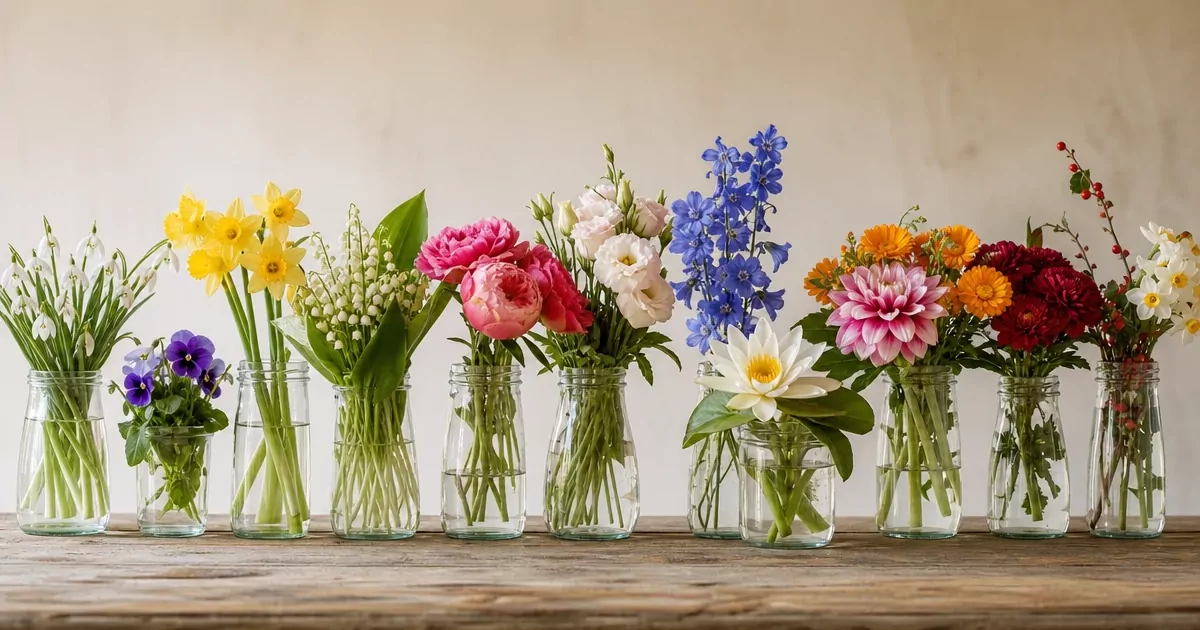
Every month has its own flower, just like a birthstone. The tradition comes from Victorian England, and today florists around the world use it to make a birthday bouquet personal. Here is the flower for each month, what it symbolises and how to build a bouquet when ‘your’ flower is out of season. When lilac blooms, what it means and whether you may pick it: when does lilac bloom.
January: carnation (love, admiration, gratitude) and snowdrop (hope). Carnations last up to two weeks in a vase, perfect for a winter bouquet. More in carnations: meaning and who to give them to.
February: violet (faithfulness, modesty) and primrose. Violets rarely appear in bouquets, so a potted plant is a great choice. See violets in bouquets.
March: daffodil (rebirth, new beginnings). Yellow daffodils with tulips make the most spring-like gift. Read more in daffodils: types and care.
April: daisy (innocence, purity) and sweet pea (gratitude, farewell). Daisies give a bouquet a light, simple feel.
May to August
May: lily of the valley (return of happiness, tenderness) and hawthorn. Lily of the valley is a favourite wedding flower with an unmistakable scent.
June: rose (love, with meaning depending on colour) and honeysuckle. The easiest choice for a June birthday is a mono bouquet of roses in a favourite shade.
July: larkspur or delphinium (openness, lightness) and water lily. Tall blue delphinium spires make a bouquet festive and full.
August: gladiolus (strength of character, integrity) and poppy (remembrance, imagination). Gladioli are an August classic — see gladioli: meaning and growing.
September to December
September: aster (wisdom, faith, love) and morning glory. Asters symbolise the start of autumn. More in asters: types and meaning.
October: marigold or calendula (warmth, creativity) and cosmos (harmony). Warm autumn colours pair well with chrysanthemums and berry branches.
November: chrysanthemum (longevity, joy, friendship). It lasts up to three weeks in a vase. See types of chrysanthemums.
December: holly (protection, home comfort) and paperwhite narcissus (hope). In bouquets they are replaced by winter arrangements with evergreens, berries and white flowers.
If the month’s flower is in season, make it the star: roses in June or asters in September.
If it is not available (violets or lily of the valley in winter), use its colour instead: a purple bouquet for February, white for May — or add a potted plant.
Mention the flower’s meaning on the card: it turns an ordinary bouquet into a personal gift. More meanings in the language of flowers.
Birth month vs zodiac flowers
These are two separate traditions: the month flower follows the calendar, while the flower horoscope follows zodiac signs, which do not match calendar months. A Leo, for example, is born between 23 July and 22 August and has a flower list of its own — see flowers for Leo.
Birthday bouquets with delivery
Tell our florist the birthday month and we will arrange a bouquet with that month’s flower or in its colour, delivered across Kyiv and Ukraine.
January carnation, February violet, March daffodil, April daisy, May lily of the valley, June rose, July larkspur, August gladiolus, September aster, October marigold, November chrysanthemum, December holly.
Where does the tradition come from?
From Victorian England, which loved the language of flowers. Similar lists exist in Japan.
What if the month’s flower is not available?
Choose a bouquet in its colour or add a potted plant, and explain the meaning on the card.
Are birth month and zodiac flowers the same?
No, they are different traditions with different date ranges and flower lists.
Graduated from Taras Shevchenko National University of Kyiv, Institute of Biology and Medicine (2001). BSc in Biology, MSc in Horticulture. Writes about plants, works at a garden centre selecting and repotting plants, and contributes to plant reference guides.






 Birthday
 Hydrangeas