The rubber plant, Ficus elastica, is a home and office classic: big glossy leaves, slow growth and tolerance of dry air. Here are the popular varieties, from dark burgundy to variegated, how to care for the plant, how to make it branch, why leaves drop and how to propagate it by cuttings or air layering.
More on this topic: ficus types and care, weeping fig, houseplants: names and care.
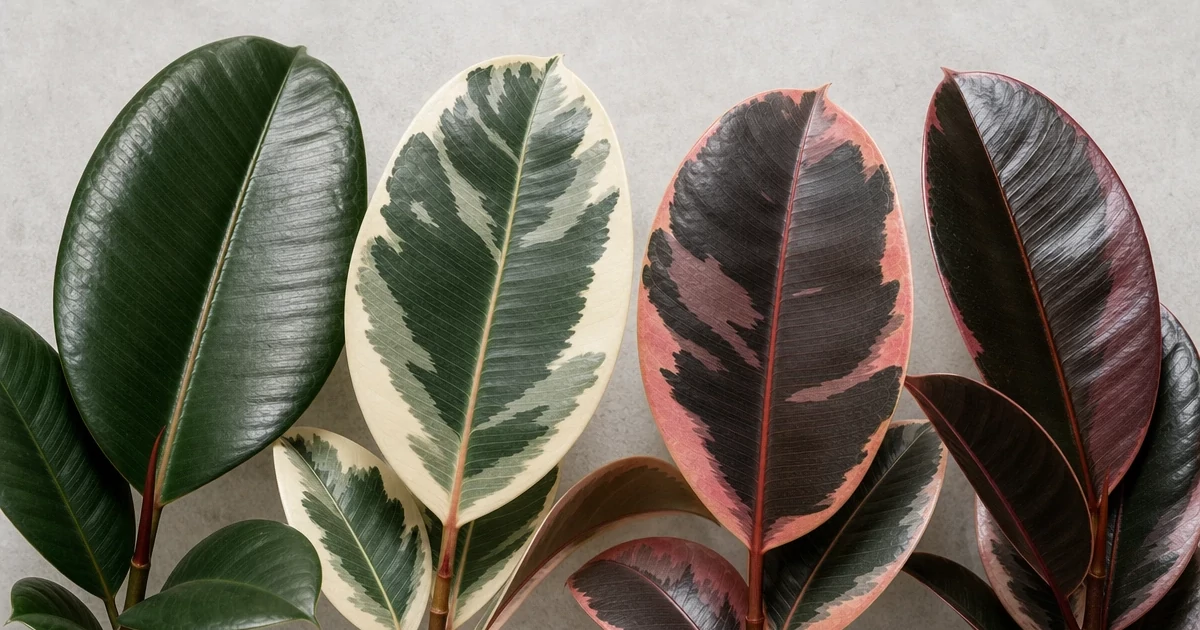
Robusta: the classic green, toughest and fastest-growing.
Melany: compact with short gaps between leaves and dense foliage; good for small rooms.
Abidjan and Burgundy (Black Prince): dark burgundy, almost black leaves with a red midrib.
Tineke: cream and green variegation with a pink tinge on new leaves.
Ruby and Belize: variegated with pink-red patches; the brighter the light, the stronger the colour.
Variegated types grow more slowly and need more light than green ones. Other species are covered in ficus types and care. Another easy indoor tree: money tree (pachira).
If you want a large tree with a different leaf shape, consider the fiddle leaf fig with its violin-shaped leaves — it needs more light but is very striking.
The ideal spot is 1–2 m from an east- or west-facing window, or by a south-facing one behind a sheer curtain. A large floor-standing ficus does well near a balcony door if there is no draught. Keep it away from radiators and air conditioners and do not keep moving it: the plant adapts to its light and answers every change by dropping leaves. Turn the pot a quarter turn once a month for even growth.
Light: bright and indirect; a little morning sun helps. In shade it gets leggy and drops lower leaves.
Water when the top 3–4 cm is dry. Slightly too little is better than too much; roots rot quickly in wet soil.
Temperature: 18–26 °C, not below 15 °C in winter. It dislikes draughts and moving and may drop a few leaves after a move.
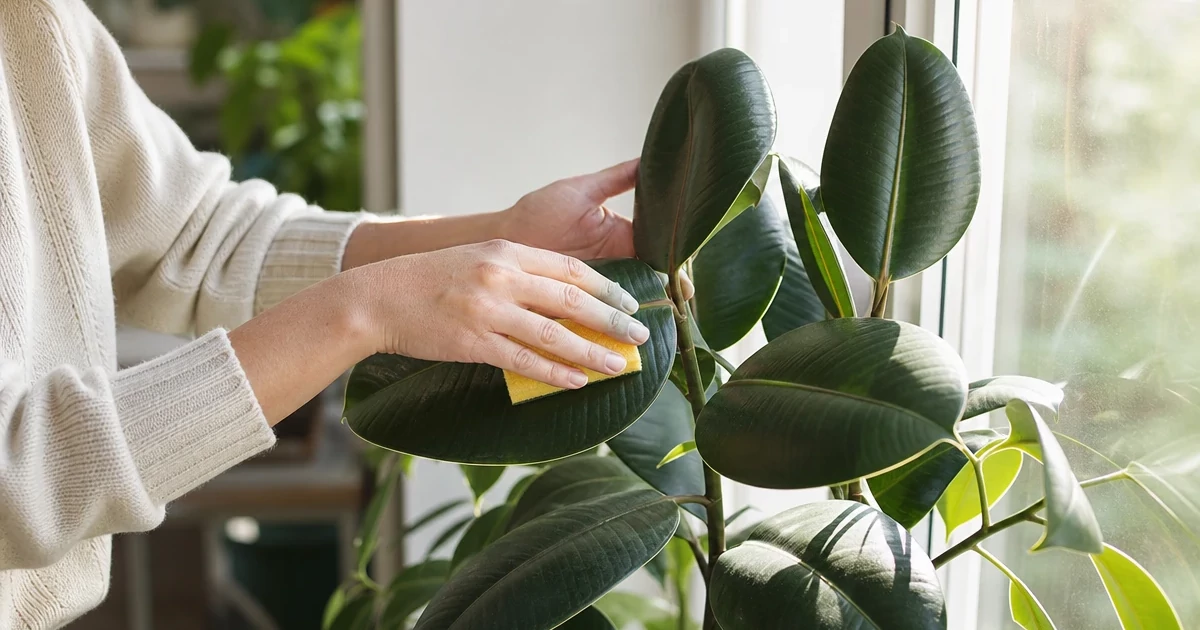
Leaves: wipe with a damp sponge every 2–3 weeks; dust blocks pores and dulls the shine. Leaf polish isn't needed.
Feeding: spring to autumn, every 2–3 weeks with a foliage-plant fertiliser.
Repotting: young plants every spring, mature ones every 2–3 years; see how to repot a houseplant.
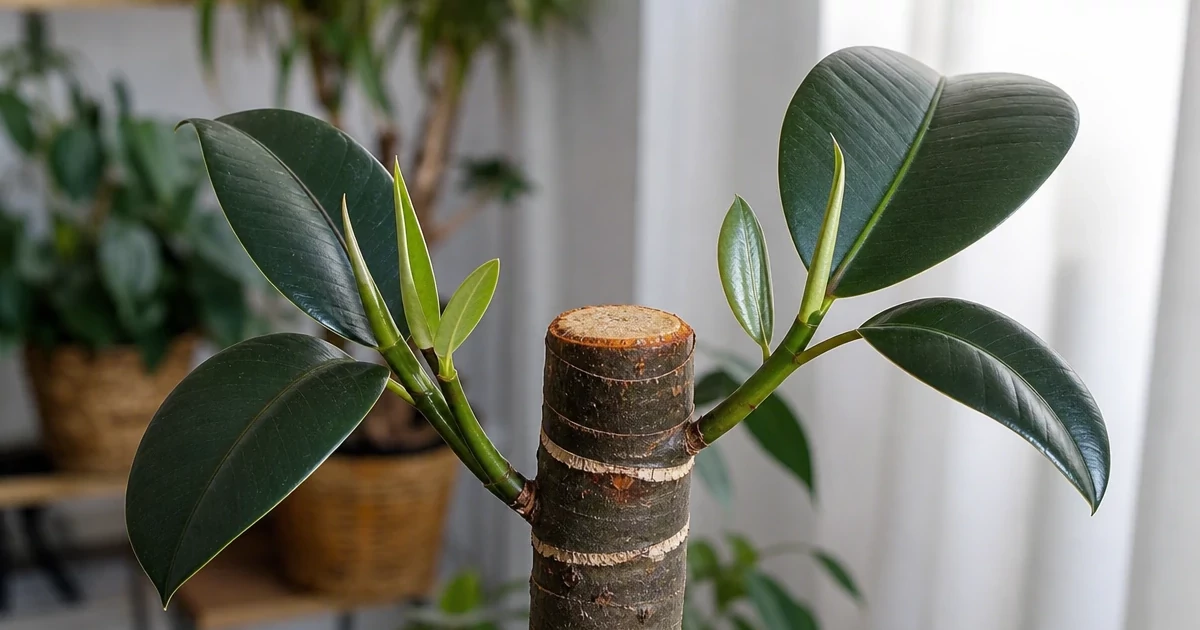
A rubber plant rarely branches on its own and grows as a single stem. For a fuller crown, cut the top off in spring 10–15 cm above a leaf: 2–3 side buds below the cut will wake up. An old, bare ficus can be cut back harder, to 30–50 cm, and will sprout from the stumps. Blot the sap with a tissue and dust the cut with charcoal. You can also bend and tie the stem for a few weeks so buds on the upper side of the curve break.
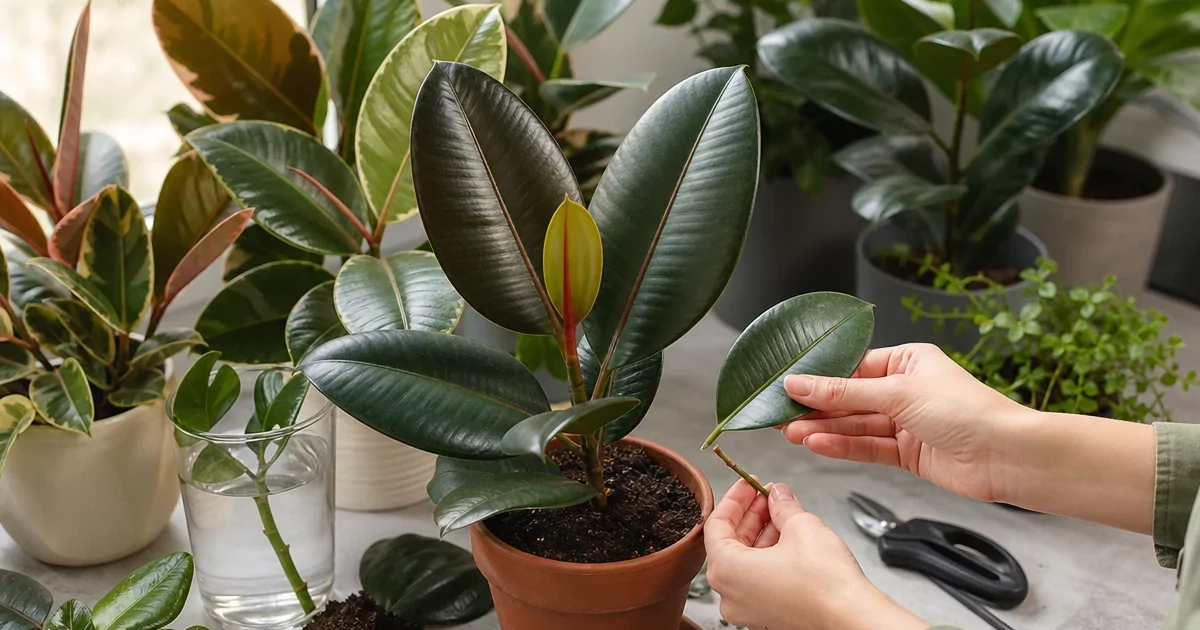
Take a 10–15 cm tip cutting with 2–3 leaves, rinse off the milky sap, let the cut dry for 1–2 hours and root it in water or moist mix. Roll large leaves and hold them with a rubber band to reduce water loss.
Roots appear in 3–5 weeks, faster in warmth under a plastic bag.
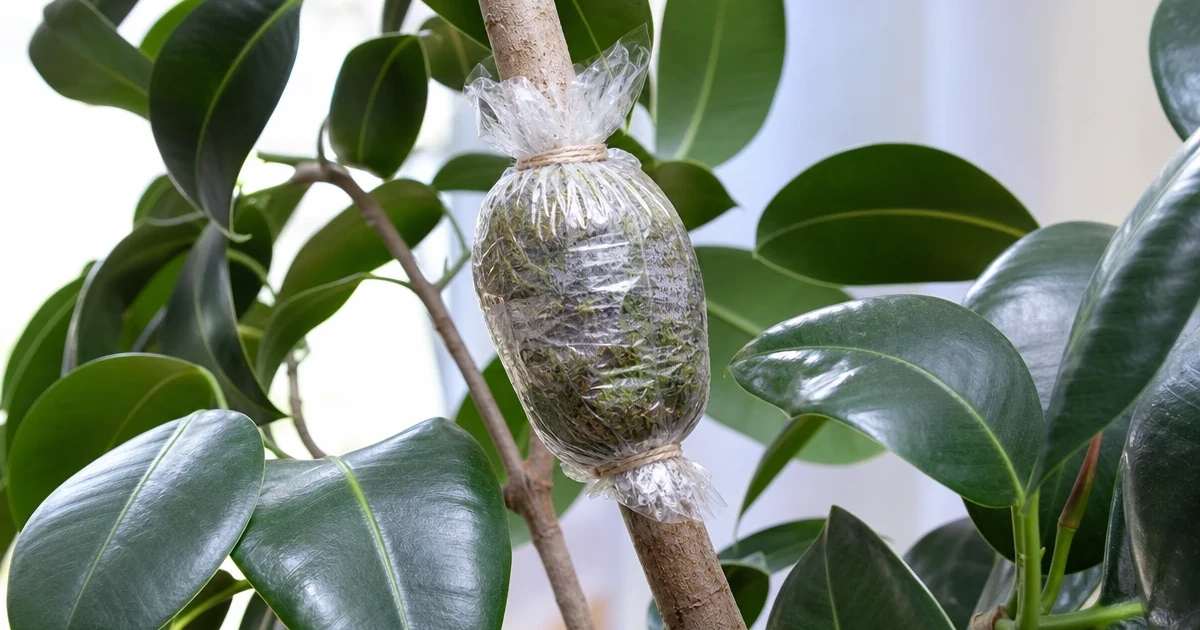
Air layering for a tall plant: make a shallow cut in the stem, wrap it in damp moss and film. When roots show under the film (1–2 months), cut below them and pot up.
In the wild a rubber plant forms small figs (syconia), greenish-yellow "berries" in the leaf axils with the flowers hidden inside. They are pollinated only by a specific fig wasp that does not live in Europe. Indoors it practically never flowers, so it is grown for its foliage.
Yes. Superstitions that a ficus "drives men away" or "drains energy" have no basis. There are only two real caveats: the milky sap irritates skin and is harmful to cats, dogs and small children, and people with a latex allergy may react to it. Place it where pets cannot chew the leaves and wear gloves when pruning.
The milky sap (latex) irritates skin and is toxic to cats and dogs; wear gloves and keep it away from pets.
People with latex allergy should be careful when pruning.
Beliefs linking ficus to new babies are folklore; it is simply a handsome plant.
Looking for a living gift that lasts for months? A potted orchid is a great choice for home or office.

See houseplants and orchids.

In spring cut the tip above a node and give the plant good light; side shoots follow in 3–6 weeks.
When the top 3–4 cm is dry: every 7–10 days in summer, less in winter.
Usually moving, draughts, cold or overwatering.
Keep it out of reach: the milky sap is toxic to pets.
A single leaf may root in water, but it will never grow into a new plant because it has no bud. Take a cutting with a piece of stem and at least one node.

Author: Maria Svitlovir
Graduated from Taras Shevchenko National University of Kyiv, Institute of Biology and Medicine (2001). BSc in Biology, MSc in Horticulture. Writes about plants, works at a garden centre selecting and repotting plants, and contributes to plant reference guides.
© Kyiv 2026 UFL Flower Shop

Trademark UFL №191476 is used under license of the rights holder.
All rights reserved. Any use of materials without a link to the site is prohibited.

 Birthday
 Hydrangeas