
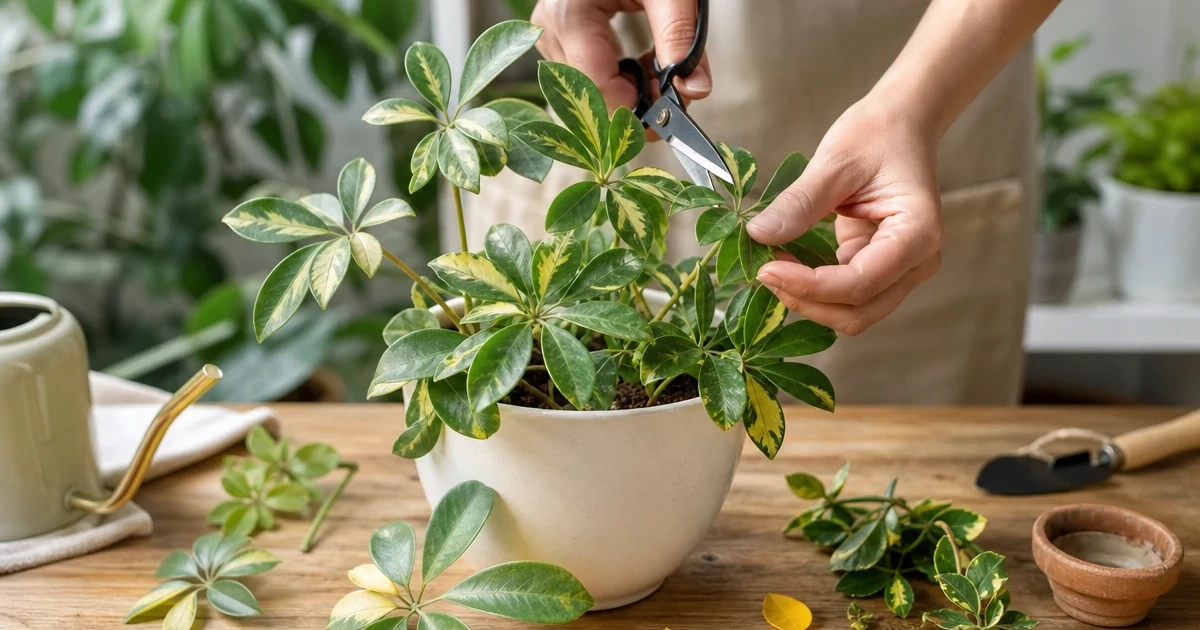
Schefflera is an indoor “tree” with leaves like an open umbrella or a hand with outstretched fingers. It grows fast, fills a corner nicely and is easy to shape by pruning — from a bushy plant to a single-stem tree. Its owners’ main complaint is sudden leaf drop. Here is how to care for schefflera so it keeps its crown, and what to do if leaves are already falling.
Schefflera is a genus of evergreen trees and shrubs in the ivy family (Araliaceae). Two species are commonly grown indoors:
Schefflera likes bright indirect light. Green forms accept light shade, but variegated ones need more light or they turn green. Midday summer sun can scorch the leaves. Aim for 18–24 °C in summer and 14–18 °C in winter — a cool winter with less water suits it well. Below 12 °C it starts dropping leaves.
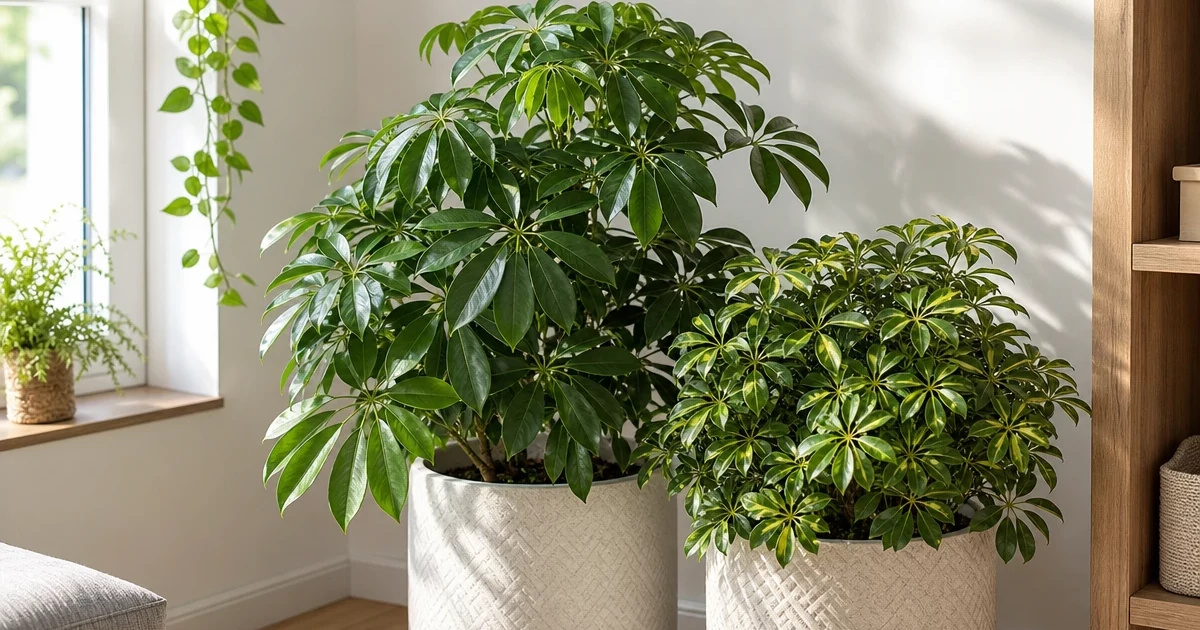
View full-size photoSchefflera arboricola and actinophylla: difference in leaf size and shape.
Water when the top 2–3 cm of soil are dry, even less often in a cool winter. Water standing in the saucer is the main cause of root rot and black leaf spots. Schefflera tolerates dry air better than many tropical plants, but near a radiator mist or wipe the leaves with a damp sponge. Feed every 2–3 weeks from April to September with a foliage-plant fertiliser.
Schefflera branches readily after pruning. In spring cut back the tip or long shoots just above a leaf — new branches will sprout and the crown will thicken. For a tree shape, remove side shoots low on the stem and pinch the tips at the height you want. Several plants with braided stems in one pot is a popular way to make it look fuller.
Use foliage-plant compost with perlite or fine bark. Repot young plants every spring and mature ones every 2–3 years; for large specimens, simply replace the top layer of soil. Choose a heavy, stable pot, as a tall plant tips over easily. See how to repot houseplants.
Large woody plants are propagated by air layering; seed is rarely available.
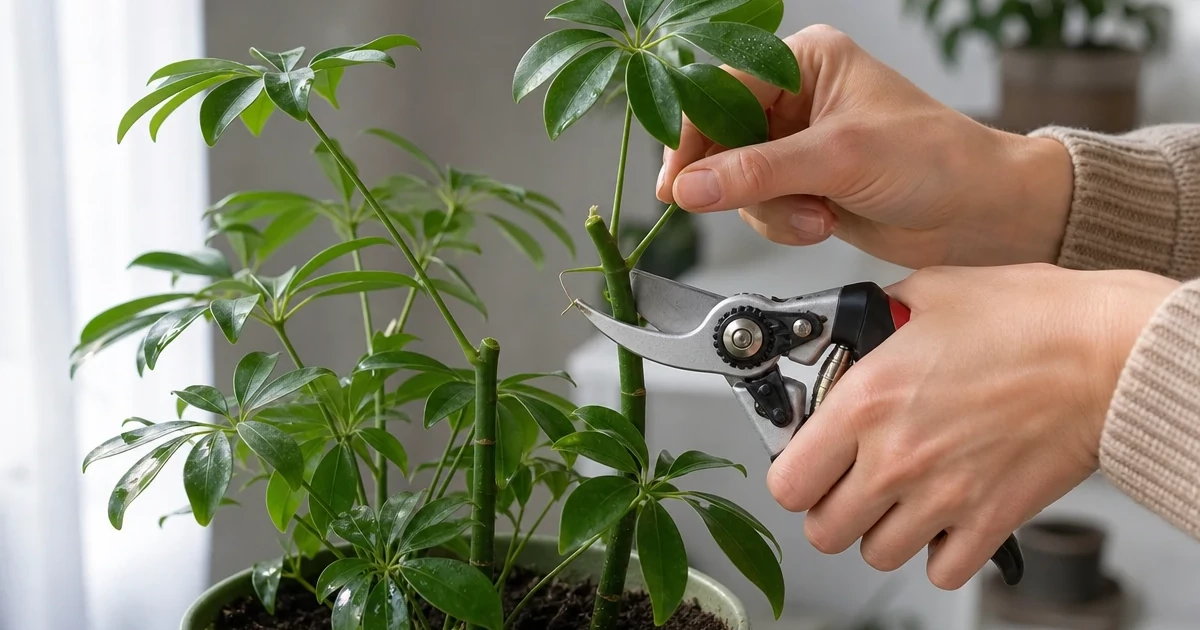
View full-size photoPruning encourages branching in schefflera.
More in houseplant problems and symptoms.
Yes, it contains calcium oxalate crystals. A cat or dog chewing the leaves may suffer mouth irritation, drooling and vomiting, and the sap can irritate human skin. Keep it away from pets and small children and wear gloves when pruning. For other large statement plants, see monstera and ficus; browse potted plants.
When the top 2–3 cm of soil are dry — usually every 5–7 days in summer and every 10–14 days in a cool winter.
Yes, in spring. Cutting above a leaf encourages side branches and a fuller crown.
Very rarely. It is grown for its leaves; flowers almost never appear indoors.

Author: Maria Svitlovir
Graduated from Taras Shevchenko National University of Kyiv, Institute of Biology and Medicine (2001). BSc in Biology, MSc in Horticulture. Writes about plants, works at a garden centre selecting and repotting plants, and contributes to plant reference guides.
© Kyiv 2026 UFL Flower Shop

Trademark UFL №191476 is used under license of the rights holder.
All rights reserved. Any use of materials without a link to the site is prohibited.

 Birthday
 Hydrangeas