
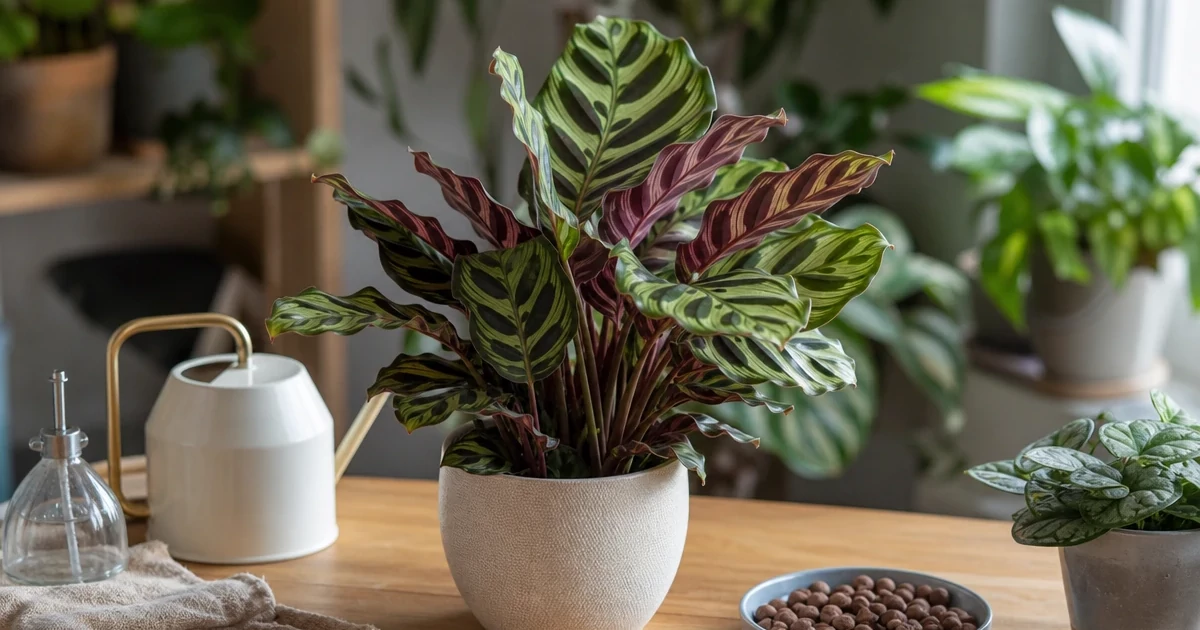
People buy calathea for its leaves: striped as if painted with a brush, burgundy underneath and sometimes velvety. It also “moves” — the leaves fold up in the evening and lower again in the morning. Yet this tropical beauty has a fussy reputation: dry air or hard water is enough to make the leaf tips brown. Here is how to give calathea the conditions it needs to grow lush without crispy edges.
Calathea is a tropical plant of the prayer-plant family (Marantaceae) from the forests of Central and South America. In 2012 botanists moved most species to the genus Goeppertia, but they are still sold as calatheas. In the wild it grows on the forest floor, in humid air and shade beneath the canopy — hence its key needs at home: bright indirect light, steady warmth and high humidity.
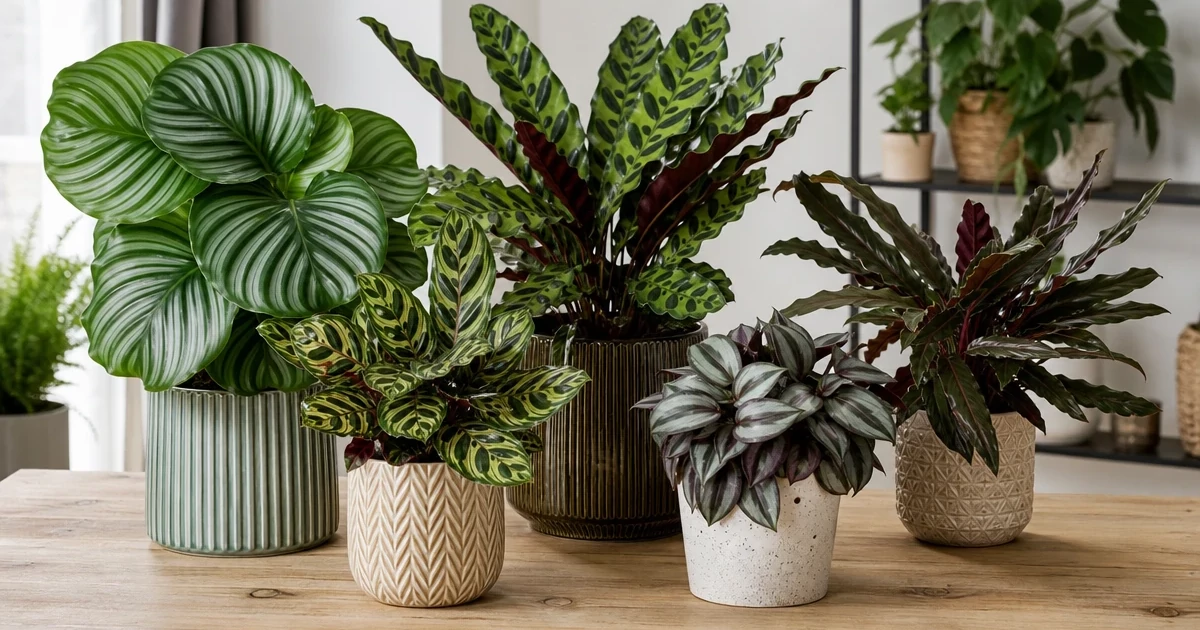
View full-size photoCalatheas feature a variety of leaf patterns and textures
Each leaf has a “joint” at the base of the blade, so it responds to light, rising at night and lowering by day. That is why it is called a prayer plant.
Calathea needs bright indirect light: 1–2 m from an east or west window, or a south window with a sheer curtain. Direct sun bleaches the pattern and scorches the leaves, while deep shade makes them smaller and duller. Keep it at 18–24 °C all year, never below 16 °C, away from draughts, cold windowsills and hot radiators.
Keep the soil lightly moist but never soggy: water when the top 2–3 cm have dried. Water less in winter. Calathea is sensitive to chlorine, fluoride and salts, so use soft water — filtered, rested or rainwater — at room temperature.
The real secret is humidity of 60% or more. A humidifier, a pebble tray and grouping plants all help. A fine mist suits smooth-leaved types, but velvety ones are best kept dry to avoid spots. See our houseplant watering guide.
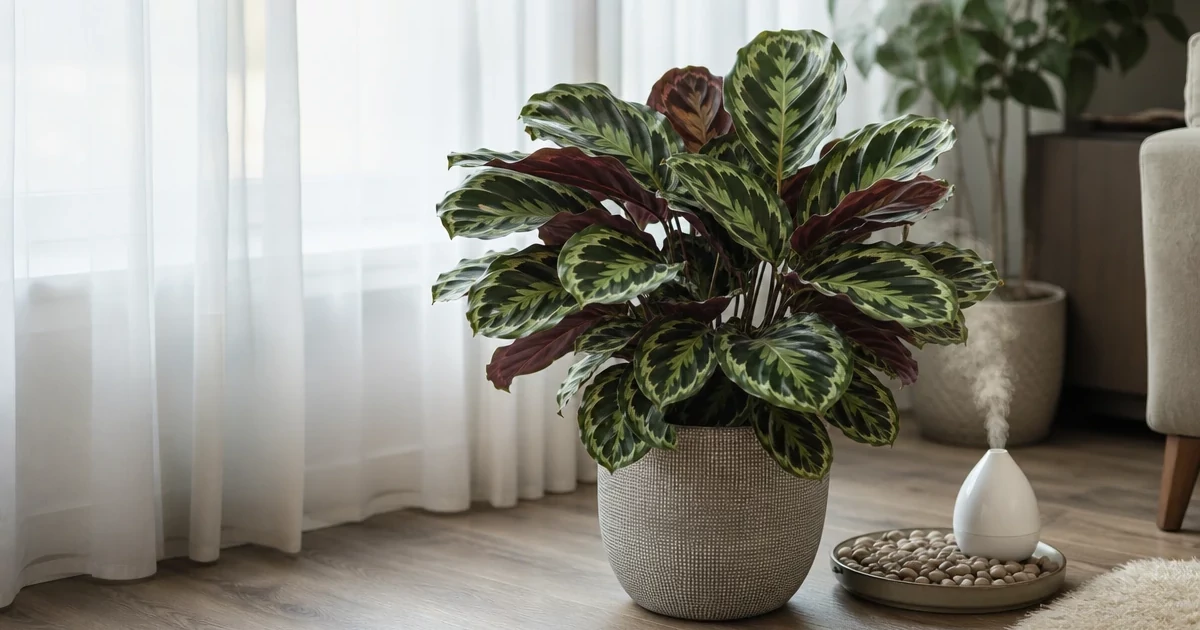
View full-size photoOptimal calathea conditions: indirect light, humidity, and pebble tray
Use a light, airy, slightly acidic mix: a ready-made prayer-plant or azalea mix, or all-purpose compost with peat, perlite and fine bark. The roots are shallow, so choose a wide, shallow pot with drainage holes. Repot young plants every spring and mature ones every 2 years, going up 2–3 cm in size. Let a new plant settle for 2–3 weeks before repotting. Step-by-step: how to repot houseplants.
From April to September feed every 2–3 weeks with a liquid foliage-plant fertiliser at half strength. Excess salts show up as brown leaf edges, so under-feeding is safer than over-feeding. No feeding in winter.
Calathea cannot be grown from stem or leaf cuttings — only by dividing the rhizome. Do it in spring when repotting: ease the plant out, split it into sections, each with several leaves and healthy roots, and pot them separately. Keep divisions warm and humid for the first weeks, covered with a clear bag.
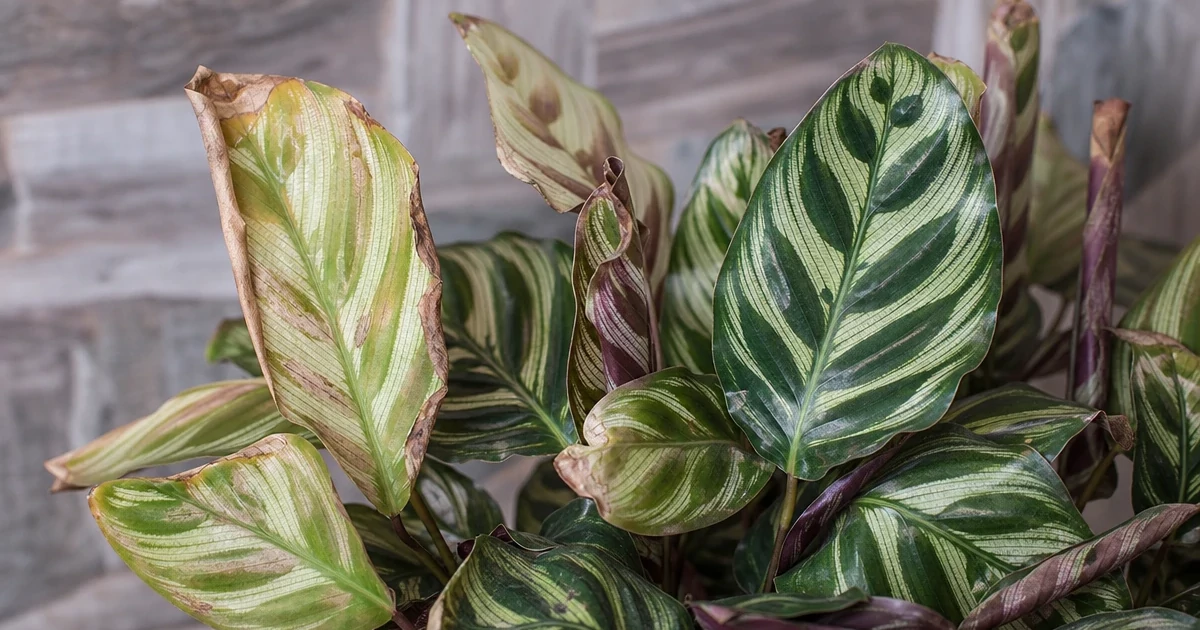
View full-size photoCommon calathea issues: brown tips, curled and healthy leaves
More in houseplant problems and symptoms.
Calathea is considered non-toxic to people, cats and dogs, so it is a good choice for homes with pets — though chewed leaves are bad for the plant, so keep it out of the cat’s reach. For more ideas, see foliage houseplants and houseplant names and care. Browse potted plants.
It is a normal response to changing light: leaves rise in the evening and lower in the morning. Leaves curled during the day signal thirst.
When the top 2–3 cm of soil are dry — usually once or twice a week in summer, less in winter. Check the soil, not the calendar.
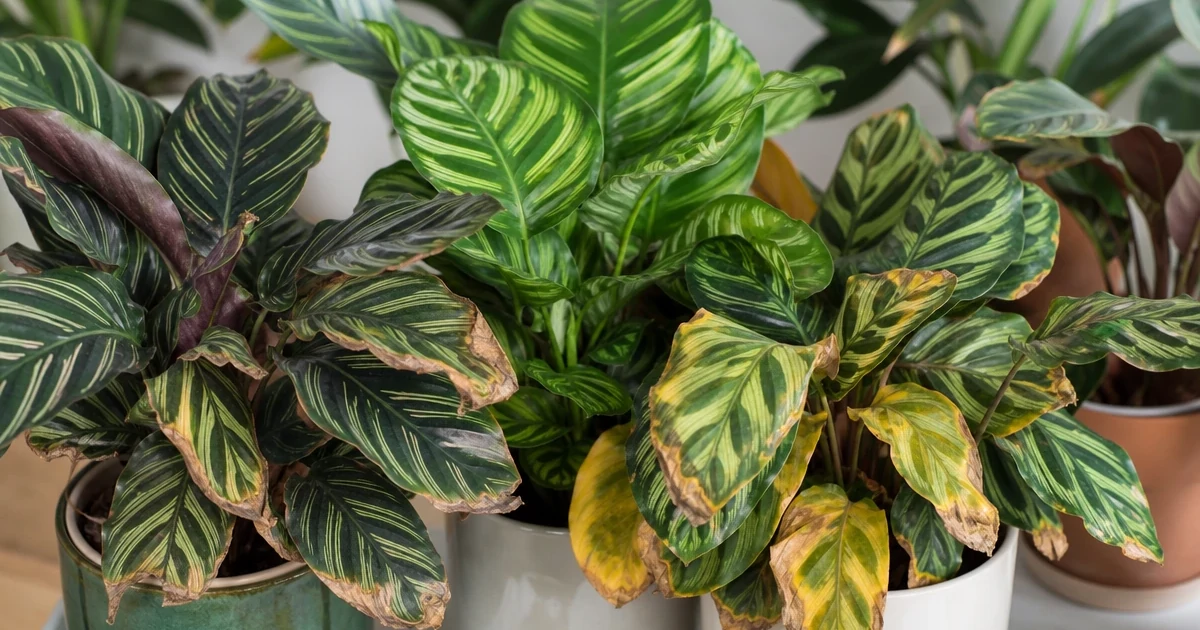
View full-size photoThe photo shows various calathea leaf issues: brown tips, curling, and healthy leaves.
Yes, cut off the dry part with clean scissors, leaving a thin strip of brown so you do not wound the living leaf.
Calathea lancifolia and makoyana are the toughest. Orbifolia and crocata need higher humidity.

Author: Maria Svitlovir
Graduated from Taras Shevchenko National University of Kyiv, Institute of Biology and Medicine (2001). BSc in Biology, MSc in Horticulture. Writes about plants, works at a garden centre selecting and repotting plants, and contributes to plant reference guides.
© Kyiv 2026 UFL Flower Shop

Trademark UFL №191476 is used under license of the rights holder.
All rights reserved. Any use of materials without a link to the site is prohibited.

 Birthday
 Hydrangeas