
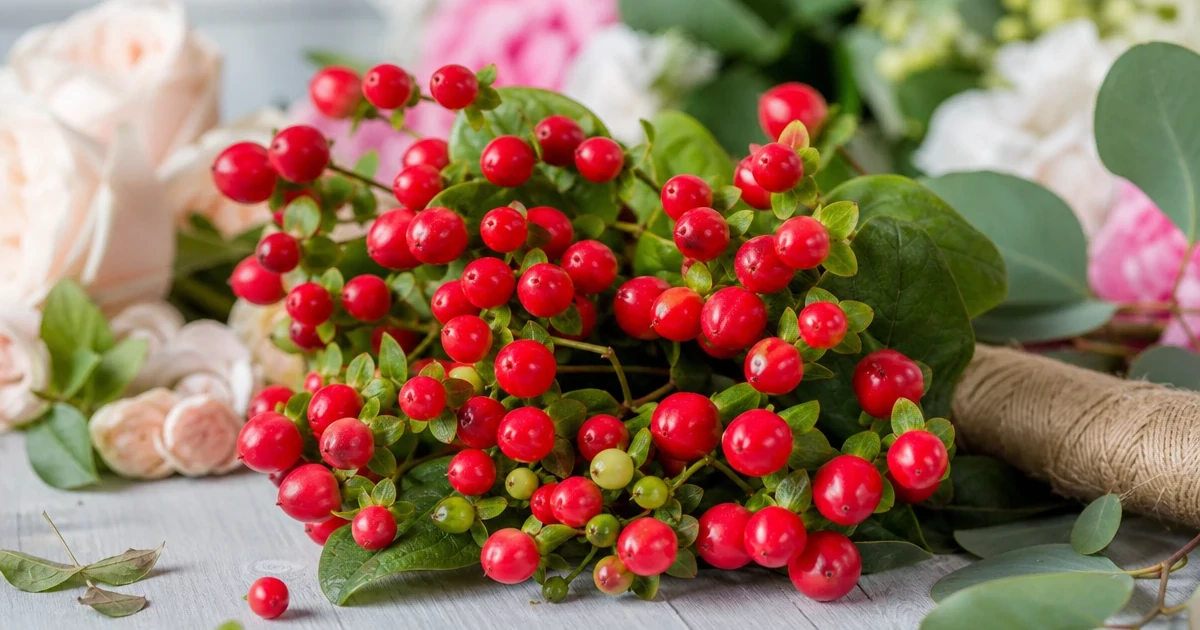
Hypericum gives you stems of glossy little berries that make a bouquet fuller, more textured and a little autumnal even in spring. The berries come in red, pink, white, green, peach and almost black, so florists can match hypericum to any palette. Here is what the plant is, what it pairs best with and how long it lasts in a vase.
Hypericum is the Latin name for St John’s wort. Florists, however, do not use the medicinal wild plant but decorative garden forms, mainly hybrids of tall tutsan (Hypericum × inodorum). It is a low shrub with yellow star-shaped flowers in summer, followed by berry-like fruits. These smooth berries, 1–1.5 cm across and borne in clusters, are what decorates a bouquet.
Hypericum is a filler that works as an accent. It pairs well with roses, chrysanthemums, alstroemerias, tanacetum and eucalyptus. In bouquets for men the berries add restraint and texture; in autumn arrangements they warm up the palette alongside sunflowers and leucadendron. Red berries with white roses and fir are a winter classic.
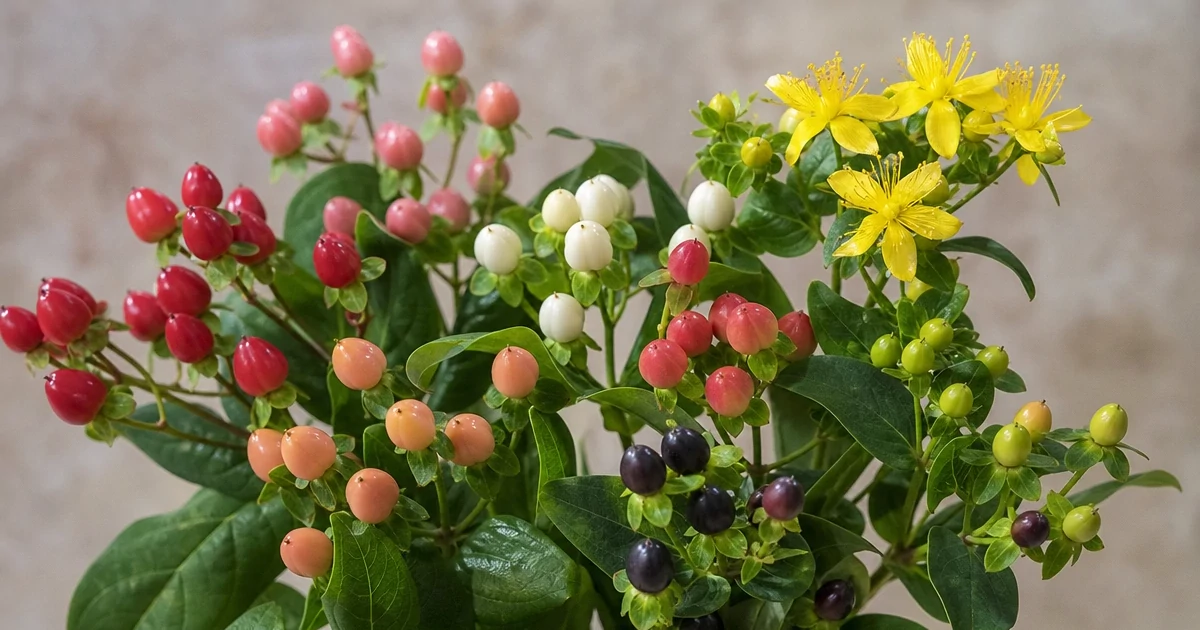
View full-size photoHypericum berries come in red, pink, white, green, peach and almost black.
Hypericum is one of the longest-lasting parts of a bouquet: the berries hold for 2 weeks or more. Cut the stems at an angle, strip leaves below the waterline and change the water every 2–3 days. The leaves may wilt before the berries — simply pick them off.
No. The berries of decorative St John’s wort are not edible, so place a hypericum bouquet out of reach of small children and pets. If a child or pet swallows a berry and behaves unusually, contact a doctor or vet.
See more in bouquet greenery and our florist’s glossary.
Yes, Hypericum is the genus of St John’s wort, but bouquets use decorative garden hybrids with large berries.
Usually 2 weeks or more — the berries outlast most flowers in a bouquet.
There are no naturally blue berries. The most common colours are red, pink, white, green, peach and brown.

Author: Maria Svitlovir
Graduated from Taras Shevchenko National University of Kyiv, Institute of Biology and Medicine (2001). BSc in Biology, MSc in Horticulture. Writes about plants, works at a garden centre selecting and repotting plants, and contributes to plant reference guides.
© Kyiv 2026 UFL Flower Shop

Trademark UFL №191476 is used under license of the rights holder.
All rights reserved. Any use of materials without a link to the site is prohibited.

 Birthday
 Hydrangeas