
 Birthday
 Hydrangeas
Scarlet poppies among the wheat are one of summer’s most recognisable sights. A poppy flower lasts only a few days, but its brilliance and fragility have won over artists, poets and gardeners. Here is what the poppy symbolises, the main types and how to grow poppies in the garden.
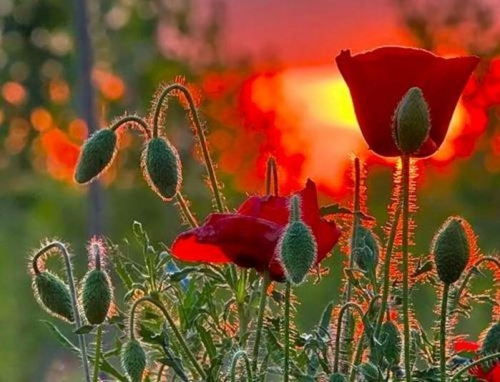
The poppy as a symbol of remembrance
After the First World War the red poppy became the international symbol of remembrance for the fallen: Canadian doctor John McCrae wrote the famous poem “In Flanders Fields”, where poppies blow between the rows of crosses. In Ukraine, since 2014 the red poppy has been the symbol of the Day of Remembrance and Reconciliation on 8 May — its stylised design recalls both a drop of blood and a bullet hole.
The poppy in myth and folk tradition
- Ancient Greece. The poppy belonged to Hypnos and Morpheus, gods of sleep, and to Demeter: in one myth it helped the goddess find oblivion in her grief after her daughter Persephone vanished.
- Ukrainian tradition. On 1 August (14 August before the 2023 calendar change) Ukrainians celebrate Makoviy, when poppy seeds, honey and small bouquets of flowers and herbs are blessed. Poppy seeds go into kutia and festive baking as a symbol of prosperity and family, and folk belief held that sprinkled poppy seeds protected the home from evil.
- A love game. Girls laid a poppy petal over a ring made with their fingers and slapped it: a loud pop meant a boy was in love.
Types of poppy
- Corn poppy (Papaver rhoeas) — the classic field poppy, an annual with scarlet flowers; garden forms come in pink, white and bicolours.
- Oriental poppy (P. orientale) — a perennial with huge red, orange, pink or white flowers in May and June.
- Iceland poppy (P. nudicaule) — delicate yellow, orange and pink flowers, good for cutting.
- Breadseed or opium poppy (P. somniferum) — food varieties provide seeds for baking. Growing it in Ukraine is regulated by law, so sow only permitted varieties and check the rules first.
Growing poppies in the garden
- Position — sunny, with light, free-draining soil; poppies hate standing water.
- Sowing — sow annual poppies directly outdoors in late autumn or early spring, mixing the tiny seeds with sand. They dislike transplanting because of their taproot.
- Care — thin seedlings, water moderately and remove spent seed heads to prolong flowering.
- Perennial poppies die back after flowering and rest until autumn, so plant neighbours that will fill the gap.
Poppies in a vase
Cut poppies are short-lived, but you can help them: cut when the bud shows colour and is just cracking, then immediately dip the stem ends in boiling water for a few seconds or sear them over a flame to stop the milky sap from leaking. They will then last 3–5 days. For Tuscany’s famous poppy fields, see the world’s most beautiful landscapes, and for other wild beauties, wildflowers.
Safety
All parts of the poppy except the ripe seeds of food varieties contain alkaloids and are toxic to people and pets.
FAQ
What does the red poppy symbolise?
Remembrance of those who died in war; in Ukraine, the Day of Remembrance and Reconciliation on 8 May. In folk culture, also fertility and prosperity.
When do poppies flower?
Oriental poppies in May–June, field poppies from June to midsummer.
How long do poppies last in a vase?
3–5 days if the stem ends are sealed with boiling water right after cutting.
Bright summer bouquets are available with delivery in Kyiv from UFL.

View full-size photo
Author: Maria Svitlovir
Graduated from Taras Shevchenko National University of Kyiv, Institute of Biology and Medicine (2001). BSc in Biology, MSc in Horticulture. Writes about plants, works at a garden centre selecting and repotting plants, and contributes to plant reference guides.