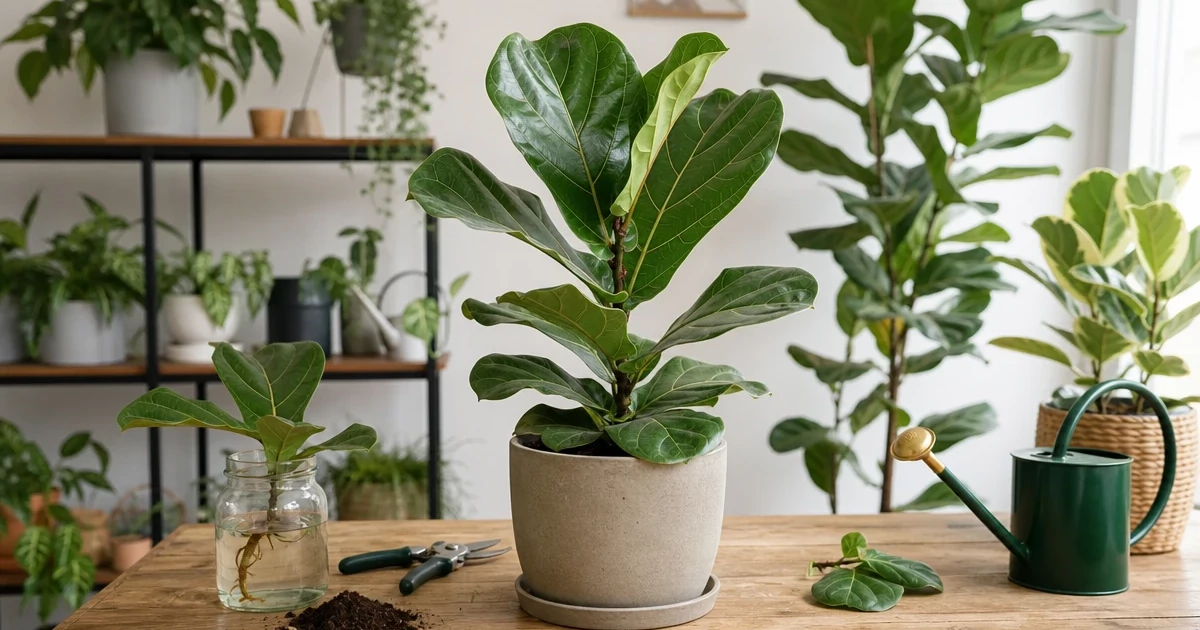
The fiddle leaf fig (Ficus lyrata) is a tree with large, wavy, violin-shaped leaves that has become an icon of modern interiors. It is not the easiest houseplant: it dislikes being moved, draughts and low light. But find it the right spot from day one and avoid overwatering, and it grows fast and keeps a full canopy for years. Below is everything you need for indoor care, from choosing a variety to pruning, propagation and the reasons leaves drop.
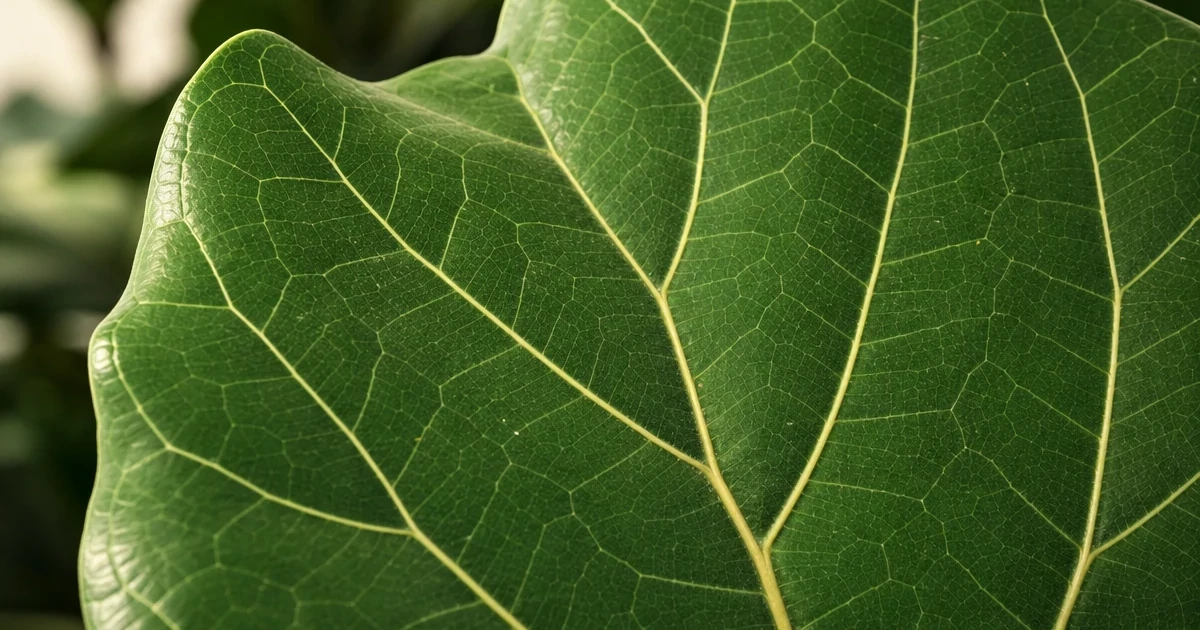
The fiddle leaf fig belongs to the mulberry family and comes from the rainforests of West and Central Africa. In the wild it reaches 12–15 m; indoors it usually stays at 1.5–3 m. The leaves are stiff and glossy with pale veins, up to 30–45 cm long, shaped like a lyre or violin — hence the name. It is a relative of the rubber plant and the weeping fig; see our overview of ficus types and care.
In good conditions it adds 30–60 cm and several large leaves per season. Growth almost stops in winter, which is normal.
Choose a plant with firm, dark green leaves without brown patches, foliage reaching low down the trunk and no webbing on the leaf undersides. Lift the pot: soil that feels waterlogged or smells damp is a warning sign.
At home it needs 2–4 weeks to adjust and may drop 1–3 lower leaves — that is stress, not disease. Put it in its permanent spot straight away, do not repot or feed for the first month, and water only once the soil has dried.
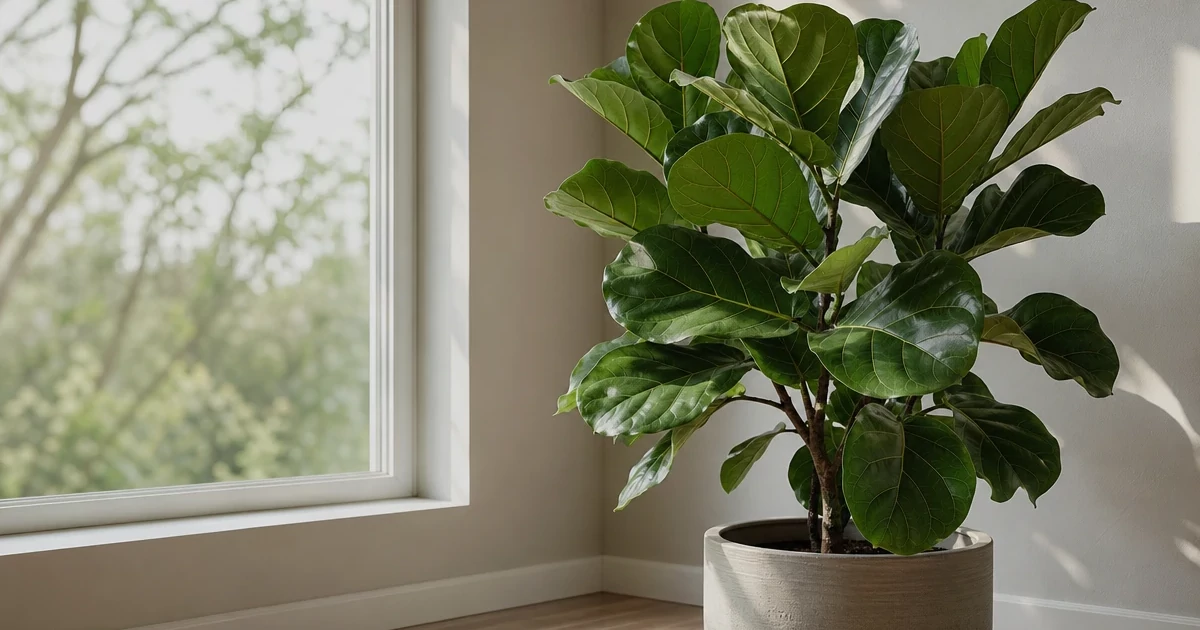
Light is the key to success. A fiddle leaf fig needs bright, filtered light for at least 6 hours a day; gentle morning or evening sun does it good. The ideal spot is 0.5–1.5 m from an east-, west- or south-facing window (with light shade at midday in summer on a south side). Deep inside a room it stretches, produces smaller leaves and sheds the lower ones.
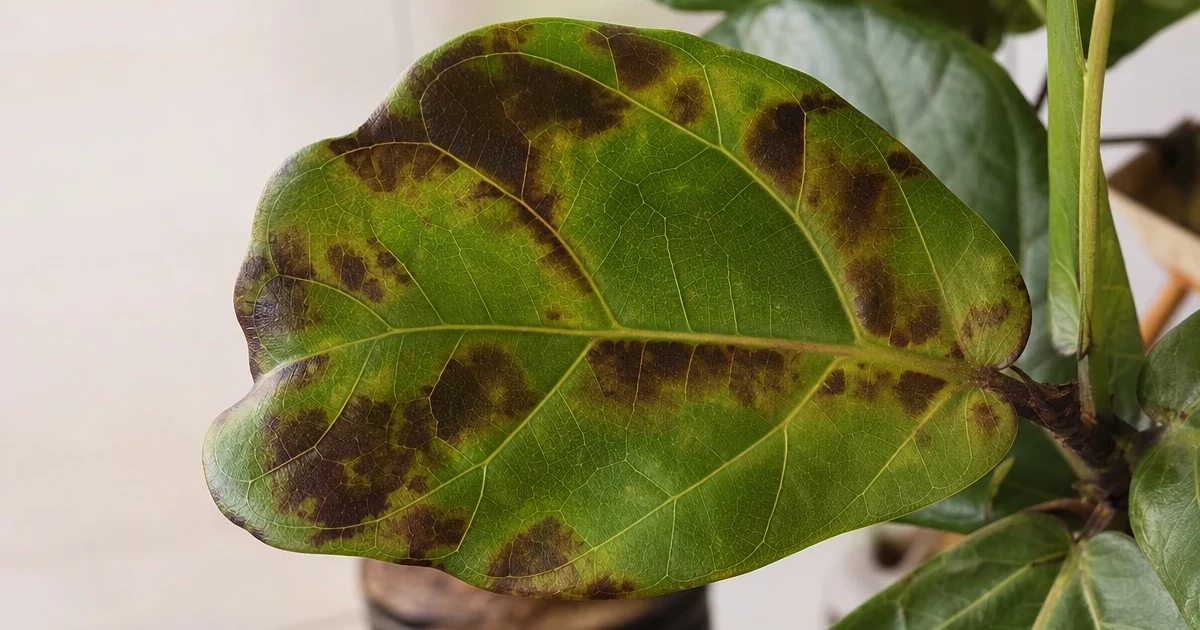
Water when the top 3–5 cm of soil is dry: usually every 7–10 days in summer and every 2–3 weeks in winter. Use room-temperature, settled water until it runs into the saucer, then empty the excess after 15–20 minutes. Overwatering is more dangerous than underwatering: soggy soil rots the roots and causes dark brown leaf spots. More in our houseplant watering guide.
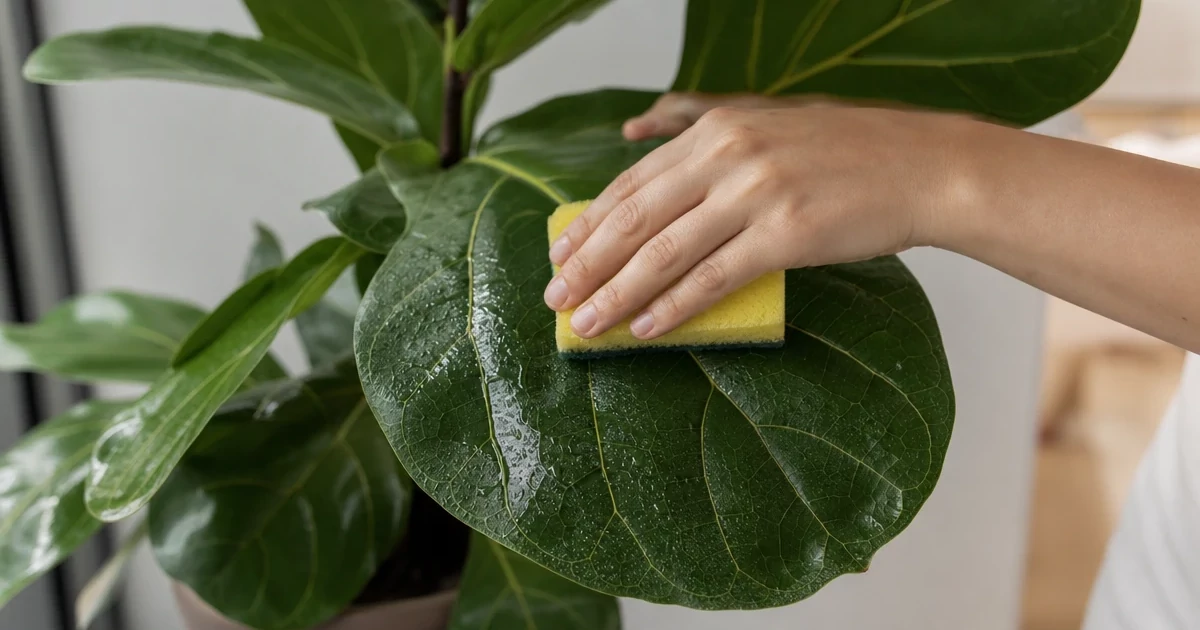
Aim for 40–60 % humidity. During the heating season a humidifier or a tray of wet clay pebbles helps; wipe the leaves with a damp sponge every 1–2 weeks so they stay glossy and photosynthesise better.
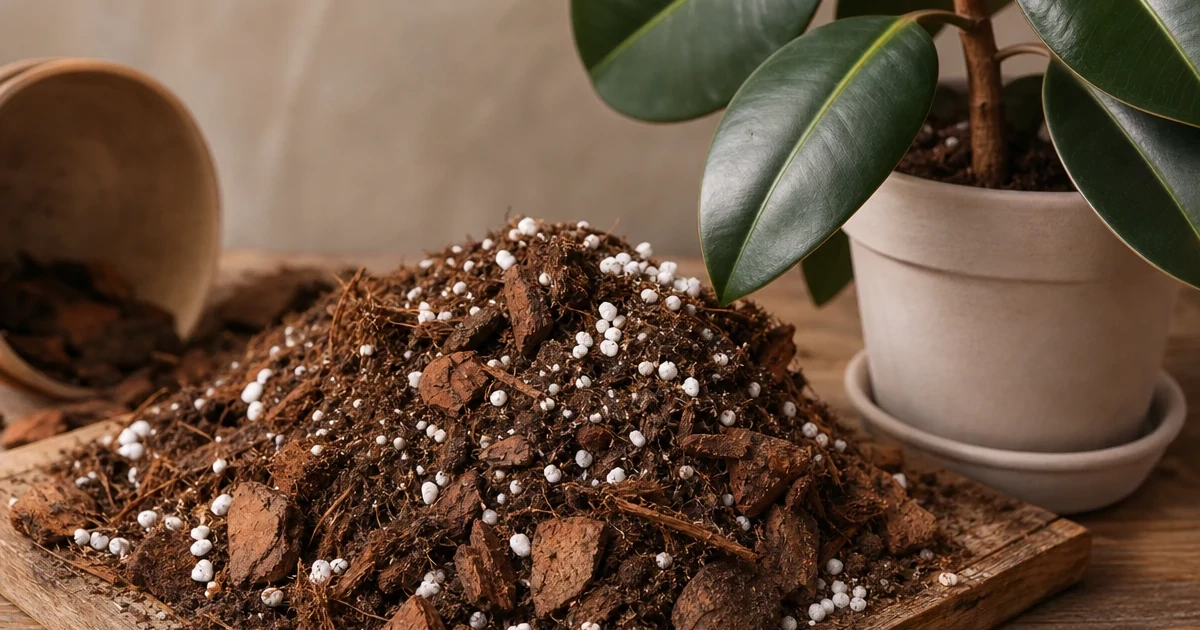
Use a loose, airy, slightly acidic mix (pH 6–7). A ready-made ficus potting mix works, or blend 2 parts general peat-based compost, 1 part pine bark and 1 part perlite. Add 2–3 cm of drainage at the bottom.
The pot must have drainage holes; plastic holds moisture longer, ceramic is more stable under a tall tree. Do not oversize: excess soil stays wet for too long and the roots rot.
From March to September feed every 2–3 weeks with a balanced foliage-plant or ficus fertiliser that is higher in nitrogen (NPK roughly 3:1:2). Apply only to moist soil, at the label dose or half of it. Skip feeding in winter, right after repotting and when the plant is unwell. Organic options are covered in natural fertilisers for houseplants.
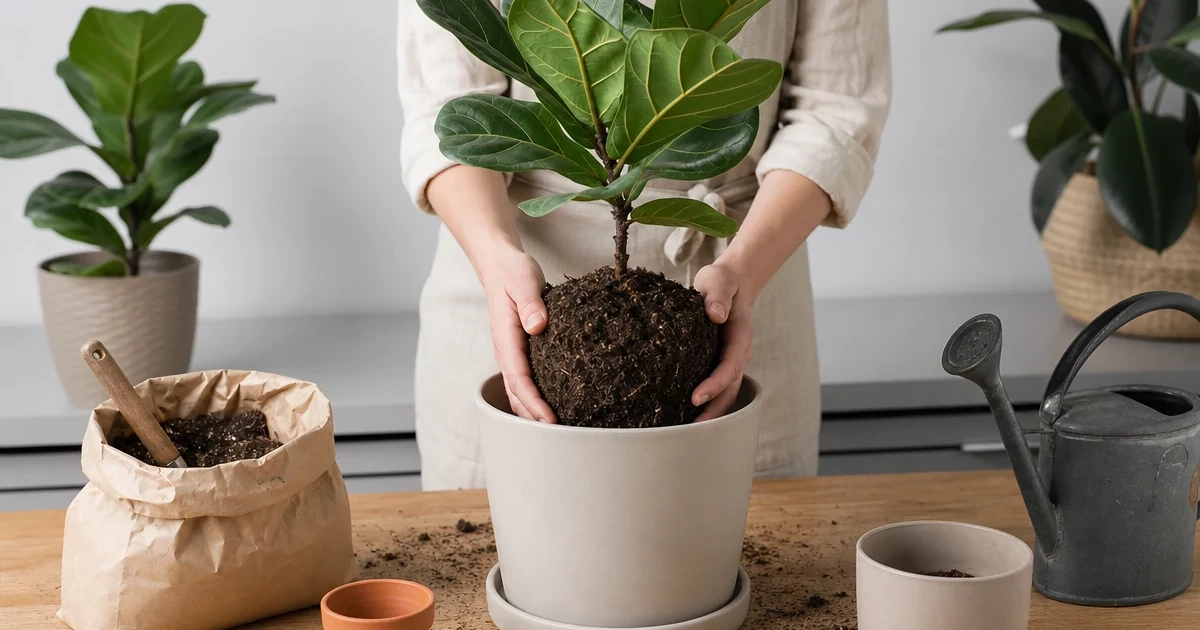
Repot young plants every spring and mature ones every 2–3 years, when roots poke out of the drainage holes or water runs straight through. Go up only 3–5 cm in diameter. Move the root ball intact and keep the trunk at the same depth. For large tubs that are hard to repot, replace the top 3–5 cm of soil each year. Step-by-step instructions: how to repot a houseplant.
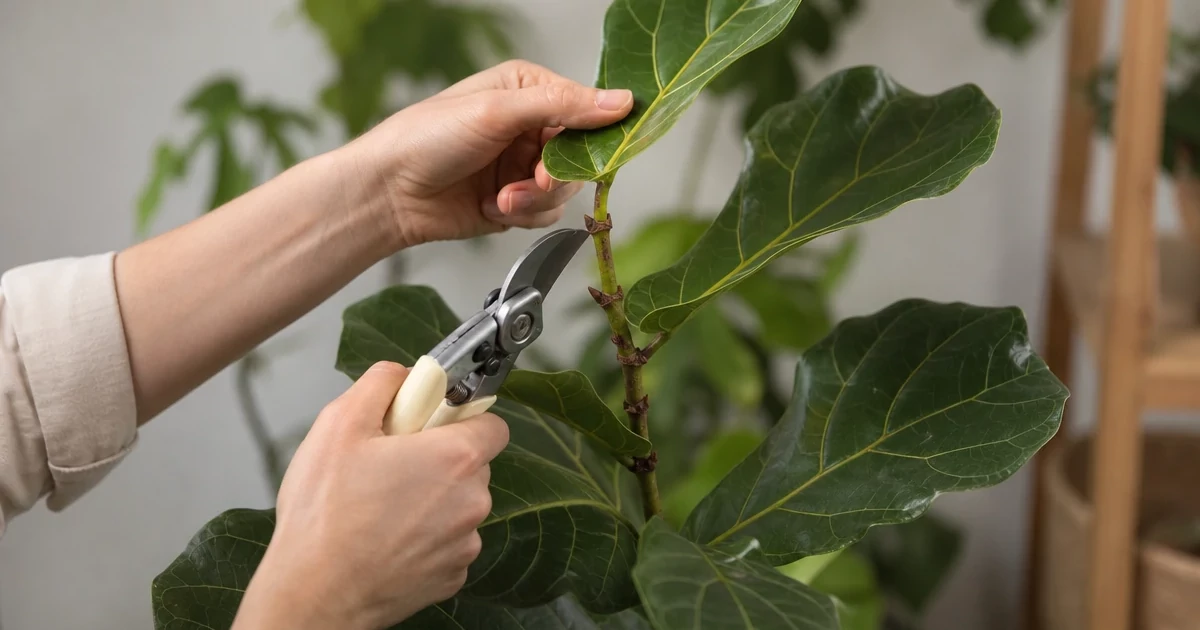
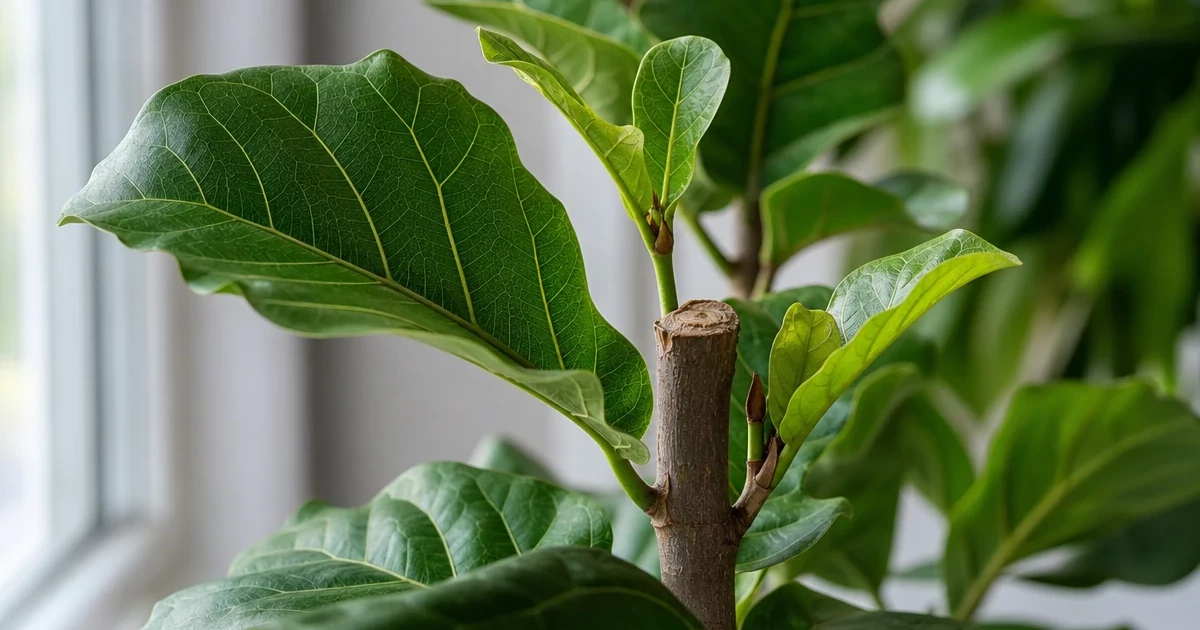
A fiddle leaf fig naturally grows as a single stem and branches reluctantly. For a fuller crown, cut the top back above a leaf node in spring — 1–3 buds below the cut will produce new branches. Use clean, sharp secateurs; blot the white latex with a tissue and wear gloves, as the sap irritates skin.
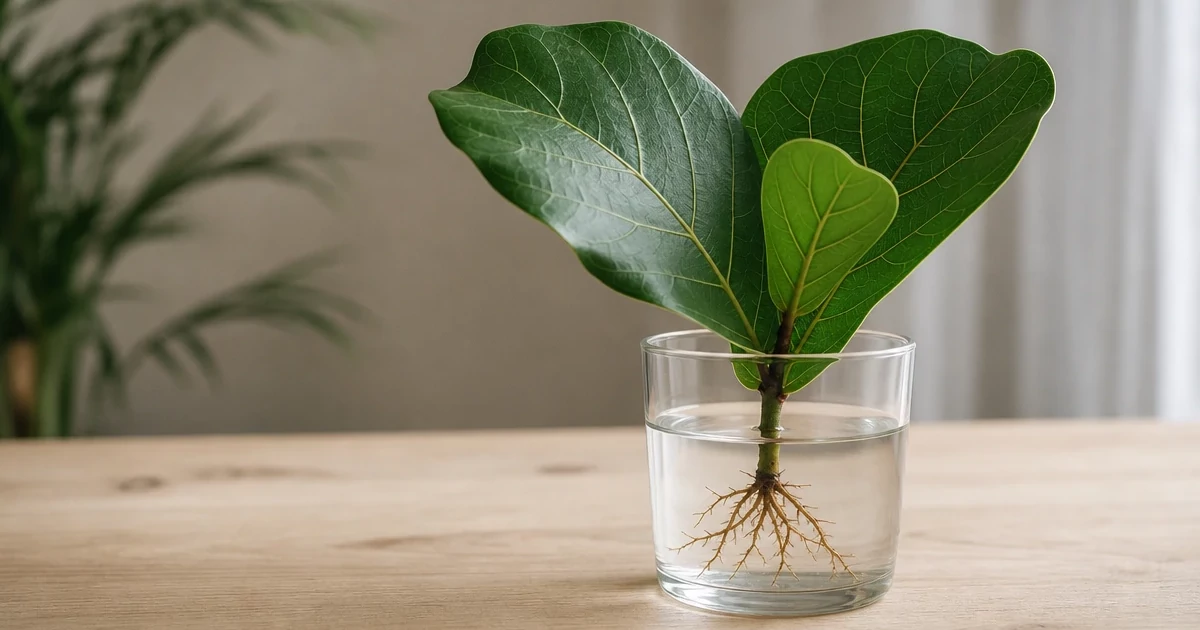
The easiest method is tip or stem cuttings in spring or early summer, which pairs neatly with pruning.
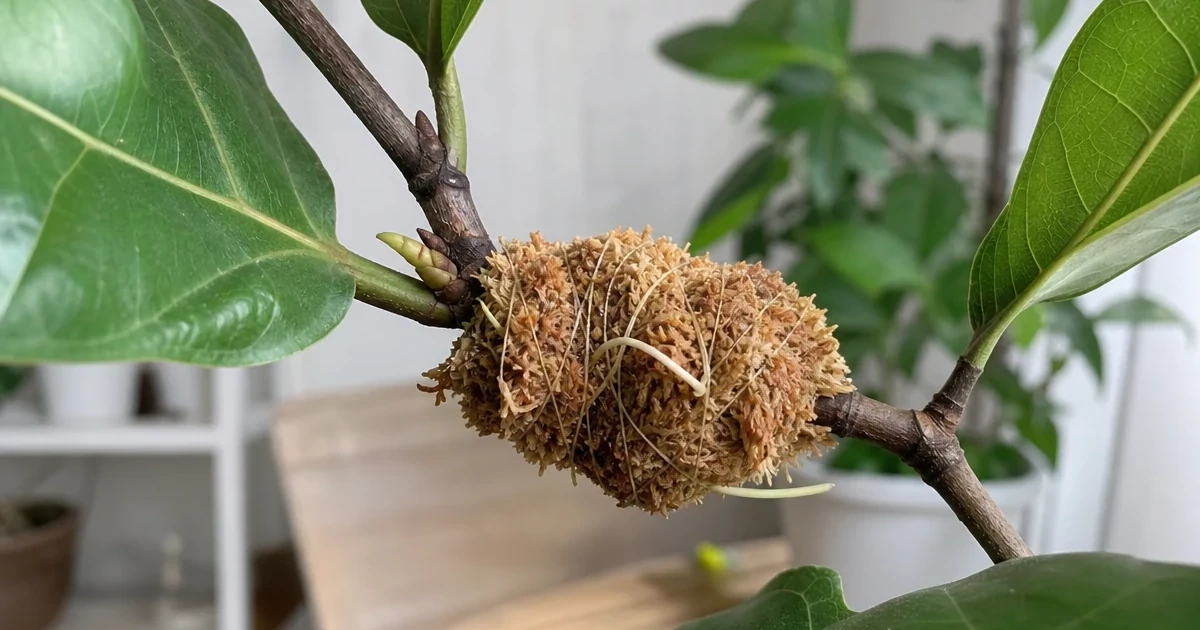
Mature trees can be air-layered: make a ring cut in the stem, wrap it in moist sphagnum moss and film, and after 1–2 months cut off the rooted branch. A single leaf without a node may root but will never grow into a new plant.
Most fiddle leaf fig problems come down to watering and light. Compare the symptoms:
| Symptom | Cause | What to do |
|---|---|---|
| Healthy lower leaves dropping | Moving, draughts, low light | Return it to a bright permanent spot away from draughts |
| Dark brown patches starting mid-leaf | Overwatering, root rot | Let soil dry, check roots, water less |
| Dry, light brown edges | Underwatering, dry air | Water more consistently, raise humidity |
| Tiny red-brown dots on new leaves | Oedema from uneven watering | Even out watering; old dots stay, new leaves come out clean |
| Leaves yellow and wilt | Overwatering or lack of nutrients | Check drainage, resume feeding in spring |
| Leggy growth, small leaves | Too little light | Move closer to a window or add a grow light |
For a broader symptom guide, see houseplant problems and symptoms.
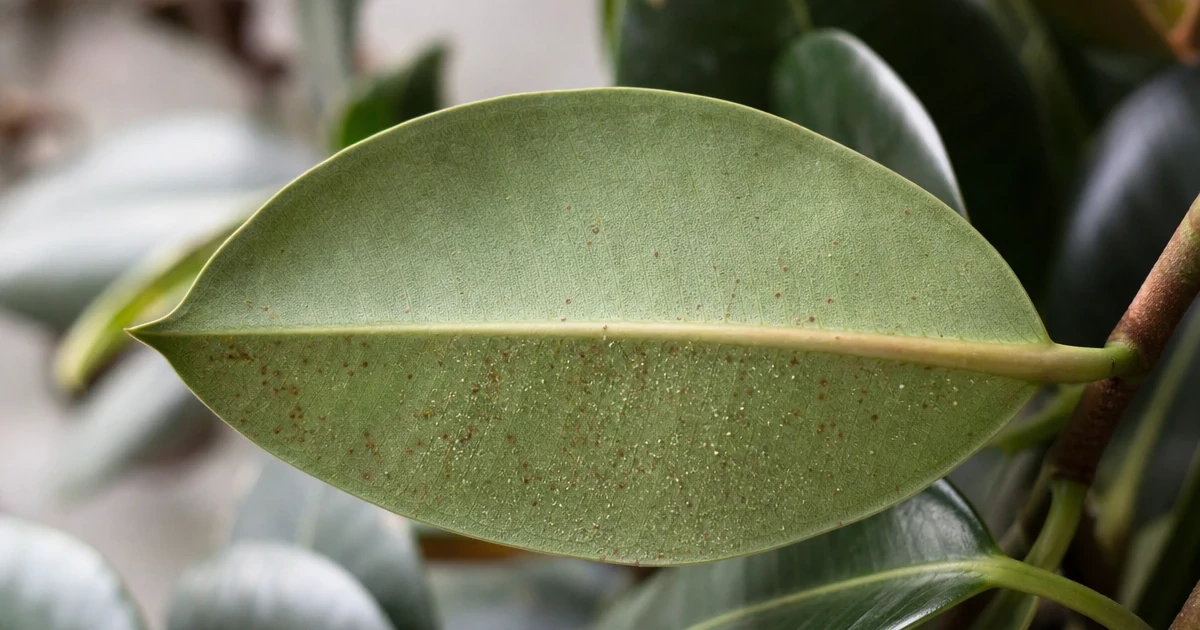
In warm, dry air the most common pest is spider mite: tiny pale speckles and fine webbing appear on the leaves. Scale (brown bumps along the veins), mealybugs (white cottony tufts) and thrips (silvery streaks) also turn up. Check leaf undersides weekly; at the first sign, shower the plant with warm water and wipe the leaves with soapy water, and for heavy infestations use a miticide or insecticide as directed. Gnats in the soil signal overwatering — see fungus gnats in pots.
Fig flowers are tiny and hidden inside round structures called syconia. Indoors a fiddle leaf fig almost never flowers or fruits; it is grown for its foliage.
The milky sap irritates skin and mucous membranes, and the plant is considered toxic to cats and dogs: chewing the leaves can cause drooling and vomiting. Place it where pets cannot nibble it and wear gloves when pruning. If you have a cat, safer alternatives include the parlour palm and the Boston fern.
| Season | Watering | Feeding | Other |
|---|---|---|---|
| March–May | Every 7–10 days | Every 2–3 weeks | Repotting, pruning, cuttings |
| June–August | Every 5–8 days | Every 2 weeks | Shade from midday sun, check for mites |
| September–October | Gradually less | Last feed in September | Prepare for heating season, humidifier |
| November–February | Every 2–3 weeks | None | Away from radiators and cold glass, grow light on dull days |
These are guidelines: soil dries faster in a warm, bright flat and slower in a cool one. Always check moisture with a finger or a wooden stick before watering.
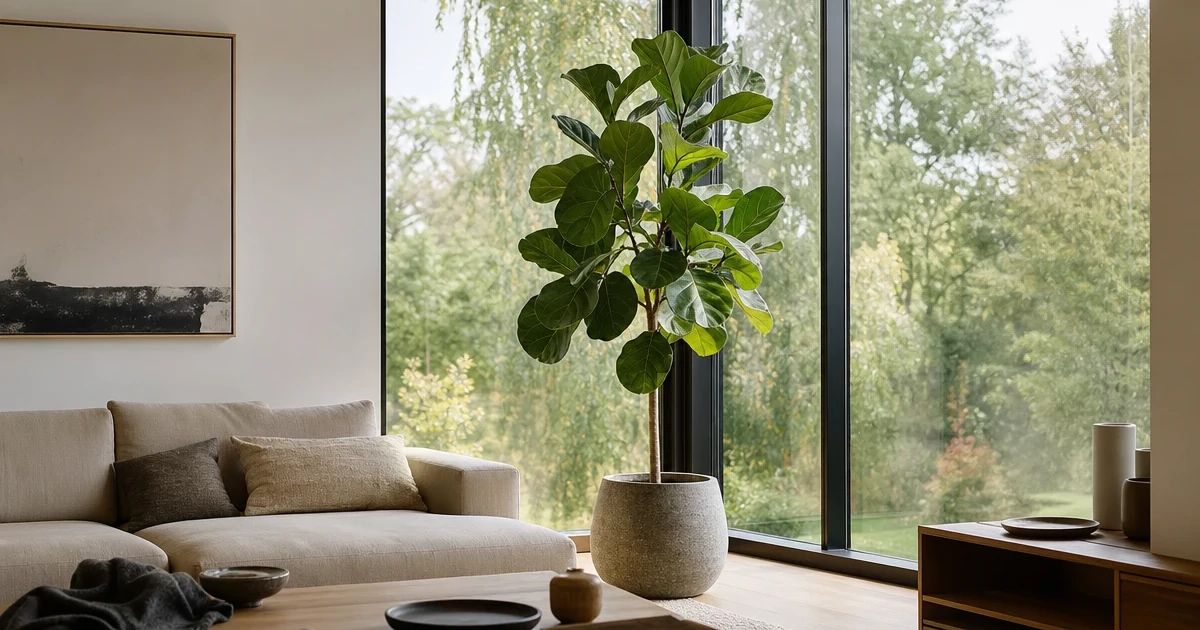
A tall fiddle leaf fig in a plain pot is an instant focal point in a minimalist, Scandi or loft living room — place it by a large window, beside the sofa or in a bright corner. The compact Bambino suits a desk, a chest of drawers or a windowsill. Choose a pot on castors so a large tree is easy to turn towards the light.
A fiddle leaf fig makes a striking housewarming or new-office gift, especially for a bright space with big windows. For a small flat choose the compact Bambino. See more gift ideas among our houseplants.
In good conditions 30–60 cm per season, spring to autumn. Bambino grows about half as fast. Growth nearly stops in winter.
In spring cut the top back above a node or notch the trunk above a dormant bud, and give it plenty of light and regular feeding.
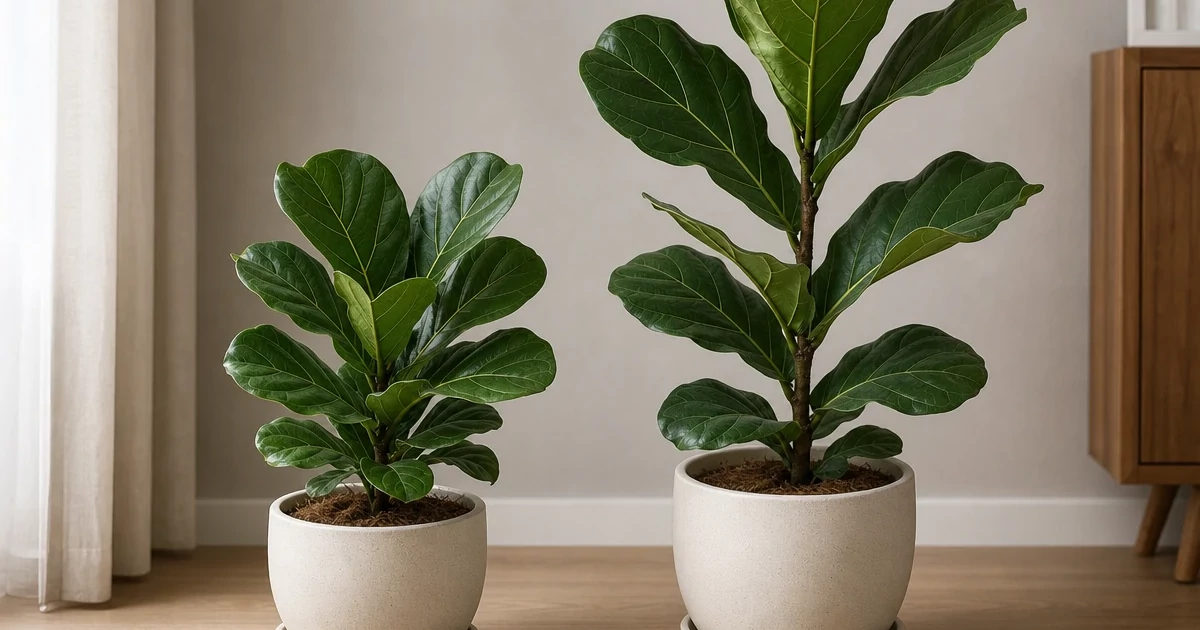
Smaller leaves, a denser crown and a lower height — usually up to 1–1.2 m. Care is identical.
Every 2–3 weeks, once the top 3–5 cm has dried. Near a hot radiator soil dries faster, so check the soil rather than the calendar.
Yes, if the room is bright. It releases nothing harmful into the air; just keep it out of reach of pets.
Usually too little light or nutrients. Move the plant closer to a window and resume regular feeding from spring.
Yes, on a glazed or shaded balcony at 18–28 °C. Acclimatise it gradually, shelter it from midday sun and wind, and bring it in before autumn cools.

Author: Maria Svitlovir
Graduated from Taras Shevchenko National University of Kyiv, Institute of Biology and Medicine (2001). BSc in Biology, MSc in Horticulture. Writes about plants, works at a garden centre selecting and repotting plants, and contributes to plant reference guides.
© Termez 2026 UFL Flower Shop

Trademark UFL №191476 is used under license of the rights holder.
All rights reserved. Any use of materials without a link to the site is prohibited.

 Birthday
 Hydrangeas