The rose is the most popular bouquet flower and one of the best-loved garden plants. In this guide we have gathered everything you need to know about roses: the main types and varieties, what colour and number of stems mean, how much one rose costs and how to care for a bouquet in a vase and a bush in the garden. Each section leads to a detailed article. More flowers with photos, names and meanings are in our guide to types of flowers.
Approximate monthly searches in Ukraine, our estimate
What is a rose
The rose (Rosa) is a genus of perennial shrubs in the rose family, with about 300 wild species and tens of thousands of cultivated varieties. People have grown roses for over five thousand years — they were prized in ancient China, Persia, Greece and Rome — and modern varieties appeared in the 19th century after European and Chinese roses were crossed.
Today the rose is the most popular bouquet flower in the world and in Ukraine. It is given for declarations of love, birthdays, anniversaries and for no reason at all, and the meaning of a bouquet depends on colour, number of stems and even variety.
In ancient Greece the rose was linked to Aphrodite, and in Rome banquet halls were strewn with petals. The phrase “under the rose” (sub rosa) meant a secret conversation: a rose hung over the table so that everything said stayed among those present.
In 15th-century England the rose became the emblem of rival dynasties, giving rise to the name “Wars of the Roses”. In Ukrainian tradition the rose symbolises maidenly beauty and love; it was embroidered on rushnyky and sung about in folk songs.
The oldest known rose bush grows by the cathedral in Hildesheim, Germany, and is over a thousand years old. Rose oil is still produced in Bulgaria’s Rose Valley, where several tonnes of petals are needed for one kilogram of essential oil.
Types and varieties of roses
Florists and gardeners answer the question “what types of roses are there” differently. For bouquets, flower shape and stem length matter; for gardens, bush type and frost hardiness. The main groups are below.
Hybrid teas are classic roses with a large goblet-shaped bud on a long stem — the ones we most often see in bouquets. Floribundas are free-flowering shrubs with clusters. Spray roses carry several small buds on one stem and are perfect for delicate arrangements.
Peony-style (English) roses have dense, many-petalled blooms that look like peonies and a strong scent. Climbers produce long shoots for arches and fences. Ground-cover roses spread like a carpet, and miniature (patio) roses grow even in a pot.
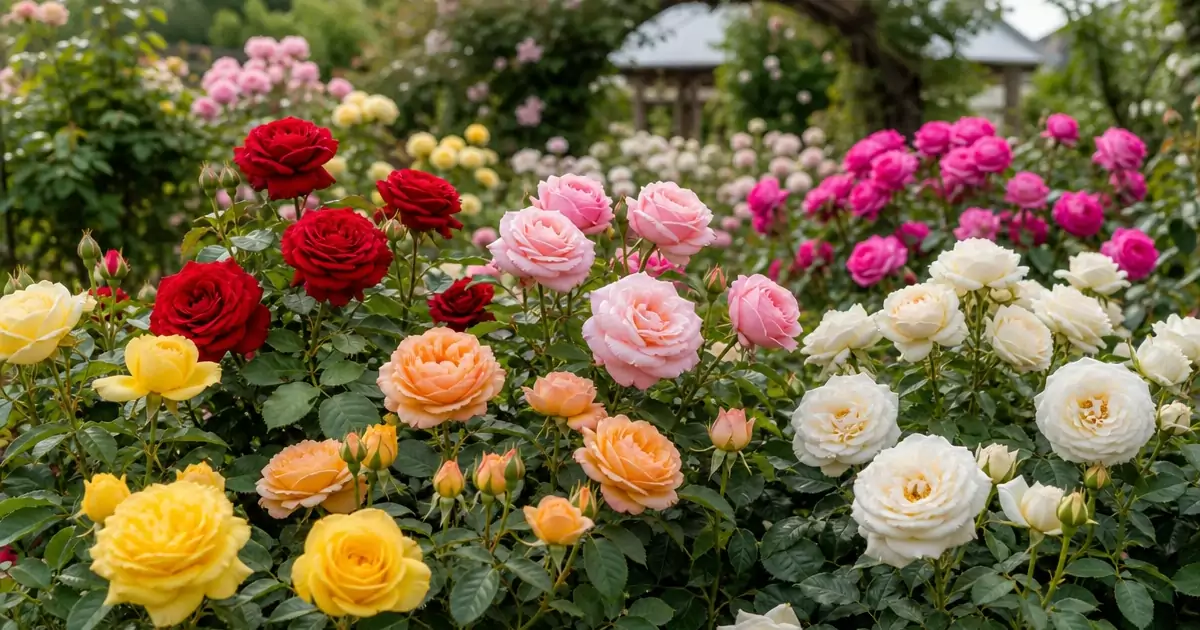
A red rose means passion and love — a classic for a declaration or an anniversary. White means purity, sincerity and new beginnings, which is why it is chosen for weddings. Pink means tenderness, gratitude and affection — a universal choice for Mum, a friend or a colleague.
Today a yellow rose means joy and friendship (not betrayal, as people once believed), orange and coral mean energy and admiration, cream and peach mean warmth and care, and burgundy means deep, mature love.
A full colour guide is in what rose colours mean, and there is a separate article on white roses. The most popular colour is covered in red roses. We also explain how rainbow roses with several colours on one bloom are made. More on shades and varieties in our article on pink roses. Is yellow really the colour of parting? See our article on yellow roses.
How many roses to give
In Ukraine, fresh flowers are given in odd numbers; even numbers are for funerals. Exceptions are large bouquets of 11 or more stems, where nobody counts, and a single rose, which is always appropriate.
One rose says “you are special”; three — “I love you”; five — sincere wishes of happiness; seven — admiration; eleven — “you are the dearest”; 15–25 — holiday or anniversary wishes; 51 and 101 — the deepest feelings, a choice for a proposal or a wedding.
The price of one rose depends on four things: variety (spray and peony-style roses cost more than classic ones), stem length (40, 60 or 80+ cm), country of origin and season. Roses are most expensive before Valentine’s Day and Women’s Day, when demand soars, and best value in summer, during the Ukrainian rose season.
Gently squeeze the bud at its base: a fresh rose feels firm and springy. The outer petals may be slightly marked — these are “guard petals” that florists often leave on — but the centre should be intact, without spots or browning.
Check the leaves and stem: leaves should be green and firm, the stem solid and not slimy at the cut. A long stem (60–80 cm) usually means a bigger bud and a longer vase life. If you are buying in advance, ask for tighter buds — they will open at home. On the differences between countries, see Kenyan vs Ecuadorian roses.
Rose bouquets
Roses look great on their own as a mono-bouquet and paired with eucalyptus, hydrangea, lisianthus or gypsophila. Long stems suit classic wrapping, while spray roses suit compact round bouquets or boxes.
To make roses last longer, cut the stems at a 45° angle by 2–3 cm with a sharp knife, remove leaves below the waterline and place the bouquet in a clean vase with cool water. Change the water every day or two and recut the stems each time.
Keep the vase away from radiators, direct sun, draughts and fruit (it releases ethylene, which speeds up wilting). Cut-flower food from a sachet extends the bouquet’s life by several days.
Roses in the garden: planting, pruning, winter care
Roses like at least six hours of sun a day, good air flow and loose, fertile, slightly acidic soil. What roses dislike: waterlogged roots, deep shade, cold draughts, fresh manure at the roots and evening watering over the leaves.
How many times a rose blooms depends on the variety: modern repeat-flowering roses bloom in waves from June to autumn, while old roses and some climbers flower once a season, but very profusely. The main pruning is done in spring as the buds swell, and spent flowers are removed in summer to encourage new blooms.
Petals of fragrant roses are used for jam, tea, toners and homemade cosmetics, and dried petals for sachets and festive décor. Only use flowers that have not been chemically treated, ideally from your own garden.
These roses are for you alone, Each bloom a word of love so true, May joy be yours wherever you’ve gone, As sweet as their scent, as fresh as the dew!
Roses with delivery
Our catalogue includes classic red and white roses, spray, peony-style, coral and cream roses, mono-bouquets of 7 to 101 stems and roses in boxes. Our florists will match the variety and stem length to your occasion and budget.
Graduated from Taras Shevchenko National University of Kyiv, Institute of Biology and Medicine (2001). BSc in Biology, MSc in Horticulture. Writes about plants, works at a garden centre selecting and repotting plants, and contributes to plant reference guides.






 Birthday
 Hydrangeas